Art & Entertainment
“Joy in Dark Times”
 Art and
Entertainment in the Aetherium
Art and
Entertainment in the Aetherium
Music
Folk Traditions
Constellation Songs: Hymns, prayers set to music Work Songs: Rhythmic (harvesting, sailing, crafting) Story Ballads: Historical events, legends, heroes Laments: Grief songs (Rot losses, tragedies)
Instruments
Common: Flutes, drums, string instruments (lute-like) Materials: Wood, bone, sinew (available resources) Makeshift: Sky-kelp stretched = strings, hollow wood = drums Precious: Pre-Shattering instruments (rare, valuable)
Notable
Storm-Sailor Chants: Deep harmonics, wind-mimicking Murk Blues: Melancholy corruption songs Bright-Folk Dances: Upbeat celebration music
Visual Arts
Painting & Drawing
Subjects: Constellations, landscapes, portraits, pre-Shattering imagination Materials: Limited (pigments expensive) Status: Wealthy commission, common sketch Religious: Icon painting (clergy-sponsored)
Sculpture
Stone: Rare (heavy, limited) Wood: Ironwood carvings (valuable) Bone: Common (sky-rat, aether-fish bones) Metal: Precious (functional > decorative)
Textiles
Practical: Most art is functional (decorated clothing, tapestries as insulation) Patterns: Constellation symbols, clan markings, personal designs Status: Embroidery quality = wealth indicator
Literature
Oral Tradition (Primary)
Why: Limited literacy Types: Myths, histories, legends, jokes, wisdom Storytellers: Respected (entertainment + education) Evolution: Stories change (oral telephone effect)
Written
Religious: Clergy texts (prayers, theology) Historical: Archivists’ records Technical: Manuals, navigation guides Creative: Rare (paper expensive, time limited)
Popular Stories
Kalis Dren Tales: Legendary hero (embellished) - “Kalis and the Void-Whale” (how he rode a whale to the Deeps) - “Kalis at the Hollow” (his final, doomed expedition) - “Kalis and the Storm-Serpent” (taming the untamable) - Each telling adds new details, contradicts previous versions
Pre-Shattering Myths: Golden age nostalgia - “The Garden of Terrum” (paradise lost) - “The Last Day” (Shattering from civilian perspective) - “The Luminar Council’s Hubris” (cautionary tale) - “The World That Was” (idealized past, probably inaccurate)
Rot Horror: Scary stories (cathartic) - “The Whisperer at the Window” (Rot-Touched trying to convert family) - “The Island That Ate Itself” (Hollow transformation) - “The Voice’s Promise” (temptation and corruption) - “The Last Survivor” (sole escapee from consumed island)
Romance: Escapist love stories - “The Pilot and the Priestess” (forbidden love across factions) - “Two Islands Apart” (long-distance love via letters) - “The Storm-Sailor’s Heart” (nomad learns to stay still) - “Love in the Murk” (finding beauty in darkness)
Theater & Performance
Traveling Troupes
Sun-Touched Performers: Visit settlements Shows: Plays, acrobatics, music, comedy Improvisation: Adapt to local news/interests Payment: Donations, lodging, meals
Puppet Shows
Children’s Entertainment: Simple morality tales Adult Versions: Political satire (dangerous if too pointed) Portability: Easy to transport
Shadow Plays
Technique: Light + screens = silhouettes Atmosphere: Mysterious, suited to cosmic themes Content: Constellation myths primarily
Games
Children
Cloud-Hopper Chase: Tag variant Hide and Seek: Universal Sky-Stone: Throwing game (accuracy) Constellation Patterns: Connecting dots (educational)
Adults
Dice: Gambling (illegal some places, universal anyway) Cards: Pre-Shattering deck survived (suits: Stars, Clouds, Wind, Stone) Board Games: Strategy (chess-equivalent exists) Drinking Games: Tavern staples
Physical
Combat Training: Sport among military Zero-G Acrobatics: Storm-Sailor entertainment Climbing Competitions: Underbelly specialty
Architecture as Art
Functional: Primarily practical Decorative Elements: When resources allow Constellation Symbolism: Buildings oriented to stars Ruins Appreciation: Pre-Shattering beauty (dangerous to access)
Fashion
Practical Basis: Function over form Personal Expression: Within practical limits Status Symbols: Quality materials, embroidery, jewelry Clan Markings: Storm-Sailors, some Outland groups
Seasonal Entertainment
Festivals: Major artistic displays Competitions: Music, crafts, storytelling (prizes) Shared Creation: Community murals, group songs
Controversial Art
Serpent Symbology
Forbidden: Official policy Underground: Secret artistic expressions Punishment: If discovered (exile, worse) Appeal: Forbidden = intriguing
Rot Aesthetics
Dark Art: Some explore corruption imagery Disturbing: Intentionally unsettling Therapeutic?: Processing trauma through creation Debate: Is this healing or glorifying horror?
Pre-Shattering Art
Fragments: Occasional discoveries (ruins) Valuable: Immensely (historical + artistic) Mysterious: Purposes unclear (lost context) Inspirational: Contemporary artists study
Archivists’ Role
Preservation: Recording oral traditions Documentation: Artistic techniques, styles Teaching: Sharing knowledge Loss: More art lost than saved (sadly)
Entertainment Venues
Taverns: Primary social space (music, stories, games) Market Squares: Public performances Homes: Intimate gatherings Ships: Storm-Sailors entertain themselves Temples: Religious art/music
Function of Art
Morale: Joy sustains survival Identity: Cultural preservation Memory: Keeping history alive Processing: Trauma, grief, fear expressed Hope: Beauty proves life worth living
Related Topics
- Sun-Touched - Primary musicians and storytellers
- Festivals - Major artistic displays
- Daily Life - Entertainment in context
- The Floating Market - Performance venue
- Languages - Oral tradition
In-World Documents
Sun-Touched Performer’s Creed
We sing not to forget sorrow,
But to remember joy.We tell stories not to escape reality,
But to understand it.We create beauty not because the world is beautiful,
But because it needs to be.That’s what artists do.
That’s what humans do.We make art in the darkness.
And the darkness doesn’t win.
Popular Songs (Lyrics)
“The Voyager’s Lament” (Traditional ballad)
I’ve walked a thousand islands,
I’ve sailed a thousand skies,
I’ve seen the stars grow distant,
I’ve watched good people die.But still I keep on moving,
Still I chase the light,
Because the Voyager is watching,
And I won’t stop my flight.Home is where I’m standing,
Home is where I roam,
The Aether is my country,
The void is where I’m home.
“The Rot-Touched’s Song” (Murky Chasm drinking song)
Black veins upon my fingers,
Green glow within my eyes,
The Voice, it whispers sweetly,
Of truths and pretty lies.They say I’m damned and broken,
They say I’ve lost my soul,
But I feel more than human,
I feel completely whole.So pour another drink, friend,
Before I fade away,
Tomorrow I’m a monster,
But tonight I’m still okay.
“Eos Morning” (Children’s song)
Wake up, wake up, the stars are fading,
The Aether glows with morning light,
The ships are docking, merchants trading,
Another day we’ve survived the night.Thank the Radiant for the dawn,
Thank the Shepherd for our sleep,
Thank the Voyager for the paths we’re on,
Thank the Keeper for memories we keep.
“The Fall” (Haunting melody, no words)
Played on single flute, mimics the sound of someone falling into the void. The melody descends chromatically, getting quieter and quieter until it’s inaudible. Considered deeply unlucky to play before a journey. Often played at funerals.
Famous Artworks
“The Last Sunrise” (Painting) - Artist: Unknown (pre-Shattering) - Location: Elder’s Hall, Skyport Eos - Description: Depicts the sun turning black during the Shattering - Value: Priceless (one of few pre-Shattering paintings to survive) - Controversy: Some say looking at it too long causes nightmares
“The Hollow Throne” (Sculpture) - Artist: Corrupted sculptor (name forgotten) - Location: The Hollow (abandoned) - Description: Throne carved from single piece of Rot-corrupted stone - Status: Still standing, still growing - Warning: Viewing it in person accelerates corruption
“Constellation Map” (Tapestry) - Artist: Clergy weavers (collaborative, 50 years in making) - Location: Constellation’s Reach - Description: All eight constellations in embroidered silver thread - Function: Used for teaching astronomy and theology - Detail: So detailed you can see individual stars
“The Weeping Wall” (Community mural) - Artist: Refugees (hundreds of contributors) - Location: Skyport Eos, Underbelly district - Description: Names of every island lost to the Rot - Updated: Constantly (new names added monthly) - Emotional impact: Devastating (many cry when reading it)
“Hope’s Anchor” (Sculpture) - Artist: Ironhold military smiths - Location: Ironhold central plaza - Description: Massive iron anchor (symbolizing Ironhold’s stability) - Meaning: “We will not drift. We will not fall.” - Controversy: Some see it as arrogance, tempting fate
Theater Performances
“The Apogee Working” (Tragedy) - Synopsis: Dramatization of the ritual that caused the Shattering - Themes: Hubris, ambition, unintended consequences - Ending: The world breaks (stage effect with shattering mirrors) - Audience reaction: Cathartic horror - Banned: In some settlements (too disturbing)
“The Pilot’s Choice” (Drama) - Synopsis: Pilot must choose between saving cargo or passengers - Themes: Morality, sacrifice, impossible decisions - Variations: Different troupes have different endings - Audience participation: Sometimes audience votes on ending
“The Serpent’s Gift” (Controversial) - Synopsis: Rot-Touched protagonist finds peace through corruption - Themes: Acceptance, transformation, heresy - Clergy response: Condemned as dangerous propaganda - Popularity: Huge in Murky Chasm, banned in Eos
“Love in the Aether” (Comedy) - Synopsis: Romantic misunderstandings across multiple islands - Themes: Communication, cultural differences, love - Style: Slapstick, wordplay, physical comedy - Audience: Family-friendly, universally beloved
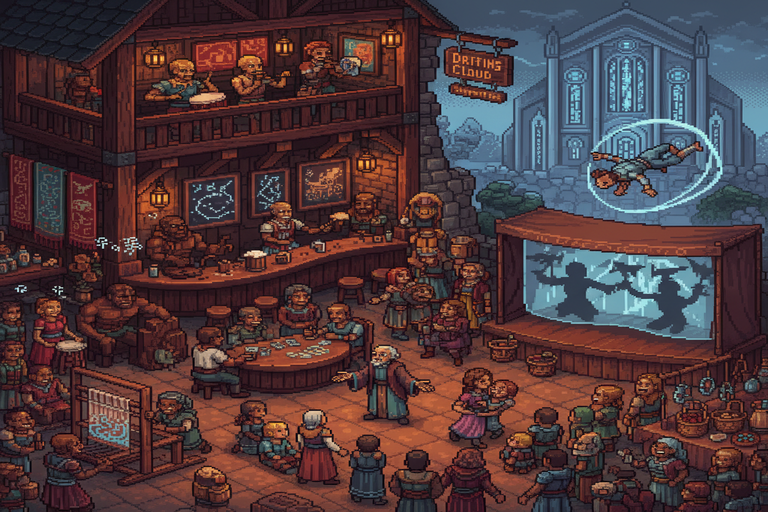
Tavern Sign (Drifting Cloud, Skyport Eos)
ENTERTAINMENT TONIGHT
Music: Sun-Touched trio (drums, flute, voice)
Stories: Old Marna (pre-Shattering tales)
Games: Dice, cards, drinking contestsAdmission: Free (buy drinks)
Donations: Appreciated (performers need to eat)Come. Laugh. Forget your troubles.
Tomorrow they’ll return.
But tonight, we celebrate being alive.
Artist’s Journal (Struggling painter, Skyport Eos)
Day 237, Year 287 S.
Sold a portrait today. 15 coins. Enough for food this week and canvas for next painting.
The subject wanted me to paint them as they were before the Rot-corruption started. Younger. Healthier. Unmarked.
I did. They cried when they saw it. Paid double.
Is that what art is now? Lies we tell to make life bearable?
Or is it truth? They were that person once. The painting preserves who they were before the Rot took them.
I don’t know anymore.
But I’ll keep painting. Because if I stop, what am I?
Critic’s Review (Archivist theater review)
Review: “The Serpent’s Gift” performed by Murk Players
I attended last night’s performance with deep skepticism. The Clergy has condemned this play as heretical propaganda. They’re not wrong.
But they’re not entirely right either.
Yes, the play portrays Rot-corruption sympathetically. Yes, the protagonist finds peace through transformation rather than resistance. Yes, the ending suggests the Voice Beneath offers genuine transcendence.
But the play is also honest about the cost. The protagonist loses everything human about themselves. Their family mourns them as dead. The final scene—where they can no longer remember their own name—is haunting.
Is this propaganda? Or is it asking uncomfortable questions we’d rather not face?
The Clergy wants to ban it. I think we should watch it. And then debate it. Because art that makes us comfortable isn’t art—it’s decoration.
Rating: Disturbing, brilliant, necessary. 4/5 stars.
Quest Hooks
The Stolen Painting: “The Last Sunrise” has been stolen from Elder’s Hall. Recover it before it’s sold to the Black Sky Cartel.
The Cursed Performance: Every actor who plays the lead in “The Apogee Working” becomes Rot-corrupted within a year. Coincidence or curse?
The Singing Stones: Ancient ruins contain stones that hum in harmony. Archivists want them studied. Clergy wants them destroyed (pre-Shattering magic?).
The Banned Song: A new song is spreading through taverns. Clergy claims it contains hidden heresy. Is it just paranoia, or is there truth?
The Artist’s Madness: Famous painter has locked themselves in studio for 30 days. When door opens, the paintings inside are… wrong. Beautiful but wrong.
The Memorial Commission: Wealthy patron wants monument to lost loved one. But the loved one was Rot-corrupted. How to honor them without glorifying corruption?
The Troupe’s Secret: Traveling performers are actually spies for the Black Sky Cartel. Do you expose them or use them for counter-intelligence?
The Living Sculpture: Sculpture in the Hollow is growing, changing, possibly alive. Archivists want to study it. Is it safe to approach?
The Forgotten Melody: Elderly musician remembers pre-Shattering song that supposedly could heal the sick. Is it real magic or just nostalgia?
The Censorship Debate: Sky-Guild wants to ban “dangerous” art. Artists resist. Mediate the conflict or take a side?
“Art in the Aetherium isn’t luxury—it’s proof we’re still human,
still capable of creating and not just surviving. They say art requires
peace, but we make art in war. We make music in grief. We make beauty in
corruption. Maybe art doesn’t require peace. Maybe it requires humanity.
And we still have that. Barely. But we have it. And as long as we
create, as long as we sing, as long as we tell stories and make each
other laugh, the Shattering
hasn’t won. We’re still here. Still human. Still making beauty in the
void.”
—From Cultural Practices of the Aetherium by Scholar Evian