Sky-Kelp
Algae aerialis / “Aether-Weed” / “The Drifting Harvest”
“Follow the kelp, you’ll find safe currents. Follow safe
currents, you’ll survive. Sky-kelp means life.”
—Harvester wisdom
Quick Reference
| Attribute | Details |
|---|---|
| Type | Flora (Floating algae/seaweed-like plant) |
| Rarity | Common (in Aether-current zones) |
| Habitat | Aether-currents, open sky regions, mid-altitude zones |
| Danger Level | Low (entanglement risk in dense patches) |
| Growth Rate | Moderate (meters per month) |
| Length | 5-20 meters (individual strands) |
| Value | Moderate (10-20 coins per kg, food and material) |
| Edibility | Yes (nutritious, salty, acquired taste) |
| Cultivation | Impossible (requires specific Aether conditions) |
| Legal Status | Legal (open harvest, some zones protected) |
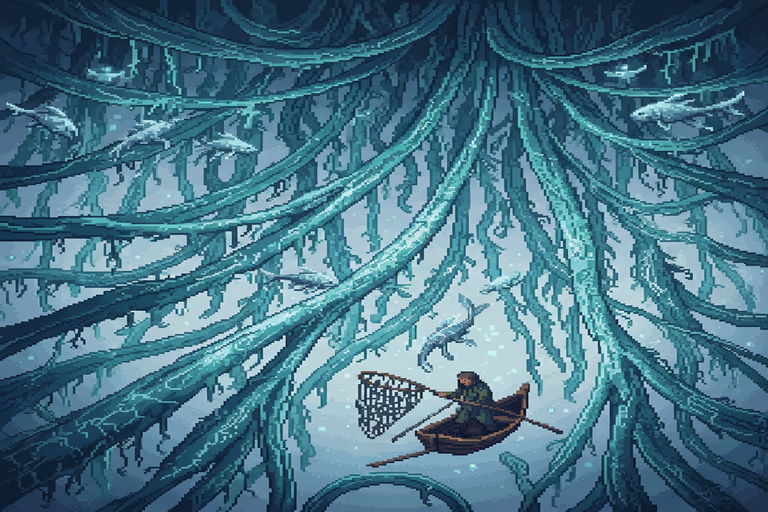 Sky-Kelp - The Drifting
Harvest
Sky-Kelp - The Drifting
Harvest
Description
Sky-kelp is one of the most remarkable plants of the Aetherium—long strands of blue-green vegetation that drift through open air on Aether-currents, forming vast aerial “forests” in predictable zones. Unlike any pre-Shattering plant, sky-kelp doesn’t grow in soil or water but floats freely through the void, absorbing nutrients directly from the Aether itself.
Individual strands can reach 20 meters in length, with a translucent, slimy texture similar to seaweed. They drift passively along Aether-currents, following the invisible rivers of flow that connect islands. Where currents are strong and stable, sky-kelp accumulates in dense patches—hundreds or thousands of strands creating floating forests that can be seen from kilometers away.
Sky-kelp serves multiple essential functions: it’s edible (nutritious if unpleasant), it provides raw materials (rope, fabric, paper), and it indicates safe Aether-currents (pilots follow kelp to find stable routes). Aerial fishermen harvest it using nets and hooks, processing it into food and materials. Aether-fish feed on it, making kelp forests prime fishing grounds. And everyone who travels the Aether learns to read kelp patterns—they’re maps written in vegetation.
The plant is entirely a post-Shattering adaptation. No pre-Shattering equivalent existed. Somehow, in the decades after reality broke, this organism evolved (or emerged, or was created—no one knows) to thrive in conditions that shouldn’t support life. Alchemists study it obsessively, trying to understand its Aether-based metabolism, hoping to unlock secrets of surviving in the void.
Physical Characteristics
Structure
Strands: - Length: 5-20 meters (average 10m) - Width: 2-5cm (ribbon-like) - Thickness: 3-5mm - Translucent blue-green - Slimy coating (protective)
Texture: - Slippery, tough - Flexible (bends without breaking) - Slightly elastic - Feels like wet seaweed - Coating: Slimy, hard to grip
Coloration: - Healthy: Blue-green, translucent - Stressed: Yellow-green - Dying: Brown - Corrupted: Black (toxic, avoid)
Internal Structure: - Hollow tubes (gas-filled for buoyancy) - Fibrous walls (provide strength) - Nutrient channels (visible as darker lines) - No roots, leaves, or traditional plant structures
Buoyancy: - Naturally buoyant (gas-filled) - Floats in Aether - Drifts with currents - Cannot sink (unless weighted)
Ecology and Behavior
Growth and Reproduction
Growth: - Elongates continuously - 10-30cm per month - Branches occasionally (forms Y-shapes) - Maximum length: ~20m (then breaks)
Reproduction: - Spores (released seasonally) - Drift on currents - Germinate in open Aether - Success rate: Unknown (but high enough)
Lifespan: - Individual strand: 2-5 years - Colony: Indefinite (continuous regeneration) - Ancient patches: Centuries old (continuously renewing)
Nutrient Acquisition
Aether-Absorption (Primary): - Absorbs nutrients directly from Aether - Mechanism: Unknown (subject of study) - Filters microscopic particles - Highly efficient
Photosynthesis (Secondary): - Uses constellation light - Less efficient than Aether-absorption - Supplementary energy source
Water: - Absorbs moisture from Aether - Internal water storage - Can survive dry periods
Distribution Patterns
Current-Following: - Drifts with Aether-currents - Accumulates in stable current zones - Creates predictable forests - Pilots use this for navigation
Seasonal Variation: - Denser in spring (new growth) - Thinner in winter (slower growth) - Storm-scattered (regrows) - Annual patterns predictable
Geographic Concentration: - Bright Reaches: Abundant - Murk: Rare (Rot-contamination) - Howling Expanse: Moderate (storms scatter) - Periphery: Sparse
Uses and Value
As Food
Preparation: - Raw: Edible but unpleasant (slimy, very salty) - Dried: Chewy strips (like jerky) - Soup: Boiled with other ingredients - Fried: Crisps nicely (popular) - Pickled: Preserves well
Taste: - Salty (very) - Fishy (ocean-like despite no ocean) - Slightly bitter - Acquired taste (most people tolerate rather than enjoy)
Nutrition: - High in minerals (especially salt, iodine) - Moderate protein - Low calories - Vitamin content: Adequate - Prevents deficiency diseases
Preservation: - Dries well (lasts months) - Salt content preserves it - Essential for long voyages - Lightweight (good for travel)
As Material
Rope (Primary use): - Process strands into fiber - Strong, flexible rope - Water-resistant - Better than Aether-vine rope - Standard material for rigging
Fabric: - Weave processed fibers - Water-resistant cloth - Rough texture - Used for sails, tarps, work clothes - Durable
Paper: - Pulp strands - Makes rough paper - Used for everyday documents - Cheaper than pre-Shattering paper - Common
Fertilizer: - Compost for farming - Rich in minerals - Improves soil - Farmers buy it
As Navigation Aid
Current Indicator: - Kelp follows stable currents - Pilots follow kelp - Indicates safe routes - Essential navigation tool
Weather Predictor: - Changes color before storms - Yellow-green = storm coming (12-24 hours) - Brown = major storm (evacuate) - Reliable warning system
Fishing Grounds: - Aether-fish feed on kelp - Kelp forests = good fishing - Harvesters know this - Dual resource
Harvesting Industry
Aerial Fishermen
Method: - Nets (scoop up strands) - Hooks (snag and pull in) - Careful (don’t damage too much) - Process aboard ship
Season: - Year-round (spring best) - Avoid storm season - Follow kelp migrations - Predictable patterns
Processing: - Sort (healthy vs. damaged) - Clean (remove debris) - Dry or preserve - Sell or use
Income: - Modest (10-20 coins per kg) - Reliable (always demand) - Sustainable (if done right) - Supports small communities
Market
Buyers: - Food markets (dried kelp) - Rope makers (fiber) - Farmers (fertilizer) - Paper mills (pulp)
Prices: - Fresh: 10 coins per kg - Dried: 15 coins per kg - Processed fiber: 25 coins per kg - Paper-grade: 20 coins per kg
Volume: High (common resource)
Threats and Challenges
Over-Harvesting
Problem: - Some zones depleted - Kelp forests thinning - Regeneration slow - Long-term sustainability concern
Response: - Some communities limit harvesting - Rotation systems - Protected zones - Education
Rot Contamination
Problem: - Corrupted kelp turns black - Toxic (don’t eat, don’t use) - Spreads corruption - Must be avoided
Identification: - Color: Black (obvious) - Smell: Rot-tainted (copper, decay) - Texture: Slimy, wrong - Test if uncertain
Frequency: Rare (5% in Murk edges, <1% elsewhere)
Storm Destruction
Problem: - Major storms scatter kelp forests - Disrupts navigation - Reduces harvest - Regrows eventually
Adaptation: - Harvesters follow migrations - Learn new patterns - Kelp recovers (resilient) - Temporary disruption only
Related Topics
- Aether-Currents - Where kelp grows
- Aether-Fish - Feed on kelp
- Aerial Fishing - Harvesting method
- The Floating Market - Major buyer
In-World Documents
Harvester’s Guide
SKY-KELP HARVESTING
Finding: - Look for blue-green clouds in Aether - Follow stable currents - Avoid black kelp (corrupted)
Harvesting: - Use nets or hooks - Take 20-30% maximum - Leave rest for regrowth - Process quickly (spoils)
Processing: - Clean thoroughly - Dry or preserve - Sort by quality - Sell or use
Remember: Over-harvest today, starve tomorrow.
Recipe (Common)
FRIED SKY-KELP
Ingredients: - Sky-kelp (dried) - Oil - Salt (optional—kelp is salty)
Instructions: 1. Soak dried kelp (softens) 2. Cut into strips 3. Fry until crispy 4. Eat hot
Tastes like salty, fishy chips.
Better than it sounds.
Staple food for pilots.
“Sky-kelp is the Aetherium’s seaweed—drifting through air instead
of water, providing food and materials for those who know how to harvest
it. It’s common, reliable, and essential. Not glamorous, not exciting,
but absolutely necessary. Follow the kelp and you’ll find safe currents,
good fishing, and food when you need it. That’s more valuable than any
treasure.”
—Aerial Fisherman’s wisdom