The Shattering
“On the eighth dawn, reality screamed. We’ve been falling ever
since.”
—Last entry in the journal of Star-Reader Matthias Cray
Quick Reference
| Attribute | Detail |
|---|---|
| Event Date | Year 0 S. (Shattering), Day 8 of the Apogee Working |
| Duration | Instantaneous (the breaking) / Ongoing (the consequences) |
| Cause | The Apogee Working ritual (officially) |
| Casualties | ~1.5-2 million dead immediately, 60% of population within 10 years |
| Result | Terrum Solidus shattered into thousands of Sky-Islands suspended in the Aether |
| Status | Irreversible (as far as anyone knows) |
Overview
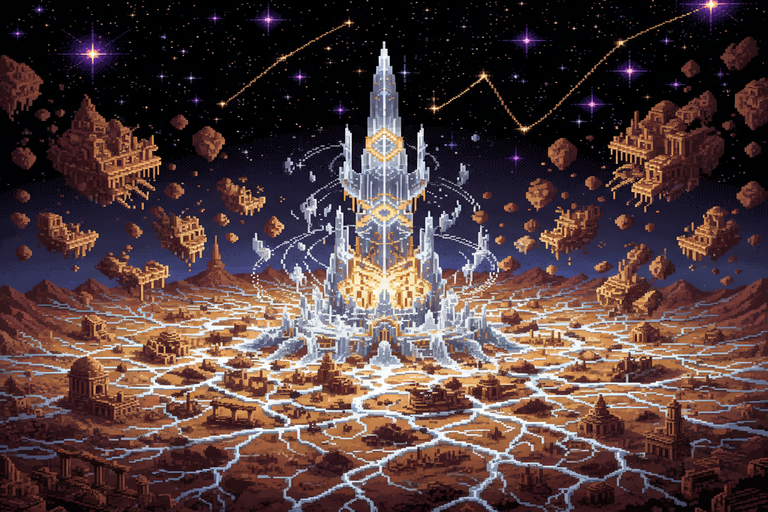
The Shattering is the single most catastrophic event in human history—the moment when the world literally broke apart. In an instant that has been called “the death of certainty,” the solid ground of Terrum Solidus fractured into thousands of pieces and was cast into a new reality: the Aether, a breathable void that defies all natural law.
Three centuries later, the Shattering remains the defining trauma of human civilization. It marks the end of one age and the desperate beginning of another. Every calendar is dated from it. Every story is colored by it. Every life exists in its shadow.
The World Before
Terrum Solidus
Before the Shattering, humanity lived on a single vast continent called Terrum Solidus (“Solid Earth” in the Old Tongue). It was a world of predictable physics, stable geography, and knowable boundaries. Mountains stood where they had always stood. Oceans flowed in their ancient courses. The sky was above, the earth below, and the horizon marked the edge of sight—not the edge of reality.
The continent stretched thousands of miles, encompassing diverse biomes: - The Golden Plains of the central regions, breadbasket of civilization - The Spine Mountains in the north, home to the Veil-Born peoples - The Sunward Jungles of the south, tropical and lush - The Iron Peaks in the east, rich in minerals and warrior cultures - The Azure Coast along the western seas
The Luminar Council
The world was ruled—nominally—by the Luminar Council, a confederation of philosopher-kings who claimed direct communication with the constellations. These were not mere astrologers but genuine intermediaries between humanity and the divine. The constellations spoke to them clearly, granting miracles, offering wisdom, and guiding civilization toward prosperity.
The Council governed from seven great cities: 1. Luminara (later became The Hollow) - The jewel of the south 2. Ironfast (fragments now form Ironhold) - Military stronghold 3. Eos Prime (fragments now form Skyport Eos) - Trading capital 4. Starfall (location unknown, presumed consumed) - Center of Star-Reader studies 5. Everlight (fragments scattered in Veiled Heights) - Religious capital 6. Deeproot (location unknown) - Agricultural hub 7. The Nexus (location unknown) - Site of the Nexus Spire
The Age of Astral Geometry
Magic was real, structured, and teachable. Astral Geometry—the science of channeling stellar power through precise architectural forms, mathematical formulas, and ritual invocations—could accomplish wonders:
- Heal mortal wounds and cure diseases
- Preserve food indefinitely
- Transmute base materials (though not into gold—that was proven impossible)
- Create zones where time moved differently
- Communicate across vast distances instantly
- Even raise the dead (though this was forbidden and dangerous)
Star-Readers built towering observatories where they calculated the positions of constellations and decoded their messages. The greatest of these was the Nexus Spire, a tower so tall it pierced the clouds and touched the edges of the atmosphere.
The Fatal Arrogance
But humanity, in its prosperity, grew arrogant. The Luminar Council began asking: If we can speak to the gods, why can’t we join them? If we can channel their power, why can’t we become like them?
The Apogee Working
Conception
The Apogee Working was conceived approximately 100 years before the Shattering. It was the culmination of centuries of Star-Reader research, an attempt to physically ascend humanity—or at least the Council—into the realm of the constellations themselves.
The theory was seductive: The constellations existed in a higher plane of reality. If a ritual could be devised powerful enough, humanity could “step up” into that plane. Death would become obsolete. Disease would be meaningless. The limitations of flesh and mortality would be transcended.
The Council commissioned the construction of the Nexus Spire specifically for this purpose. At its peak, conduits of pure star-metal (a rare material that resonated with constellation energy) focused astral power from all seven major constellations simultaneously. No such convergence had ever been attempted.
Preparation
For a century, the greatest minds of the age prepared: - Star-Readers calculated the precise astronomical alignment required - Geometers designed the ritual patterns that would be carved across the entire spire - Architects reinforced the tower to withstand energies never before channeled - The Luminar Council fasted, meditated, and purified themselves spiritually
Thousands worked on the project. It consumed the wealth of kingdoms. It was the singular goal of an entire civilization.
The Ritual (Days 1-7)
Day 1: At dawn, the ritual began. The Luminar Council ascended the Nexus Spire and began the invocations. All seven constellations were visible in the sky—an astronomical rarity that occurred only once per century.
Days 2-4: The chants continued without pause, relayed by Star-Readers in shifts. Energy began accumulating in the star-metal conduits. Observers reported the Spire beginning to glow, first faintly, then brighter, until it outshone the sun.
Day 5: Strange phenomena occurred across Terrum Solidus: - Animals fled from the cities in panic - Children born that day had strange eyes—silver, gold, or black - Plants grew at accelerated rates, then withered suddenly - Some sensitive individuals reported hearing whispers in unknown languages
Day 6: The constellations themselves began to change. Star-Readers observing through telescopes reported that the stars were moving—not in their normal celestial paths but writhing, as if in distress.
Day 7, Evening: The energy in the Spire reached a crescendo. The entire tower vibrated. The Luminar Council chanted the final invocations. Witnesses described the Spire as becoming “more real than reality,” so bright that looking at it left afterimages that lasted days.
The Shattering Event (Day 8, Dawn)
The Breaking
At dawn on the eighth day, something went catastrophically wrong.
Eyewitness accounts that survived (contradictory, terrifying, often incoherent) describe:
The Sound A noise beyond sound. Some describe it as a scream—the stars themselves screaming. Others say it was silence so profound it hurt. Still others claim they heard a voice speaking words in a language that predated humanity, words that meant ending and beginning and hunger.
The Light The sun turned black. Not an eclipse—it was still there, but its light became darkness. The constellations flared so bright that people could see them in daylight. Some witnesses claim the stars weren’t light anymore but holes—tears in the sky through which something else was looking.
The Fracturing The ground beneath everyone’s feet cracked. Not like an earthquake—like glass shattering. Fissures of pure light spider-webbed across Terrum Solidus. Cities split along these lines. Mountains crumbled. Oceans poured into the cracks and evaporated into nothing.
The Fall And then the world fell. Or perhaps reality fell away from the world. Survivors struggled to describe it. The ground didn’t drop beneath them—the sky didn’t rise above them. Direction became meaningless. They fell in all directions and no direction, through something that was neither air nor void nor water.
The Silence And then it stopped.
People found themselves standing on fragments of land—sometimes mere meters across, sometimes kilometers—suspended in a luminous, breathable nothingness. The sky was gone. The horizon was gone. There was only the Aether.
Immediate Aftermath (Months 1-12)
The First Horror: The Edges
Within hours, survivors learned the first terrible truth: the edges of islands are fatal. Step off the edge, and you fall forever into the Aether. There is no ground below. There is no end to the fall.
Thousands died in the first day simply from walking off what had been streets, not realizing the city was now fragmented. Parents watched children run off edges. People in the middle of crossing bridges found the other end suddenly hundreds of meters away.
Some jumped deliberately, unable to process the horror of what had happened.
The Silence (Constellation Silence)
For the first full year, not a single constellation appeared in the Aether’s “sky.”
The luminous void provided ambient light—a perpetual twilight—but the stars were gone. The gods were silent. Prayer produced nothing. Star-Readers who had survived attempted their rituals and received only echoes… or worse, mad whispers that drove some to suicide.
This period became known as The Silence, and it was psychologically devastating. For a civilization that had built everything on divine connection, losing the constellations meant losing hope, purpose, and sanity.
Starvation and Chaos
Islands found themselves isolated. A farming village might be separated from its lord’s castle by kilometers of empty Aether, with no way to traverse it. Trade collapsed. Food stockpiles ran out. People starved.
On some islands, violence erupted as survivors turned on each other. On others, rigid order was imposed by whoever had weapons. On still others, people simply gave up and waited to die.
Estimated casualties by month 12: 60% of pre-Shattering population (approximately 1.2-1.5 million additional deaths beyond the immediate Shattering).
The Return of Light (Year 2 S.)
In the second year after the Shattering, the constellations returned.
But they returned wrong.
Changed Patterns
The constellation patterns were different—twisted, incomplete. Some stars were missing. Others appeared in wrong positions. A few new patterns emerged that had never existed before.
Star-Readers who attempted the old communication rituals found: - Some prayers were answered, but unpredictably - The voices of the constellations, when they spoke, sounded distant, distorted, or angry - New constellations (like the Serpent and the Abyss) appeared that had never been documented - Miracles still occurred but with strange side effects
The Debate
The survivors debated what this meant: - Had the constellations been damaged by the ritual? - Were these the same gods, or new entities wearing their faces? - Had they returned willingly, or been pulled back somehow? - Were they judging humanity, or trying to help?
No consensus was ever reached.
Theories on What Happened
The Wound Theory (Clergy Position)
Proponents: The Constellation Clergy,
most scholars
Explanation: The
Apogee Working tore open reality itself. Terrum Solidus “fell through”
into the Aether, which is a kind of cosmic
sub-layer—a space between dimensions. The Rot is the universe attempting
to “heal” the wound by dissolving what fell through.
Evidence: - The Aether has properties inconsistent with normal space - The Rot behaves like an immune response—targeting and dissolving foreign matter - Some recovered texts from the Nexus Spire suggest the ritual was designed to “pierce the veil” between worlds
Counterargument: If this is true, why did the constellations allow the ritual to proceed? They had stopped lesser workings before.
The Punishment Theory (Folk Belief)
Proponents: Common people, some Clergy
hardliners
Explanation: The constellations shattered the world in
anger. Humanity’s hubris—attempting to ascend to godhood—was blasphemy
of the highest order. The Shattering was divine punishment. The Rot is divine judgment on
those who still cling to the old pride.
Evidence: - The constellations went silent after the Shattering, suggesting deliberate abandonment - The Luminar Council members all died in the event (none survived) - Prayers are less reliable post-Shattering, suggesting the gods are displeased
Counterargument: The constellations were benevolent before. Why would they punish innocents who had no say in the Council’s decision?
The Dimensionality Theory (Alchemists & Scholars)
Proponents: Alchemists, independent scholars, the Archivists
Explanation: The ritual didn’t fail—it succeeded too
well. Humanity was pulled partially into a higher dimension (the
Aether), but not completely. We’re now stuck between two realities. The
Rot is dimensional
friction—areas where the two realities grind against each other and
break down.
Evidence: - The Aether has impossible properties (breathable void, no gravity, luminous nothing) - Some corrupted individuals gain abilities that seem to violate natural law - Time behaves strangely in heavily corrupted areas
Counterargument: This theory provides no solution. If we’re between dimensions, how do we “un-stick” ourselves?
The Horror Theory (Whispered in Taverns)
Proponents: Conspiracy theorists, some Rot-Touched, drunks, and the
deeply paranoid
Explanation: There was something below Terrum
Solidus. Something ancient, vast, and hungry. It had been sleeping,
dreaming, or imprisoned beneath the earth since before human
civilization. The Apogee Working didn’t ascend humanity upward—it broke
the seal that kept this thing contained. The Shattering freed it, woke
it, or let it in. The Rot is that entity, slowly consuming everything.
The Voice Beneath is
real, and it is winning.
Evidence: - The corruption spreads from below (islands rot from their undersides up) - The Voice Beneath speaks with knowledge no hallucination should have - Corrupted individuals often mention “waking something” or “opening a door” - Some pre-Shattering texts reference “the Dreaming Beneath” and “the Sealed Prison”
Counterargument: This theory is terrifying and implies we’re all doomed. The Clergy actively suppresses it as heretical despair.
The Accident Theory (Minority View)
Proponents: A few rational scholars, some
alchemists
Explanation: The
Apogee Working was simply a mistake—a miscalculation in the ritual
geometry, a flaw in the star-metal conduits, an unforeseen astronomical
factor. There’s no cosmic intelligence behind the Shattering, no
punishment, no monster. Just catastrophic bad luck and human error. The
Aether is simply where broken reality goes. The Rot is a natural decay
process.
Evidence: - Occam’s Razor: the simplest explanation - Pre-Shattering rituals occasionally failed with localized reality distortions
Counterargument: This provides no explanation for the constellations’ changed behavior, the Voice Beneath’s apparent intelligence, or why the Rot behaves purposefully.
The Unanswered Questions
Three centuries later, fundamental questions remain:
Where is the Nexus Spire? The site of the ritual has never been found. Did it fall into the Aether? Was it destroyed? Is it hidden somewhere in the Periphery?
Did anyone in the Luminar Council survive? Official records say no, but rumors persist of Council members who fled before day 8, or who somehow endured the Shattering and now hide in exile.
Can the Shattering be undone? The Returners believe yes. Most scholars believe no. A few wonder if undoing it would erase everyone born post-Shattering—genocide by restoration.
What did the Council see at the end? In the final moments, at the peak of the Spire, with all that power channeled through them—what did they perceive? Did they ascend and find only horror? Did they touch something that touched back?
Was it worth it? Would humanity trade the current suffering to have never attempted the Apogee Working? Most say yes. But some—especially those who’ve gained power from the new reality—aren’t sure.
Legacy and Cultural Impact
Language and Measurement
The Shattering fundamentally changed language: - “Before” and “After” always refer to the Shattering - “Solid ground” is now a metaphor for reliability - “Falling” is the ultimate curse - Time is measured in S. (post-Shattering) vs B.S. (Before Shattering)
Trauma and Identity
Every human alive carries the Shattering’s trauma: - Those who lived through it (now elderly) have survivor’s guilt and PTSD - Those born after know only the shattered world but hear endless stories - The Void-Kin generation knows no other reality and resents being told how the world “should” be
Blame and Responsibility
Who was responsible? - The Luminar Council? (But they paid with their lives) - The Star-Readers who calculated the ritual? (Many feel crushing guilt) - Humanity as a whole? (For allowing it to happen) - The constellations? (For not stopping it)
There is no consensus. The blame is everywhere and nowhere.
Related Topics
- The Aether - The void that resulted from the Shattering
- The Apogee Working - Detailed account of the ritual
- Terrum Solidus - The world before
- The Luminar Council - The philosopher-kings who broke the world
- The Nexus Spire - The lost site of the ritual
- Theories & Mysteries - Deeper analysis of competing explanations
In-World Documents
Fragment from “Memoirs of a Survivor” by Elder Caedus (Written 50 S.)
I was seventeen when the world ended. I remember walking to market with my sister. The sky was bright. We were laughing about something—I can’t remember what now. Then the sound. Gods, the sound. It wasn’t loud. It was wrong. Like reality itself was making a noise it shouldn’t be able to make.
The ground cracked beneath us. Not slowly—instantly. One moment solid stone street. The next, a glowing fissure between my feet. My sister reached for me. Our hands touched. The world pulled us apart.
I woke up on a chunk of city block maybe fifty meters across. Twenty-three other people. Five buildings, all cut in half. We could see other fragments floating nearby—close enough to shout to, too far to reach.
My sister was on one of them.
For three days we shouted back and forth. Then the Aether-Current caught her island and pulled it away. I watched until I couldn’t see her anymore.
I never learned if she survived. For all I know, she’s still alive somewhere in the Bright Reaches, on an island I’ll never find.
That’s what the Shattering took from us: certainty. Before, you knew where things were. After, everything became maybe.
“We tried to become gods. Instead, we became ghosts, haunting the
ruins of our own ambition.”
—Inscription on a memorial stone, Skyport Eos