The Luminar Council
“The Philosopher-Kings Who Broke the World”
“They sought to touch the stars. They succeeded. And in doing so,
they shattered everything beneath them.”
—Historical consensus
Quick Reference
| Attribute | Details |
|---|---|
| Era | Pre-Shattering (ruled ~500 years before catastrophe) |
| Status | All deceased (presumed, none confirmed survived) |
| Role | Ruling body of Terrum Solidus |
| Members | 12 Councillors (various specializations) |
| Legacy | Caused the Shattering, destroyed world, killed billions |
| Current Relevance | Historical villains, theological debate subject, archaeological focus |
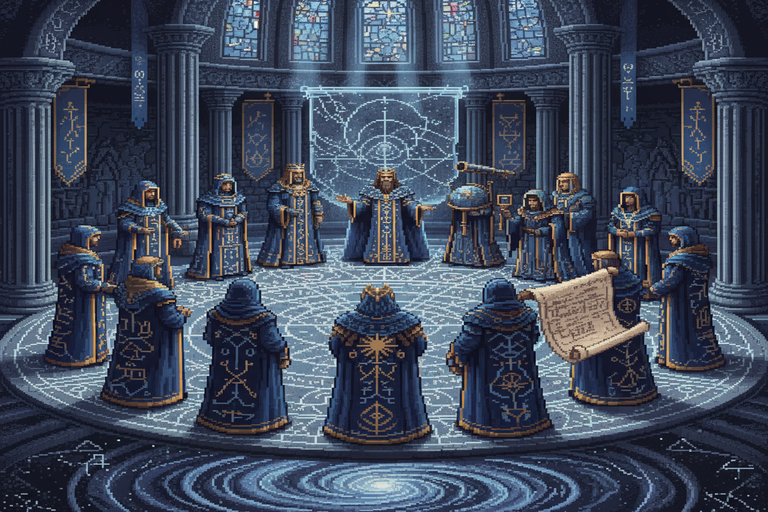 The Luminar Council - Philosopher-Kings Who Broke the World
Overview
The Luminar Council were the philosopher-kings who ruled Terrum Solidus in the centuries before the Shattering. They were humanity’s greatest minds: astronomers, mathematicians, theologians, and practitioners of Astral Geometry who claimed direct communication with the constellations. For 500 years, they guided civilization to unprecedented heights of culture, technology, and understanding.
Then they attempted the Apogee Working—a ritual designed to physically ascend humanity into the stellar realm—and instead shattered the world into floating fragments, killed billions, and plunged survivors into the nightmare of the Aetherium.
Whether the Working failed catastrophically or succeeded too well remains debated. What’s certain is that the Luminar Council’s hubris destroyed everything they claimed to protect. They are remembered as either tragic heroes who attempted the impossible, or monstrous tyrants whose arrogance murdered a world.
Few records survived the Shattering. What’s known comes from fragments: ruins, partial texts, oral traditions (often contradictory), and the occasional discovery of sealed archives. The Council members themselves remain shadowy figures—names without faces, titles without personalities, architects of apocalypse whose true motivations died with the world they destroyed.
The Council Structure
Composition
12 Councillors: - Each representing a major constellation - Elected through meritocratic process (scholarly achievement + constellation favor) - Lifetime appointments - Governed by consensus (majority vote insufficient—required 9/12 agreement)
Supporting Structure: - Star-Readers (astronomers, priests, ritual specialists): ~1,000 - Administrative officials: ~10,000 - Military/enforcement: ~50,000 - Total direct authority over ~2-3 million people
Power Base: - Spiritual (claimed divine mandate from constellations) - Intellectual (monopolized advanced knowledge) - Technological (controlled Astral Geometry applications) - Military (enforced will when persuasion failed)
Governance Philosophy
Core Principles (from recovered texts):
- “Knowledge is divine, ignorance is sin”
- Education mandatory for all citizens
- Libraries and observatories state-funded
- Intellectual achievement highest social status
- “The stars guide, we follow”
- Constellation worship state religion
- Star-Reader interpretations had legal force
- Blasphemy punishable (severely)
- “Humanity’s purpose is ascension”
- Belief that physical reality is temporary
- Ultimate goal: Transcend flesh, join constellations
- All policy oriented toward this end
- “The wise rule the willing”
- Meritocracy (in theory)
- Aristocracy (in practice—education access limited)
- Dissent tolerated if scholarly, crushed if populist
Known Council Members
Kalis the Astronomer
Constellation: The Voyager
Specialty: Astronomical observation, star-chart creation
Achievements: - Mapped constellation movements with unprecedented accuracy - Developed mathematical models predicting stellar positions - Authored “The Celestial Mechanics” (partially recovered text)
Role in Apogee Working: - Calculated optimal stellar alignment - Determined ritual timing - Arguably most responsible for technical aspects
Legacy: - Name survives (Kalis Dren chose surname as homage/irony) - Some scholars view sympathetically (scientist, not tyrant) - Others blame entirely (calculations enabled catastrophe)
Fate: Unknown (body never found)
Arduous the Illuminated
Constellation: The Constellation of Light
Specialty: Theology, constellation communication
Achievements: - High Priest before elevation to Council - Claimed clearest constellation communication of any Star-Reader - Wrote “The Radiant Truth” (religious text, fragments survive)
Role in Apogee Working: - Spiritual leader of ritual - Claimed constellation approval (disputed—did he lie? Misunderstand?) - Led prayers and invocations
Legacy: - Clergy views ambivalently (faithful servant who erred? Deceiver?) - Name survives in curses (“Arduous’s folly”) - Some believe he survived, merged with Hollow’s corruption (unverified)
Fate: Unknown (last seen at Nexus Spire)
Veilantha the Cryptic
Constellation: The Veil
Specialty: Secret knowledge, intelligence, espionage
Achievements: - Established information network across Terrum Solidus - Discovered pre-Luminar civilizations (controversial claim) - Authored encrypted texts (still undeciphered)
Role in Apogee Working: - Opposed it (sole dissenting voice, overruled by 11-1 vote) - Warned of “the thing below” awakening - Left cryptic warnings (partially recovered)
Legacy: - Vindicated by catastrophe (she was right) - Warnings studied obsessively (seeking clues to prevent recurrence) - Cult following among Archivists (saw truth others missed)
Fate: - Unknown officially - Veil-Born oral tradition claims she survived, went into hiding - Allegedly left descendants (Elder Talvyn might be one)
Forgemaster Kael
Constellation: The Forge
Specialty: Engineering, construction, weapons
Achievements: - Designed Nexus Spire (ritual site) - Developed Astral Geometry architectural applications - Created weapons that still function 287 years later
Role in Apogee Working: - Built ritual infrastructure - Ensured structural integrity during Working - Oversaw 10,000 workers for 20 years construction
Legacy: - Name common (Kael is popular in his honor—or spite) - Engineering principles still studied - Nexus Spire remains (somewhere), testament to skill
Fate: Unknown (died in Spire collapse? Survived?)
Others (Partial Information)
Memoria the Keeper (Constellation of Memory): - Archivist, historian - Opposed Working (joined Veilantha in dissent, still overruled) - Attempted to preserve knowledge before catastrophe - Some attribute Archive cave caches to her foresight
Serpentia the Coiled (Constellation of the Serpent): - Controversial member (Serpent already viewed suspiciously) - Studied transformation, corruption, forbidden arts - Some blame her for Rot (did ritual awaken it?) - Likely killed by colleagues before Working (purged for heresy?)
Other Six: Names lost or fragmentary, roles unknown
The Apogee Working
Purpose (Official)
Goal: Physically ascend humanity into stellar realm
Justification: - Terrum Solidus is flawed, temporary reality - Constellations exist in higher dimension - Humanity’s destiny is transcendence - Working would elevate entire species
Method: - Mass ritual at Nexus Spire - 10,000 Star-Readers participating - 7 days and nights continuous prayer - Precise astronomical alignment - Astral Geometry amplification
Execution
Timeline: - Planning: 50 years - Construction: 20 years (Nexus Spire) - Preparation: 10 years (training participants) - Ritual: 7 days (culminating eighth dawn)
Day 8 Dawn (0 S.): - Sun turned black - Stars screamed (audible to humans somehow) - Ground cracked like glass - Terrible wrongness seeped from below - World shattered instantly
Immediate Result: - Terrum Solidus fractured into thousands of fragments - Billions dead instantly - Survivors cast into Aether - Constellations went silent (returned “wrong” year later) - Rot began spreading
What Actually Happened (Theories)
Theory 1: Catastrophic Failure - Ritual simply failed - Backfire destroyed world - Council’s arrogance killed everyone
Theory 2: Partial Success - Humanity did ascend (partially) - Caught between dimensions - Aether is the in-between space - We’re neither here nor there
Theory 3: The Thing Below - Veilantha was right - Something existed beneath world - Ritual broke its prison - Rot is that entity
Theory 4: Deliberate - Council knew what would happen - Did it anyway - Attempting escape from something worse - Or attempting to become gods (succeeded?)
Theory 5: Divine Punishment - Constellations shattered world themselves - Response to humanity’s hubris - Apogee Working was blasphemy - We’re being punished still
Legacy and Impact
On History
Official Narrative (Constellation Clergy): - Tragic failure - Well-intentioned hubris - Lesson: Don’t attempt god-hood - Shattering is our punishment/test
Alternative Narratives: - Archivists: More complex than official story, evidence suppressed - Veil-Born: Council knew consequences, did it anyway - Rot-Touched: Council partially succeeded (transformation, not failure) - Folk Tales: They made a deal with something dark
On Modern Society
Political: - Deep distrust of centralized power - No one wants another “Council” - Sky-Guild powerful but not sovereign - Settlements remain independent (trauma legacy)
Intellectual: - Astral Geometry viewed suspiciously (enabled catastrophe) - Advanced knowledge seen as dangerous - Anti-intellectual movements cite Council as cautionary tale - But scholars still study their works (knowledge is knowledge)
Theological: - Constellation faith complicated by Council’s role - Were they following divine will? Or defying it? - Did constellations approve Working? (Arduous claimed yes) - Clergy still debates centuries later
On Individual Characters
Descendants: - Anyone with Council lineage (real or claimed) stigmatized - Some change names (Elder Silas Thorn hides ancestry) - Others embrace it (complicated relationship)
Survivors: - Abbot Silas possibly pre-Shattering Star-Reader (if true, witnessed Council’s rule) - Any 287+ year old being (rare) remembers pre-Shattering truth - They don’t talk about it
Archaeological Evidence
Ruins and Artifacts
Nexus Spire (ritual site): - Location unknown (supposedly in Periphery) - Occasionally “found” (claims dubious) - Extremely dangerous (Astral Geometry still active?) - Quest goal for many expeditions (few return)
Council Archives: - Scattered across Aetherium - Some in deep vaults (Glimmering Spire, elsewhere) - Encrypted, damaged, fragmentary - Archivists dedicate lives to recovery
Personal Effects: - Occasional discoveries (books, tools, clothing) - Collectors pay fortunes - Some items still function (Astral Geometry preservation) - Often dangerous (cursed? Unstable?)
Recent Discoveries
Last Year: Sealed chamber in Glimmering Spire Underlevel - Contains Council correspondence (pre-Working debates) - Reveals dissent (multiple members opposed, not just Veilantha) - Suggests they knew risks (proceeded anyway) - Bishop Vael classifying findings (politically explosive)
Ongoing: Highfall Village oral traditions - Elder Talvyn’s accounts (passed down 287 years) - Claims Council deliberately caused Shattering - Evidence: Pre-Working documents (hidden in Archive Cave) - Not yet public (Talvyn waiting for right moment)
Philosophical Questions
Did They Deserve Damnation?
Pro (They Were Monsters): - Killed billions through arrogance - Ignored warnings (Veilantha, others) - Prioritized ambition over safety - Ultimate villains
Contra (They Were Tragic): - Genuinely believed in higher purpose - Acted on best knowledge available - Attempting to save/elevate humanity - Catastrophic failure ≠ evil intent
Nuanced: - Both true simultaneously - Good intentions, terrible judgment - Hubris is its own evil - We cannot know their hearts (all dead)
Could It Happen Again?
Risk Factors Present: - Humanity still seeks solutions - Knowledge being recovered - Desperation from Rot - Someone might repeat mistakes
Safeguards: - Memory of catastrophe (deterrent) - Lack of resources (can’t match Council’s power) - Fragmented society (consensus impossible) - Constellations silent (can’t authorize)
But: - Desperation breeds risk-taking - If Rot threatens extinction, might try anything - History does rhyme
In Modern Context
How They’re Remembered
Children’s Tales: Bogeymen (behave or Council’s ghost will get you)
Scholarly Debate: Endlessly analyzed, never resolved
Religious Services: Named in prayers (warning against pride)
Political Rhetoric: Invoked to oppose power concentration
Rot-Touched Philosophy: Some view as martyrs (attempted transformation)
The Unfinished Business
Key Questions: 1. Did any survive? (Possible, given Abbot Silas’s existence) 2. Where is Nexus Spire? (Findable? Should it be?) 3. What did they truly attempt? (Ascension? Escape? Transformation?) 4. Could Working be reversed? (Theoretical, terrifying) 5. Are we living in its continued effect? (Aether as permanent ritual state)
Quest Hooks
- The Archive Hunt: Recover Council documents from dangerous ruins
- The Descendant: Meet someone with Council lineage (how do they cope?)
- The Nexus Expedition: Join search for ritual site
- The Survivor: Encounter pre-Shattering Star-Reader (if Silas reveals truth)
- The Ritual Fragments: Pieces of Working discovered (dangerous knowledge)
- The Vindication: Veilantha’s warnings found (change historical understanding)
- The Repeat: Someone attempting similar ritual (stop them? Help them?)
- The Memorial: Participate in annual Shattering remembrance
- The Debate: Theological/philosophical argument about Council’s morality
- The Truth: Highfall’s evidence released (societal upheaval)
Related Topics
- The Shattering
- Pre-Shattering Era
- Apogee Working
- Star-Readers of Old
- The Nexus Spire
- Constellation Clergy
“They reached for the stars and pulled down the sky. We live in
the wreckage of their ambition.”
—Common saying
“Perhaps they succeeded. Perhaps we’re living in the world they
meant to create. Perhaps this nightmare is their heaven.”
—Heretical counter-saying