Constellation of the Forge
“The Hammer” / “The Smith of Stars” / “The Builder”
“Strike true. Strike hard. Strike with purpose. The Forge watches
those who shape the world.”
—Inscription above every smithy in Ironhold
Quick Reference
| Attribute | Details |
|---|---|
| Domain | Craftsmanship, creation, strength, endurance, protection, transformation through labor |
| Symbol | Anvil struck by lightning bolt (representing divine inspiration meeting human effort) |
| Sacred Color | Red-gold (color of heated metal), iron gray, forge-fire orange |
| Virtue | Dedication to craft, patience, strength (physical and moral), pride in work, perfection pursued |
| Sin | Shoddy workmanship, laziness, abandoning projects, breaking tools, disrespecting materials |
| Typical Followers | Blacksmiths, craftsmen, builders, soldiers, guards, anyone who creates or protects |
| Clergy Title | Forge-Priest (priests), Master-Smith (bishops), Hammer of Stars (high clergy) |
| Sacred Day | The Tempering (quarterly, when constellation reaches forge-position in sky) |
| Offerings | First creation, broken tools (respectfully retired), sweat-stained work clothes, metal scraps |
| Miracles Granted | Enhanced strength, unbreakable weapons, fortitude, inspiration for designs, protection of workers |
| Price | Physical labor, defense of the weak, completion of difficult projects, teaching craft to others |
| Current Status | Strong and stable—work continues regardless of divine silence, practical faith |
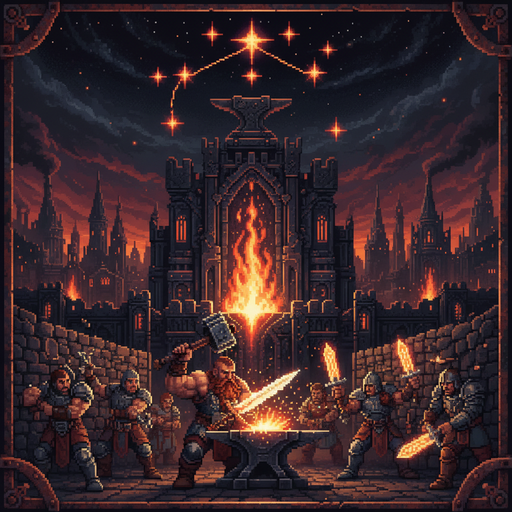 The
Constellation of the Forge - The Hammer
The
Constellation of the Forge - The Hammer
Table of Contents
- Overview
- Theology and Doctrine
- Worship and Practice
- Miracles and Blessings
- Relationship with Other Constellations
- Cultural Impact
- Theological Mysteries and Heresies
- Current Status (287 S.)
- Practical Information for Craftsmen
- Notable Followers
- Sayings and Proverbs
- Related Topics
- In-World Documents
Overview
The Constellation of the Forge is the patron of all who create, build, and shape the world through labor. In the shattered Aetherium where survival depends on maintaining what remains and building what’s needed, the Forge represents humanity’s refusal to surrender to entropy. Every tool forged, every wall built, every airship repaired is an act of worship.
Pre-Shattering, the Forge was beloved by craftsmen, soldiers, and builders—those whose hands shaped civilization. Post-Shattering, when every settlement needed walls, weapons, and constant repair, the Forge’s domain became essential to survival. The constellation is now one of the most widely worshipped, particularly in Ironhold where it serves as unofficial patron deity.
The constellation appears as seven bright stars arranged like an anvil, with an eighth star above that pulses like a hammer striking. When the constellation is at its zenith (called “forge-position”), the pulsing intensifies, and smiths across the Aetherium report feeling inspired, their work flowing more easily.
The Forge’s personality is straightforward and demanding. It values action over words, results over intentions, and quality over quantity. It has no patience for excuses or half-measures. “The metal doesn’t care about your feelings,” goes the saying. “Neither does the Forge.” But it rewards dedication absolutely—those who commit fully to their craft receive blessings that border on miraculous.
Theology and Doctrine
Core Beliefs
Work is Sacred - Labor itself is prayer - Quality work honors the divine - The act of creation connects mortal to divine - Idle hands are spiritual death
Transformation Through Fire - Metal must be heated to be shaped - Humans must be tested to grow strong - Suffering in service of creation is noble - The forge transforms both material and craftsman
Strength Protects - Physical strength enables creation - Moral strength enables sacrifice - Strong protect weak (obligation, not choice) - Strength without purpose is wasted
Perfection Pursued - Every work should be your best - Improvement is endless - Master craftsmen still have more to learn - Shoddy work insults the Forge
Tools are Sacred - Respect your tools (they enable creation) - Maintain them properly - Breaking tools through carelessness is sin - Retiring worn tools with honor
The Forge’s Personality
The Forge is described in prayers and visions as:
Demanding: Expects excellence, accepts nothing less
Fair: Rewards effort proportionally, punishes laziness equally
Patient: Understands mastery takes time, but expects continuous progress
Protective: Fiercely defends those who work honestly
Straightforward: No riddles, no games, no hidden meanings
Practical: Values results over philosophy
Priests describe the Forge as “a stern master who pushes you to be better than you thought possible, then nods once when you succeed.”
Orthodox Clergy Position
The Constellation Clergy officially recognizes the Forge as one of the six major constellations, and it enjoys strong support:
Positive View: - Essential for maintaining civilization - Encourages productive labor and skill development - Provides moral framework for workers - Miracles are reliable and practical - Philosophy aligns with survival needs
Strengths: - Most stable faith post-Shattering - Followers don’t require constant divine intervention - “Work whether the gods watch or not” mentality - Strong community bonds among craftsmen
Concerns: - Can become too focused on material over spiritual - Emphasis on strength sometimes leads to militarism - Tension with Voyager (stability vs. movement) - Some followers worship work itself, not the Forge
Official Doctrine: “The Forge teaches that humanity’s salvation lies in our hands—literally. We build our future, one hammer-strike at a time.”
Theological Debates
The Transformation Question - Does the Forge transform the craftsman, or does the craftsman transform themselves? - Is divine intervention real, or is “blessing” just the result of dedicated practice? - Moderate clergy: “Both—the Forge provides potential, we provide effort” - Strict interpretation: “The Forge shapes us as we shape metal”
The Strength Paradox - If strength is virtue, are the weak sinful? - What about those who cannot labor (elderly, disabled, children)? - Orthodox answer: “Strength takes many forms—moral, intellectual, spiritual” - Radical answer: “The weak must be protected by the strong, but they must strive to contribute”
The Quality vs. Quantity Debate - Should one perfect creation be valued over many adequate ones? - In desperate times, is “good enough” acceptable? - Traditionalists: “Never compromise quality” - Pragmatists: “Survival requires quantity sometimes”
The Creation Limit - Is there a point where humanity has built enough? - Should we focus on maintaining what exists vs. creating new? - Expansionists: “Always build, always improve” - Conservationists: “Preserve what remains, don’t overreach”
Worship and Practice
Prayer Rituals
The Morning Forge Prayer (Before beginning work):
“Hammer of Stars, I stand at the anvil.
Grant me strength for the work ahead,
Skill for the task at hand,
Patience for the process,
And pride in what I create.
Let my labor honor you.
Let my work outlast me.
Through fire, transformation.
Through labor, meaning.
Strike true.”
The Blessing of Tools (New tools or major projects):
“Forge of Stars, bless these tools.
They are extensions of my hands,
Instruments of creation,
Partners in transformation.
Keep them sharp, keep them strong,
As I strive to be sharp and strong.
Together, we will build what endures.”
The Tempering Prayer (During difficult work):
“The metal resists. The work is hard.
But resistance makes strength,
And difficulty makes mastery.
Forge, you test me as I test the metal.
I accept the heat.
I accept the hammer.
I will emerge transformed,
Stronger than I was.”
The Completion Prayer (Finishing a work):
“It is done.
Not perfect—perfection is pursuit, not destination—
But the best I could make it.
Forge, I offer this work to you.
May it serve its purpose,
May it endure,
May it honor your example.
I am ready for the next task.”
The Protector’s Prayer (Soldiers and guards):
“Forge, make me the shield.
Make me the wall.
Make me strong enough to stand between danger and those I protect.
I am the weapon you shaped,
The armor you tempered,
The fortress you built.
I will not break.
I will not yield.
Through me, your strength protects.”
Offerings and Sacrifices
Common Offerings: - First Creation: First item made by apprentice or first work in new forge - Broken Tools: Respectfully retired tools (never discarded carelessly) - Work Clothes: Sweat-stained aprons, gloves worn through honest labor - Metal Scraps: Leftover materials from projects (recycled by clergy) - Weapon Offerings: Soldiers offer weapons after successful defense
Ritual Offerings: - The Tempering Offering: Quarterly, craftsmen offer their finest recent work - The Apprentice Offering: When taking on apprentice, master offers tools - The Retirement Offering: When retiring from craft, offer final masterwork
Living Sacrifices (not literal death): - Vow of Craft: Dedicate life to mastering specific craft - Vow of Teaching: Promise to train at least three apprentices - Vow of Protection: Pledge to defend community with strength gained - Vow of Quality: Never produce shoddy work, even under pressure
Sacred Spaces
Forge-Shrines: - Found in every smithy, workshop, construction site - Simple altar with anvil symbol - Offering bowl for metal scraps - Hammer hung above (symbolic, not for use) - Maintained by workers themselves
The Chapel of the Forge (Ironhold): - Largest Forge temple in Aetherium - Built like fortress—stone, iron, enduring - Working forge at center (sacred fire never extinguished) - Walls covered with tools from master craftsmen - High Priest Harmon Steelprayer presides
The Anvil Temples: - Dedicated temples in major settlements - Architecture emphasizes strength and function - Training facilities for apprentices - Libraries of technical knowledge - Community workshops
Sacred Landmarks: - The First Forge (Ironhold): Pre-Shattering forge still functional - The Unbroken Wall (Ironhold): Section of Bulwark that has never needed repair - Stonehand’s Forge (Ironhold): Master Blacksmith Garrick’s workshop, pilgrimage site
Clergy Structure
Forge-Priests: - Must be master craftsmen in at least one discipline - Serve communities as both spiritual leaders and skilled workers - Teach apprentices while ministering - Bless tools, consecrate forges, perform rituals - Expected to work with their hands daily
Master-Smiths (Bishops): - Oversee regions - Masters of multiple crafts - Coordinate large construction projects - Arbitrate disputes over quality and fair payment - Maintain technical libraries
Hammer of Stars (High Clergy): - One representative on High Constellation council - Must have created masterwork recognized across Aetherium - Coordinates all Forge clergy - Preserves ancient crafting techniques
Current Hammer of Stars: Theron Ironwright, age 61, forged the gates of Ironhold’s Bulwark, can work any metal
Festivals and Holy Days
The Tempering (Quarterly): - Three-day festival when constellation reaches forge-position - Craftsmen display finest recent works - Competitions (speed-forging, precision work, innovation) - Masters take new apprentices - Community feasts (everyone contributes) - Sacred fire re-lit in all forges
The Day of the Hammer (Anniversary of first post-Shattering forge, 3 S.): - Celebrates humanity’s refusal to surrender - All workers take day off (rare honor) - Stories of great craftsmen told - Tools blessed en masse - New construction projects blessed and begun
The Apprentice Festival (Spring): - Celebrates new apprentices - Youth demonstrate skills - Masters offer guidance - Community invests in next generation - Reminds everyone: knowledge must be passed on
The Retirement Ceremony (Individual, as needed): - When master craftsman retires - Final masterwork created and offered - Tools passed to successor - Community honors lifetime of labor - Bittersweet celebration
Miracles and Blessings
Documented Miracles
The Unbreakable Blade (245 S.): Blacksmith Garrick Stonehand prayed over a sword for three days while forging it, never sleeping, barely eating. When he quenched the blade, the Forge constellation blazed brighter than ever seen. The sword emerged perfect—absolutely flawless edge, perfect balance. It has been used in hundreds of battles and has never dulled, chipped, or broken. Garrick refuses to make another, saying “The Forge gave me one perfect work. That’s enough.”
The Wall That Held (267 S.): When Rot-Beasts attacked Thornvale, the wooden palisade should have fallen in minutes. Builder Marta Strongback prayed desperately while defenders held the wall. The Forge answered: the wood became hard as iron, the joints fused solid. The wall held for six hours until reinforcements arrived. Afterward, the wood returned to normal, but the joints remained fused. Engineers cannot explain it.
The Endless Strength (271 S.): During construction of Ironhold’s new shipyard, a support beam collapsed, trapping five workers. Foreman Darius Ironarm prayed to the Forge and lifted the beam alone—a feat requiring the strength of ten men. He held it for twenty minutes while workers were extracted. When released, the beam was bent where his hands gripped it. Darius collapsed and slept for three days. His hands still bear the marks.
The Inspired Design (280 S.): Engineer Torven Ironhull struggled for months to design an airship that could survive Aether-storms. After praying at the Chapel of the Forge, he fell asleep at his drafting table. He dreamed of the Forge itself, saw the constellation rearrange into a ship design. He woke and drew frantically. The design worked perfectly. Storm-Sailors now use “Forge-pattern” ships exclusively.
The Healed Hands (285 S.): Master potter Elara Clayborn lost use of her hands to arthritis, ending her career. She prayed at the Forge shrine daily for a year, not for healing but “for one more day of work.” On the anniversary, her hands suddenly moved without pain. She worked for 18 hours straight, creating her finest pieces. The pain returned afterward, but she had her final masterworks. She died content.
Common Blessings
Enhanced Strength (Most frequent): - Temporary increase in physical power - Enables lifting, building, fighting beyond normal capacity - Success rate: ~70% when constellation visible - Duration: Hours to days depending on need - Price: Exhaustion afterward, must complete task undertaken
Fortitude (Very common): - Resistance to pain, fatigue, injury - Ability to work through hardship - Mental resilience during difficult projects - Success rate: ~60% - Duration: Until task completed - Price: Recovery time afterward
Unbreakable Weapons/Tools (Rare but powerful): - Items blessed become extraordinarily durable - Not literally unbreakable but far superior - Success rate: ~20% (requires master craftsman, perfect work, deep faith) - Duration: Permanent - Price: Significant—often years of service or major sacrifice
Inspiration (Uncommon): - Sudden insight into design problems - Vision of how to complete difficult project - Understanding of material properties - Success rate: ~30% - Duration: Single insight or dream - Price: Must share knowledge, teach others
Protection of Workers (Situational): - Prevents accidents in dangerous work - Shields from injury during construction/battle - Success rate: Hard to measure (absence of harm) - Duration: Duration of dangerous task - Price: Offering afterward, continued dedication to craft
Failed Prayers and Consequences
When the Forge Doesn’t Answer: - Most common reason: Shoddy work in past (Forge rewards quality) - Second reason: Asking for strength without willingness to work - Third reason: Constellation not visible - Fourth reason: Task is meant to be difficult (test of skill) - Fifth reason: Asking for wrong thing (Forge grants practical blessings, not miracles of convenience)
The Curse of Broken Tools: - Those who break tools through carelessness or disrespect suffer - Symptoms: Tools malfunction, projects fail, injuries increase - Cure: Offer broken tools respectfully, complete penance project - Documented cases: Common but usually minor
The Lazy Hand: - Those who pray for strength but don’t work suffer weakness - Rare but severe: hands lose strength, tools feel heavy - Cure: Month of hard labor without complaint - Message: “The Forge grants strength to those who use it”
Relationship with Other Constellations
Allied Constellations
The Constellation of Light: - Both value creation (Light creates truth, Forge creates objects) - Clergy cooperate on community projects - Shared belief in improvement through effort - Tension: Light focuses on spiritual, Forge on material
The Constellation of Memory: - Memory preserves knowledge; Forge applies it - Strong cooperation on preserving crafting techniques - Memory’s libraries essential for Forge’s work - Mutual respect and practical alliance
Neutral Constellations
The Constellation of the Veil: - Veil reveals secrets; Forge uses them - Some overlap (discovering lost techniques) - Little direct interaction - Occasional cooperation on pre-Shattering technology
The Constellation of the Broken Chain: - Both value strength - Tension: Chain values freedom, Forge values discipline - Philosophical differences but practical coexistence - Some followers worship both
Opposed Constellations
The Constellation of the Voyager: - Fundamental philosophical opposition - Voyager values movement; Forge values building/staying - Theological debates: “Can you build while moving?” vs. “Can you move while building?” - Followers often in conflict (nomads vs. settlers) - Clergy maintain polite distance but underlying tension
The Constellation of the Abyss: - Abyss represents entropy; Forge represents creation - Diametrically opposed - Forge clergy actively counter Abyss worship - “We build. The Abyss destroys. Choose.”
The Serpent Question
The Constellation of the Serpent (Forbidden): - Serpent offers transformation through corruption - Forge offers transformation through labor - Orthodox position: “The Serpent’s transformation is false—it destroys while claiming to create” - Heretical theory: Both transform, different methods (violently rejected) - Some corrupted craftsmen claim Rot enhances their work (horrifying to Forge clergy)
Cultural Impact
Among Craftsmen and Builders
Universal Respect: - Even non-religious craftsmen acknowledge the Forge - “Forge-blessed” = highest quality - “Forge-cursed” = shoddy workmanship - Pre-work ritual: touch anvil symbol, whisper quick prayer
Professional Culture: - Apprentice system mirrors religious structure - Master-apprentice relationship sacred - Quality work is moral obligation, not just professional - Competition to create “Forge-worthy” masterworks
Garrick Stonehand’s Influence: - Most famous blacksmith in Aetherium - Created one perfect blade (Forge miracle) - Embodies Forge virtues but minimal formal worship - Represents tension between work-as-worship and organized religion
Among Soldiers and Guards
Martial Faith: - Soldiers pray to Forge more than any other constellation - “Make me the shield” prayer before battles - Weapons blessed at Forge temples - Belief that Forge protects those who protect others
Ironhold’s Military: - Forge is unofficial patron deity - Commandant Vask respects Forge (though not deeply religious) - Military training includes Forge philosophy - Strength and discipline aligned with Forge values
Among Common Laborers
Practical Faith: - Work is prayer (don’t need formal rituals) - Forge shrines in every workplace - Community bonds through shared labor - Belief that honest work has inherent dignity
The Working Class: - Forge clergy come from working class - Religion validates their labor - Provides moral framework and community - “The Forge watches the worker, not the noble”
Among Elite and Merchants
Complicated Relationship: - Appreciate Forge’s role in production - Uncomfortable with emphasis on labor over wealth - Some wealthy craftsmen deeply devout - Others see religion as tool to motivate workers
Sky-Guild Tension: - Guild values profit; Forge values quality - Conflict over “good enough” vs. “perfect” - Guild-Master Elara Song respects Forge but prioritizes economics - Forge clergy criticize Guild’s compromises
In Art and Literature
Common Themes: - Transformation through suffering - Dignity of labor - Master-apprentice relationships - Creation as meaning-making
Famous Works: - The Hammer’s Song (epic poem about legendary smith) - Forged in Fire (collection of craftsmen’s stories) - The Anvil and the Stars (theological text on work as worship)
Visual Art: - Anvil and hammer motifs everywhere - Sculptures of famous craftsmen - Murals depicting creation myths - Tattoos of hammer and anvil (common among workers)
Theological Mysteries and Heresies
The Self-Forging Heresy
Claim: Humans forge themselves; the Forge is metaphor, not deity
Evidence: - Skill improves through practice, not prayer - “Miracles” explainable as peak human performance - Forge’s blessings correlate with effort
Orthodox Response: “The Forge provides potential and inspiration. We provide effort. Both are necessary.”
Heretic Counter: “We don’t need gods to be strong. We make ourselves strong.”
Status: Tolerated as philosophical position, condemned if denies Forge’s existence
The Endless Improvement Paradox
Question: If perfection is pursuit, not destination, when is work good enough?
Practical Problem: - Craftsmen obsessing over minor flaws - Projects never completed - Paralysis through perfectionism
Orthodox Answer: “Do your best with time and materials available. The Forge judges effort and intent.”
Radical Answer: “Nothing is ever good enough. Keep improving until death.”
Status: Ongoing debate, causes mental health issues in some followers
The Strength Hierarchy Heresy
Claim: The strong are morally superior to the weak
Evidence: - Forge values strength - Weak cannot create as much - Natural hierarchy based on capability
Orthodox Response: “Strength is gift and obligation. The strong must protect and teach the weak.”
Heretic Counter: “The weak are burden. Resources should go to strong.”
Status: Violently condemned, associated with Ironhold’s worst authoritarian tendencies
The Creation Limit Theory
Question: Is there a point where humanity should stop building?
Context: - Pre-Shattering hubris (Apogee Working) - Current resource scarcity - Environmental concerns (Rot spreading)
Traditionalist View: “Always build, always improve. Stagnation is death.”
Reformist View: “Build wisely. Not everything should be created.”
Status: Increasingly relevant debate as resources dwindle
Current Status (287 S.)
Constellation’s Activity
Visibility: Appears 70% of nights in Bright Reaches, reliable schedule
Prayer Response Rate: - Stable over time (~60-70% of prayers answered) - Most consistent of all constellations - Miracles less dramatic but more reliable
Clergy Assessment: - Forge is strongest remaining constellation - Most stable faith post-Shattering - “Work whether gods watch or not” mentality ensures continuity
Major Developments
Ironhold’s Dominance: - Forge worship strongest in Ironhold - Military-industrial complex aligned with Forge values - Commandant Vask uses Forge philosophy to justify authoritarianism - Tension: Is this honoring Forge or corrupting its message?
The Craft Renaissance: - Desperate need driving innovation - New techniques developed - Forge clergy preserving knowledge - Apprentice programs expanding
The Quality vs. Survival Debate: - Resource scarcity forcing compromises - “Good enough” becoming necessary - Traditional Forge clergy resisting - Pragmatic clergy adapting
The Weapon Boom: - Increasing militarization - Forge clergy blessing more weapons - Ethical questions: Is this protection or aggression? - Some priests refusing to bless weapons of conquest
Challenges Facing the Faith
Resource Scarcity: - Metal increasingly rare - Quality materials hard to find - Affects ability to create quality work - Forge’s standards harder to meet
Militarization: - Forge’s strength emphasis exploited - Used to justify authoritarian policies - Tension between protection and aggression - Risk of Forge becoming war god
Labor Exploitation: - “Work is worship” used to justify poor conditions - Employers exploiting religious devotion - Forge clergy must balance honoring labor with protecting workers
The Apprentice Crisis: - Fewer young people learning trades - Knowledge being lost - Master craftsmen dying without successors - Forge’s continuity threatened
Hope and Renewal
Despite challenges, Forge worship remains strong:
Practical Faith: - Work continues regardless of divine silence - “Build whether gods watch” mentality - Most resilient faith system
Community Bonds: - Shared labor creates strong communities - Forge shrines as gathering places - Master-apprentice relationships preserve culture
Innovation: - Necessity driving creativity - New techniques honoring old principles - Forge’s blessing on adaptation
The Next Generation: - Young craftsmen finding meaning in work - Apprentice programs growing in some areas - Hope that skills will survive
Practical Information for Craftsmen
Seeking the Forge’s Blessing
Before Major Work: 1. Clean your workspace (respect for craft) 2. Prepare tools properly 3. Make offering at forge-shrine 4. Speak blessing of tools prayer 5. Begin work with clear intent
During Work: - Focus completely (distraction is disrespect) - Work to best of ability - Accept difficulty as part of process - Pray when struggling, but keep working
Upon Completion: - Speak completion prayer - Offer first creation or finest work - Share knowledge gained - Begin planning next project
Finding Forge Clergy
Major Temples: - Ironhold: Chapel of the Forge (largest) - Skyport Eos: The Anvil Hall - Thornvale: The Builder’s Rest
Forge-Shrines: - Every smithy, workshop, construction site - Look for anvil symbol - Maintained by workers themselves
Wandering Forge-Priests: - Travel to remote communities - Teach skills, bless tools, perform rituals - Recognizable by hammer pendant and work-stained robes
Costs and Expectations
Blessings: Free (offerings encouraged)
Tool Blessing: Donation suggested (1-5 coins)
Major Rituals: Varies (10-50 coins for complex ceremonies)
Apprenticeship: Often through Forge clergy (includes spiritual and technical training)
Expectations: - Honesty about skill level - Willingness to learn and improve - Respect for tools and materials - Commitment to quality - Teaching others when able
Notable Followers
Historical Figures
Theron Firstforge (3 S.): - Lit first forge post-Shattering - Forge constellation appeared and blessed the fire - Fire has never gone out (burns in Chapel of the Forge) - Founded Forge clergy as organized religion
Marta the Builder (87 S.): - Designed Ironhold’s Bulwark - Walls have stood for 200 years - Prayed over every stone laid - Died completing final section (fell from scaffolding)
The Three Masters (156 S.): - Garrick Ironwright, Elara Stonehand, Darius Hammerborn - Collaborated on masterwork: The Unbroken Gate - Gate has never needed repair in 131 years - All three received Forge’s blessing simultaneously
Contemporary Figures
Hammer of Stars Theron Ironwright: - Current high clergy representative - Age 61, forged Ironhold’s gates - Can work any metal - Concerned about militarization of faith
Master Blacksmith Garrick Stonehand: - Most famous craftsman in Aetherium - Created one perfect blade (Forge miracle) - Refuses to make another - Embodies Forge virtues, minimal formal worship
High Priest Harmon Steelprayer: - Leads Chapel of the Forge (Ironhold) - Former blacksmith turned clergy - ~2,000 regular congregation - Balances traditional values with practical needs
Engineer Torven Ironhull: - Designed Forge-pattern storm-ships - Received vision from Forge - Lives in Howling Expanse - Sends designs to Ironhold anonymously
Copperpot the Smith (Skyport Eos): - Inventor and blacksmith - Serves through innovation - Creates practical tools for common people - Believes invention is highest form of worship
Sayings and Proverbs
“Strike true. Strike hard. Strike with purpose.”
“The metal doesn’t care about your feelings. Neither does the Forge.”
“Work whether the gods watch or not.”
“Better to create one perfect thing than a thousand flawed things.”
“The Forge shapes us as we shape metal.”
“Strength without purpose is wasted. Purpose without strength is futile.”
“Every master was once an apprentice. Every apprentice can become a master.”
“The hammer falls. The metal yields. The craftsman grows.”
“Respect your tools. They remember how you treat them.”
“It’s not done until it’s done right.”
Related Topics
- Constellation of the Voyager - Philosophical opposition
- Constellation of Light - Allied constellation
- Constellation of Memory - Knowledge preservation partnership
- Constellation Clergy - Religious organization
- Ironhold - Primary worship center
- Garrick Stonehand - Exemplar of Forge virtues
- Chapel of the Forge - Largest temple
- Sky-Guild - Complicated relationship
In-World Documents
Inscription Above Every Forge in Ironhold
THE FORGE’S LAW
Work is sacred.
Quality is honor.
Strength protects.
Labor transforms.Strike true.
Strike hard.
Strike with purpose.The Forge watches.
From The Hammer’s Song (Epic Poem, Traditional)
In the beginning, there was metal,
Cold and formless, waiting.
The Forge descended from the stars,
And taught humanity creating.“Take up the hammer,” said the Forge,
“And strike with all your might.
Transform the world through labor,
And I will grant you light.”So we struck, and we shaped,
And we built what would endure.
And the Forge watched from above,
And blessed our hands, made sure.Now the world is shattered,
But the hammer still falls.
We build upon the ruins,
We raise new walls.The Forge still watches,
The fire still burns.
And every strike of hammer,
Is a prayer that returns.
Garrick Stonehand’s Workshop Sign
STONEHAND’S FORGE
I can make anything.
I will make it perfect.
You will pay accordingly.Quality is not negotiable.
Neither is my price.The Forge blessed me once.
That was enough.
Prayer Carved Into Ironhold’s Bulwark
These walls were built by hands that prayed,
By backs that bent but never swayed,
By hearts that knew what must be made,
By the Forge’s blessing, we are stayed.Two hundred years these stones have stood,
Through storm and siege and Rot-touched flood,
Because the builders understood:
Quality work serves the greater good.So when you pass through these gates,
Remember those who built them straight,
Who worked until the light grew late,
And trusted in the Forge’s fate.
Last Words of Marta the Builder (87 S.)
I see the final stone.
It fits perfectly.
The Forge taught me well.[She placed the stone, completing the Bulwark, then fell from the scaffolding. The wall has never needed repair.]
“We are what we make. And what we make outlasts us. So make it
well, make it strong, and make it matter. The Forge demands nothing
less.”
—Hammer of Stars Theron Ironwright