Chapel of the Forge
“Where Work is Worship”
“Strike true. Strike hard. Strike with purpose. The
Forge watches.”
—Inscription above the main entrance
Quick Reference
| Attribute | Details |
|---|---|
| Location | Ironhold, The Commons district |
| Region | The Bright Reaches |
| Size | 5,000 square meters (building and grounds) |
| Population | 15 permanent clergy, ~2,000 regular congregation |
| Government | Administered by Constellation Clergy (Forge branch) |
| Primary Faction | Constellation of the Forge clergy |
| Purpose | Primary worship center, craftsman training, community forge |
| Founded | Year 45 S. (242 years ago) |
| Notable Feature | The Eternal Forge (never extinguished since founding) |
| Architecture | Fortress-temple hybrid (strength and sanctity) |
| Congregation | ~2,000 regular worshippers, 5,000+ on holy days |
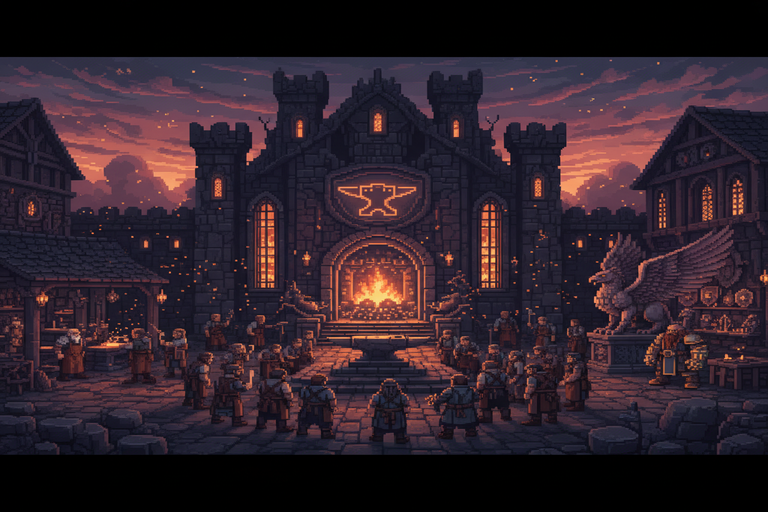 Chapel of the Forge
Table of Contents
- Overview
- History and Founding
- Architecture and Design
- Key Locations
- The Eternal Forge
- Worship and Ceremonies
- The Working Forges
- Training and Apprenticeship
- Clergy and Staff
- Congregation
- Cultural Significance
- Current Situation (287 S.)
- Controversies and Tensions
- Quest Hooks
- Related Topics
- In-World Documents
Overview
The Chapel of the Forge is the largest and most important temple dedicated to the Constellation of the Forge in the Aetherium. Located in the Commons district of Ironhold, it serves simultaneously as worship center, working forge, craftsman training facility, and community gathering place. Here, the line between labor and prayer dissolves—work is worship, and worship is work.
Built in Year 45 S. by Theron Ironwright the Elder (ancestor of current Hammer of Stars Theron Ironwright), the Chapel embodies Forge philosophy in stone and iron. It is both fortress and temple, both sacred space and practical workshop. The Eternal Forge at its heart has burned continuously for 242 years, tended day and night by dedicated Forge-Keepers who view its maintenance as their highest calling.
The Chapel is administered by High Priest Harmon Steelprayer, a former master blacksmith who turned to clergy after receiving a vision from the Forge. Under his leadership, the Chapel has grown to serve a regular congregation of ~2,000 craftsmen, soldiers, builders, and workers who gather here to worship through labor, to learn their crafts, and to connect with the divine through the act of creation.
This is not a place of quiet contemplation or abstract theology. The Chapel rings with the sound of hammers on anvils, glows with forge-fire, and smells of hot metal and honest sweat. Services involve actual work—forging, building, creating—because the Forge teaches that action is prayer, and quality work is the highest form of worship.
The Chapel also houses the Hall of Perfect Works, a gallery displaying masterpieces created by Forge-blessed craftsmen, including Garrick Stonehand’s perfect blade—the most famous example of a Forge miracle in living memory. Pilgrims travel from across the Aetherium to see these works and to pray at the Eternal Forge.
History and Founding
Theron Ironwright the Elder (Year 45 S.)
Background: - Master blacksmith in early Ironhold - Devout Forge worshipper - Believed work itself was prayer - Wanted dedicated space for Forge worship
His Vision (Year 44 S.): - While forging, received vision from the Forge - Saw temple that was also workshop - Understood: sacred and practical must unite - Decided to build Chapel
Construction (Year 44-45 S.): - Gathered craftsmen to help - Built fortress-temple hybrid - Incorporated working forges into design - Lit the Eternal Forge (has never gone out) - Opened doors Year 45 S.
First Service: - Not traditional ceremony - Congregation forged together - Created gate for Ironhold’s walls - Work as worship demonstrated - Established Chapel’s character
Legacy: - Theron served as first High Priest - Died Year 78 S., age 89 - Buried beneath Chapel - Considered founder-saint - Current Hammer of Stars is his descendant
Early Years (Year 45-100 S.)
Growth: - Craftsmen flocked to Chapel - Forge worship spread in Ironhold - Chapel became community center - Training programs established
The First Miracle (Year 67 S.): - Blacksmith praying at Eternal Forge - Forged blade that never dulled - Forge-blessed weapon - Proved divine presence - Inspired devotion
Expansion (Year 82 S.): - Original building too small - Added wings for more forges - Built Hall of Perfect Works - Expanded training facilities - Became largest Forge temple
Middle Period (Year 100-200 S.)
Golden Age (Year 120-180 S.): - Forge worship at peak - Miracles relatively common - Master craftsmen trained here - Ironhold’s prosperity linked to Chapel - Cultural center of city
Military Alliance (Year 156 S.): - Chapel blessed Ironhold’s army - Forge-Priests became military chaplains - Weapons forged here considered superior - Complicated relationship (worship vs. militarism)
The Great Schism (Year 156 S.): - When Serpent worship was banned - Forge clergy supported ban (order vs. chaos) - Chapel became more orthodox - Some criticized militarization
Modern Era (Year 200-287 S.)
Divine Silence Impact (Year 200+ S.): - Miracles became rare - But Forge worship remained strong - “Work whether gods watch or not” mentality - Practical faith sustained community
Harmon Steelprayer Appointed (Year 265 S.): - Former master blacksmith - Received Forge vision - Became High Priest - Balanced tradition with adaptation - Current leader (22 years)
Current Status (Year 287 S.): - 242 years old - Largest Forge temple in Aetherium - 2,000 regular congregation - Essential to Ironhold’s identity - Facing challenges but strong
Architecture and Design
Overall Design Philosophy
Fortress-Temple Hybrid: - Thick stone walls (strength, protection) - Sacred symbols (anvil, hammer, Forge constellation) - Working forges integrated (practical worship) - No separation between sacred and functional
Materials: - Gray granite (local stone, durable) - Iron reinforcements (symbolic and structural) - Forge-fire light (no external windows in forge areas) - Honest materials (no false decoration)
Aesthetic: - Brutal efficiency meets sacred purpose - Every element serves function - Beauty in utility - Strength as beauty
Main Building
Dimensions: - 100m x 50m footprint - 20m tall at peak - Three stories in some sections - Massive, imposing presence
Exterior: - Thick stone walls (2m thick) - Giant anvil-and-hammer symbol above entrance - Inscription: “Strike true. Strike hard. Strike with purpose.” - Fortress-like but welcoming to workers
Interior Layout: - Central nave (The Eternal Forge) - Side wings (working forges) - Upper level (Hall of Perfect Works) - Lower level (training workshops) - Clergy quarters (attached)
The Central Nave
Description: Main worship space centered on the Eternal Forge.
Features: - 30m x 20m open space - Vaulted ceiling (15m high) - Eternal Forge at center (massive brazier) - Anvil-altar before the Forge - Seating for 500 (benches, simple) - Forge constellation mosaic on ceiling
Atmosphere: - Hot (Eternal Forge radiates heat) - Bright (forge-fire light) - Loud (forges working in side wings) - Energetic (work happening constantly)
Acoustics: - Designed to amplify hammer-strikes - Rhythmic work sounds like prayer - Creates meditative atmosphere through repetition
Key Locations
The Eternal Forge
Description: Massive forge-brazier that has burned continuously for 242 years.
Specifications: - 3m diameter brazier - Special coal blend (burns hotter, longer) - Tended 24/7 by Forge-Keepers - Never allowed to diminish
Symbolism: - Forge’s eternal presence - Humanity’s refusal to surrender - Work never stops - Divine fire made manifest
Rituals: - Craftsmen light their forges from it - Weapons blessed in its flames - Oaths sworn before it - Most sacred object in Chapel
Legend: - Lit by Theron Ironwright the Elder - Said to contain spark of Forge constellation - If it goes out, Forge will abandon humanity - Forge-Keepers take duty with ultimate seriousness
Maintenance: - 4 dedicated Forge-Keepers (rotating shifts) - Special coal delivered weekly - Cleaning and maintenance daily - Emergency protocols (if fire threatened)
The Hall of Perfect Works
Description: Gallery displaying masterpieces created by Forge-blessed craftsmen.
Location: Upper level, overlooking central nave
Contents: - 50+ perfect works - Garrick Stonehand’s blade (centerpiece) - Unbreakable Gate (survived 200 years, no repairs) - Perfect tools (never wear out) - Legendary weapons - Architectural marvels (models)
Garrick’s Blade: - Most famous Forge miracle in living memory - Perfect in every way (balance, edge, beauty) - Garrick refuses to make another - Pilgrims travel to see it - Displayed in place of honor
Significance: - Proof of Forge’s power - Inspiration for craftsmen - Pilgrimage destination - Teaching tool (this is what perfection looks like)
Security: - Heavily guarded (priceless artifacts) - Climate controlled (preservation) - Limited access (prevent theft)
The Working Forges
Description: 12 fully functional forges integrated into Chapel’s side wings.
Purpose: - Worship through work - Training apprentices - Community service (repairs, commissions) - Demonstration of faith
Organization: - 6 forges per wing - Each staffed by master craftsman - Apprentices assist - Open during services (work is prayer)
Products: - Tools for community - Weapons for military - Repairs for citizens - Training pieces for apprentices - Occasional masterworks
Atmosphere: - Hot, loud, productive - Sparks flying, metal ringing - Sacred and practical united - This is what Forge worship looks like
The Tempering Ground
Description: Outdoor courtyard for large-scale ceremonies and communal work.
Features: - 50m x 50m open space - Massive anvil-altar (2m tall) - Seating for 1,000+ - Multiple work stations - View of sky (Forge constellation visible at night)
Use: - Quarterly Tempering ceremonies - Large-scale projects (community builds) - Military weapon blessings - Festivals and gatherings
The Anvil-Altar: - Pre-Shattering anvil (ancient, sacred) - Used for most important blessings - Oaths sworn upon it - Center of outdoor worship
The Training Workshops
Description: Lower level facilities for apprentice training.
Features: - 20 work stations - Tool storage - Materials storage - Classroom space - Master craftsmen offices
Programs: - Blacksmithing (most popular) - Carpentry - Masonry - Weapon-smithing - Tool-making - Other crafts
Significance: - Trains next generation - Preserves knowledge - Serves community - Sacred duty (teaching is worship)
The Forge-Keepers’ Chamber
Description: Living quarters for the four Forge-Keepers who tend the Eternal Forge.
Features: - Four small rooms - Always one on duty - View of Eternal Forge - Minimal comfort (duty over luxury)
Forge-Keepers: - Dedicated clergy - Sworn to tend Eternal Forge - Rotate 6-hour shifts - Most sacred duty in Chapel
Life: - Austere, focused - Entire existence centered on Forge - High honor, high burden - Considered living saints
The Eternal Forge
Maintenance
Daily: - Add coal every 2 hours - Monitor temperature - Clean ash buildup - Check ventilation - Record observations
Weekly: - Deep cleaning - Coal delivery and inspection - Structural inspection - Blessing ceremony
Emergency Protocols: - If fire diminishes: immediate response - Backup coal stores - Multiple ignition sources - Never allowed to go out
History: - 242 years continuous burning - Never extinguished - Survived disasters, attacks, accidents - Symbol of endurance
Symbolism
For Forge Worship: - Physical manifestation of divine - Proof of Forge’s presence - Connection to constellation - Sacred fire
For Ironhold: - Symbol of city’s strength - Cultural touchstone - Source of pride - Identity marker
For Humanity: - Refusal to surrender - Work continues - Light against darkness - Hope made tangible
Rituals
Lighting Personal Forges: - Craftsmen light their forges from Eternal Forge - Carries blessing to their work - Connection to divine - Daily ritual for many
Weapon Blessings: - Weapons heated in Eternal Forge - Blessed by Forge-Priest - Believed to be stronger, more reliable - Military tradition
Oath-Taking: - Oaths sworn before Eternal Forge - Binding and sacred - Forge witnesses - Breaking oath is grave sin
Vigils: - Craftsmen keep vigil before Eternal Forge - Pray for inspiration, strength, skill - Meditate on craft - Seek Forge’s blessing
Worship and Ceremonies
Daily Services
Dawn Striking (6:00 AM): - Congregation gathers - High Priest strikes anvil-altar three times - Prayer: “The Forge wakes. We wake. Work begins.” - Congregation disperses to work - Brief (15 minutes)
Noon Tempering (12:00 PM): - Midday prayer - Blessing of work in progress - Brief rest - Communion through shared meal (workers’ lunch) - 30 minutes
Dusk Quenching (6:00 PM): - Evening prayer - Thanks for day’s work - Display of completed works - Blessing for rest - 30 minutes
Night Vigil (Ongoing): - Forge-Keepers tend Eternal Forge - Some craftsmen keep personal vigils - Chapel never closes - Work never stops
The Tempering (Quarterly)
Timing: When Forge constellation reaches forge-position (quarterly)
Scale: Largest ceremony (5,000+ attendees)
Location: Tempering Ground (outdoor courtyard)
Process: 1. Dawn: Congregation gathers, brings works in progress 2. Morning: Communal work (everyone contributes to large project) 3. Noon: The Great Striking (High Priest strikes anvil-altar, all craftsmen strike their work simultaneously) 4. Afternoon: Blessing of completed works 5. Evening: Feast (communal meal, celebration of labor) 6. Night: Vigil (some stay all night, working and praying)
Significance: - Most important Forge holy day - Entire Ironhold participates - Community bonding through shared labor - Demonstration of faith through action
Apprentice Dedication
Purpose: Formally begin apprenticeship (sacred commitment)
Process: 1. Apprentice presents themselves before Eternal Forge 2. Master craftsman vouches for them 3. High Priest asks: “Will you dedicate yourself to craft?” 4. Apprentice: “I will. I swear by the Forge.” 5. Given first tools (blessed) 6. Begin training
Significance: - Sacred commitment - Forge witnesses - Lifelong bond between master and apprentice - Community celebration
Master Craftsman Recognition
Purpose: Acknowledge achievement of mastery
Process: 1. Craftsman presents masterwork 2. Panel of masters judges 3. If approved, presented before Eternal Forge 4. High Priest blesses craftsman 5. Masterwork displayed in Hall of Perfect Works (if exceptional) 6. Craftsman recognized as master
Frequency: 2-3 per year (mastery is rare)
Significance: - Highest honor for craftsman - Proof of dedication - Forge’s approval - Community recognition
Weapon Blessings (Military)
Purpose: Bless weapons for Ironhold’s military
Process: 1. Weapons brought to Chapel 2. Heated in Eternal Forge 3. Forge-Priest blesses each 4. Returned to soldiers 5. Believed to be stronger, more reliable
Frequency: Before deployments, after repairs
Controversy: - Militarization of faith - Forge as war god? - Some clergy uncomfortable - But tradition continues
The Working Forges
Purpose
Worship Through Work: - Work is prayer (core Forge teaching) - Forging during services is worship - No separation between sacred and practical - Action over words
Community Service: - Repairs for citizens (free or low-cost) - Tools for those who need them - Training for apprentices - Serving through craft
Training Ground: - Apprentices learn by doing - Masters teach through demonstration - Sacred duty to pass knowledge - Preserving craft traditions
Organization
12 Forges Total: - 6 in east wing - 6 in west wing - Each staffed by master craftsman - Apprentices assist
Specializations: - 4 blacksmithing forges (general) - 2 weapon-smithing forges - 2 tool-making forges - 2 artistic metalwork forges - 2 training forges (apprentices)
Schedule: - Open dawn to dusk (6 AM - 6 PM) - Some work at night (by request) - Busiest during services (work is worship) - Never all idle (work continues)
Products
For Community: - Tool repairs (free for poor) - Horseshoes, nails, hinges - Cookware, utensils - Agricultural implements - Whatever is needed
For Military: - Weapons (commissioned) - Armor repairs - Military equipment - Blessed weapons (special)
For Training: - Practice pieces (apprentices) - Learning through doing - Mistakes are lessons - Quality still matters
Masterworks: - Occasionally, something perfect - Forge-blessed (rare) - Displayed in Hall of Perfect Works - Proof of divine presence
The Masters
Requirements: - Recognized master craftsman - Devout Forge worshipper - Willing to teach - Dedicated to service
Responsibilities: - Maintain forge - Train apprentices - Serve community - Worship through work
Current Masters (12 total): - Master Theron Coalhand (head blacksmith) - Master Kara Truehammer (weapon-smith) - Master Garrick Ironwright (tool-maker) - Others (9 more)
Relationship with Garrick Stonehand: - Garrick is most famous craftsman - But doesn’t work at Chapel (independent) - Visits occasionally - His blade displayed in Hall - Complicated relationship (respects Chapel, values independence)
Training and Apprenticeship
Programs Offered
Blacksmithing (Most Popular): - 5-year apprenticeship - Learn forging, tempering, finishing - General metalwork skills - Most versatile craft
Weapon-Smithing (Specialized): - 7-year apprenticeship (after blacksmithing basics) - Swords, axes, spears, arrows - Military contracts - High demand, high skill
Tool-Making (Essential): - 4-year apprenticeship - Hammers, chisels, saws, etc. - Serving other craftsmen - Underappreciated but vital
Other Crafts: - Carpentry (3 years) - Masonry (4 years) - Leatherworking (2 years) - Various others
Apprenticeship Process
Application: - Age 12-16 typically - Apply to master craftsman - Demonstrate interest and aptitude - Master decides whether to accept
Dedication Ceremony: - Formal beginning - Sworn before Eternal Forge - Given first tools - Sacred commitment
Training: - Work alongside master - Learn by doing - Mistakes are lessons - Gradual increase in responsibility
Completion: - Create journeyman piece - If approved, become journeyman - Continue learning - Eventually attempt mastery
Duration: - 3-7 years (depends on craft) - Some never complete - Some become masters - All gain valuable skills
Philosophy
Teaching is Sacred Duty: - Masters must teach - Knowledge must be passed - Hoarding knowledge is sin - Forge demands sharing
Learning Through Doing: - No books, no lectures - Watch, practice, repeat - Muscle memory and understanding - Action over theory
Mistakes Are Lessons: - Failure is part of learning - Analyze what went wrong - Try again, do better - Perfection through practice
Quality Matters: - Even practice pieces should be good - Shoddy work insults Forge - Do it right or do it again - Standards are high
Clergy and Staff
High Priest Harmon Steelprayer
Background: - Age 58, former master blacksmith - Worked 30 years before becoming priest - Received Forge vision (Year 264 S.) - Appointed High Priest (Year 265 S.) - Leads Chapel for 22 years
Appearance: - Muscular (still works forge) - Scarred hands (lifetime of labor) - Wears priest robes with leather apron - Practical, not fancy
Philosophy: - Work is worship - Actions over words - Serve through craft - Balance tradition with adaptation
Challenges: - Balancing military relationship - Divine silence (miracles rare) - Maintaining traditions - Serving growing congregation
Reputation: - Respected by craftsmen (one of them) - Trusted by clergy (devout) - Admired by community (serves well) - Strong leader
Forge-Priests (10 total)
Roles: - Lead services - Bless works - Counsel craftsmen - Teach theology - Perform rituals
Requirements: - Master craftsman first - Then theological training - Both practical and spiritual - Rare combination
Current Priests: - Mix of specialties (blacksmiths, builders, etc.) - All still work their crafts - Worship through labor - Lead by example
Forge-Keepers (4 total)
Sacred Duty: Tend the Eternal Forge
Life: - Austere, focused - 6-hour shifts (rotating) - Entire existence centered on Forge - High honor, high burden
Requirements: - Absolute dedication - Physical endurance - Attention to detail - Spiritual devotion
Current Keepers: - Brother Kael Flamewatcher (20 years service) - Sister Mara Coalhand (15 years) - Brother Theron Emberkeeper (10 years) - Sister Kara Fireward (5 years)
Master Craftsmen (12 total)
Role: Staff the working forges
Responsibilities: - Maintain forges - Train apprentices - Serve community - Worship through work
Status: - Respected positions - Serve Chapel and Forge - Paid modest stipend - Work is reward
Support Staff (20 total)
Roles: - Maintenance (building, grounds) - Administration (records, scheduling) - Kitchen (communal meals) - Security (protect Hall of Perfect Works) - Various others
Significance: Keep Chapel running smoothly
Congregation
Demographics
Size: ~2,000 regular worshippers
Composition: - Craftsmen (40%) - Soldiers/guards (25%) - Builders (15%) - Laborers (10%) - Others (10%)
Age Range: - All ages - Many families - Children learn early - Elderly honored
Economic Status: - Mostly working class - Some wealthy (master craftsmen) - Some poor (laborers) - All welcome
Why They Worship Here
Forge Devotion: - Primary Forge temple - Eternal Forge presence - Strongest connection to constellation - Most authentic worship
Community: - Fellow craftsmen - Shared values - Mutual support - Belonging
Practical Benefits: - Training opportunities - Tool access - Repairs and services - Networking
Tradition: - Families worship here for generations - Cultural identity - Ironhold pride - Heritage
Worship Style
Active, Not Passive: - Work during services - Participate through labor - Actions over words - Physical worship
Practical, Not Abstract: - Theology through craft - Philosophy through action - Faith demonstrated - Results matter
Communal: - Work together - Support each other - Shared projects - Community bonding
Cultural Significance
For Ironhold
Identity Marker: - Largest Forge temple - Symbol of city’s values - Source of pride - Cultural center
Economic Impact: - Trains craftsmen - Produces goods - Supports military - Essential infrastructure
Social Cohesion: - Community gathering place - Shared values - Mutual support - Bonds through work
For the Aetherium
Model Forge Temple: - Largest, most successful - Inspires others - Sets standards - Demonstrates philosophy
Pilgrimage Destination: - Hall of Perfect Works - Eternal Forge - Garrick’s blade - People travel to see
Cultural Influence: - Forge worship spreads from here - Training programs copied - Philosophy exported - Impact beyond Ironhold
For Forge Worship
Theological Center: - Where Forge theology practiced most purely - Training ground for clergy - Source of liturgical innovation - Model for other temples
Practical Demonstration: - Shows what Forge worship looks like - Physical manifestation of theology - Inspiration for believers - Proof that faith works
Current Situation (287 S.)
Challenges
Divine Silence: - Miracles rare (Forge grants few blessings) - Constellation seems distant - Tests faith - But work continues (“Work whether gods watch or not”)
Military Relationship: - Chapel blesses weapons - Forge-Priests serve as military chaplains - Concern about militarization - Is Forge becoming war god? - Harmon trying to balance
Overcrowding: - 2,000 regular congregation - Building at capacity - Services crowded - Need expansion (but expensive)
Apprentice Shortage: - Fewer young people learning crafts - Modern skills more attractive? - Tradition at risk - Masters worried
Maintenance Costs: - 242-year-old building needs repairs - Eternal Forge coal expensive - Limited funding - Dependent on donations
Opportunities
Garrick’s Fame: - His blade attracts pilgrims - Increased visibility - More donations - Renewed interest in craft
Military Contracts: - Steady income - Supports operations - But ethical concerns - Balancing act
Training Expansion: - Could train more apprentices - Preserve knowledge - Serve community - Need resources
Interfaith Cooperation: - Working with other constellations - Shared projects - Building bridges - Strengthening community
Recent Events
Garrick’s Blade Displayed (Year 285 S.): - Garrick agreed to display his perfect blade - Massive boost to Chapel’s prestige - Pilgrims increased 300% - Donations up - But Garrick remains independent
Expansion Proposal (Year 286 S.): - Harmon proposed adding wing - More forges, more training space - Need funding - Community debating
Military Blessing Controversy (Year 287 S.): - Some clergy uncomfortable with weapon blessings - Debate about Forge’s role - Is this worship or militarism? - Harmon defending tradition - Ongoing tension
Controversies and Tensions
Militarization Concern
Issue: Is Chapel too closely allied with military?
Evidence: - Weapon blessings routine - Forge-Priests serve as military chaplains - Military contracts fund operations - Forge becoming war god?
Defense: - Forge teaches strength protects weak - Defending civilization is sacred - Making weapons is craft like any other - Tradition is old, not new
Critics: - Some Forge-Priests uncomfortable - Other constellations concerned - Pacifists oppose - Debate continues
Harmon’s Position: - Balance is key - Serve military but not become military - Strength for protection, not conquest - Walking fine line
Work vs. Worship Debate
Issue: Is work itself worship, or is worship separate?
Traditional View: - Work IS worship - No separation - Quality labor is prayer - Action over words
Orthodox View: - Work is good but worship is distinct - Need formal prayers, rituals - Theology matters - Balance needed
Chapel Position: - Work is primary worship - But rituals have place - Both/and, not either/or - Practical faith
Garrick’s Independence
Issue: Most famous Forge craftsman doesn’t worship at Chapel
Facts: - Garrick Stonehand is devout Forge worshipper - But worships independently - Doesn’t attend Chapel regularly - Values personal relationship with Forge
Chapel Response: - Respects his choice - Grateful he displayed blade - Wishes he’d participate more - But doesn’t pressure
Significance: - Shows Forge worship doesn’t require institution - Personal faith valid - Chapel not mandatory - Complicated feelings
Exclusivity Concern
Issue: Does Chapel serve only craftsmen?
Reality: - Congregation mostly craftsmen - Services involve work - Non-craftsmen feel excluded?
Chapel Position: - All welcome - Many ways to serve Forge - Not just metalwork - But perception persists
Efforts: - Emphasize all honest work is sacred - Include non-craftsmen in services - Broaden definition of craft - Ongoing challenge
Quest Hooks
The Apprentice Search: Master craftsman needs apprentice (aging, must pass knowledge). Help recruit candidates, assess aptitude, convince families. Future of craft at stake.
The Eternal Forge Crisis: Special coal supply disrupted (trade route cut, supplier died). Find alternative before Eternal Forge diminishes. Race against time. If it goes out, catastrophic.
The Perfect Work: Craftsman seeking Forge’s blessing (wants to create masterwork). Help them prepare, gather materials, maintain focus. Witness attempt. Success or failure affects their life.
The Military Debate: Clergy divided about weapon blessings (some want to stop). Attend debates, hear arguments, influence decision. Your choice affects Chapel’s future.
The Stolen Masterwork: Item stolen from Hall of Perfect Works (priceless artifact). Investigate theft, track thief, recover item. Security failure, prestige at stake.
The Expansion Campaign: Chapel needs funding for expansion. Help raise money, convince donors, navigate politics. Success means more training, more service.
The False Master: Someone claiming mastery (forged credentials, shoddy work). Investigate, test their skills, expose fraud. Protecting Forge’s standards.
The Apprentice Crisis: Fewer young people learning crafts (modern skills more attractive). Convince families, demonstrate value, recruit apprentices. Tradition at risk.
The Forge Vision: Craftsman receives vision from Forge (rare in divine silence). Help them interpret, fulfill divine mission, create what Forge demands. Witness miracle.
The Weapon Curse: Blessed weapon failed in battle (soldier died). Investigate why (blessing failed? weapon flawed? user error?). Faith crisis if blessing failed.
The Garrick Visit: Garrick Stonehand visiting Chapel (rare event). Attend his demonstration, learn from master, witness perfection. Opportunity to meet legend.
The Tempering Ceremony: Help prepare for quarterly Tempering (massive undertaking). Organize logistics, recruit volunteers, coordinate communal project. Success affects entire Ironhold.
The Heretic Craftsman: Craftsman claiming Forge doesn’t care about quality (work fast, not well). Debate them, prove them wrong, defend standards. Philosophy at stake.
The Forge-Keeper Succession: Forge-Keeper retiring (20 years service). Help find replacement, train them, ensure smooth transition. Eternal Forge must be tended.
The Military Chaplain: Forge-Priest deployed with military (needs assistant). Join them, serve soldiers, maintain faith in war. Experience Forge worship in combat.
Related Topics
- Constellation of the Forge - The deity worshipped here
- Ironhold - The city where Chapel is located
- Garrick Stonehand - Most famous Forge craftsman
- Constellation Clergy - Religious organization
- Commandant Theron Vask - Military leader (complicated relationship)
- Sky-Guild - Economic power (some overlap with craftsmen)
In-World Documents
Inscription Above Main Entrance
THE CHAPEL OF THE FORGE
Established Year 45 S.
By Theron Ironwright the ElderStrike true.
Strike hard.
Strike with purpose.The Forge watches those who shape the world.
Theron Ironwright the Elder’s Founding Statement (Year 45 S.)
I built this Chapel because work is sacred.
The Forge teaches that labor itself is prayer. That quality work honors the divine. That the act of creation connects mortal to divine.
So I built a temple that is also a workshop. A sacred space that is also practical. A place where work and worship are one.
Here, we will forge. We will build. We will create. And through our labor, we will worship.
The Forge demands action, not words. Results, not intentions. Quality, not quantity.
So let us work. And through our work, let us pray.
Strike true. Strike hard. Strike with purpose.
High Priest Harmon Steelprayer’s Daily Prayer
Forge, I stand before your eternal fire.
My hands are scarred from labor. My back aches from work. My eyes are tired from focus.
But I continue. Because work is sacred. Because creation honors you. Because labor is prayer.
Grant me strength to strike true.
Grant me patience to pursue perfection.
Grant me wisdom to teach others.
Grant me endurance to continue.I am your servant. My hammer is my prayer. My anvil is my altar. My work is my worship.
The Forge watches. I work.
Apprentice’s Oath (Dedication Ceremony)
I swear by the Forge:
I will dedicate myself to craft.
I will pursue perfection.
I will respect my tools.
I will honor my master.
I will serve through labor.I will work whether the gods watch or not.
I will create with purpose.
I will build with strength.My hands will shape the world.
My work will honor the Forge.Strike true. Strike hard. Strike with purpose.
I swear this before the Eternal Forge.
May it witness my commitment.
Visitor’s Account (Pilgrim, Year 286 S.)
I traveled to Ironhold to see Garrick Stonehand’s perfect blade.
I expected a museum. A quiet, reverent space. A blade behind glass.
Instead, I found a working forge. Hammers ringing. Sparks flying. Craftsmen laboring while worshipping.
The blade was there, yes. Perfect in every way. Beautiful. Inspiring.
But more inspiring was the Chapel itself. The Eternal Forge burning bright. The masters teaching apprentices. The community working together.
This is what Forge worship looks like. Not abstract theology. Not quiet prayer. But action. Labor. Creation.
I watched a blacksmith forge a horseshoe while praying. I saw an apprentice learn to temper steel while worshipping. I witnessed work and worship united.
And I understood. The Forge doesn’t want words. It wants action. It wants us to shape the world with our hands.
I left inspired. Not just by the blade. But by the Chapel. By the people. By the faith made manifest in labor.
This is what religion should be. Not escape from world. But engagement with it. Not contemplation. But creation.
Strike true. Strike hard. Strike with purpose.
Forge-Keeper’s Journal (Brother Kael Flamewatcher, Year 287 S.)
Twenty years I’ve tended the Eternal Forge.
Twenty years of 6-hour shifts. Twenty years of adding coal, monitoring temperature, cleaning ash. Twenty years of ensuring it never goes out.
Some think it’s boring. Repetitive. Mindless.
They’re wrong.
Every time I add coal, I’m honoring the Forge. Every time I monitor the flame, I’m serving the divine. Every time I ensure it continues, I’m defying entropy.
This fire has burned for 242 years. It burned before I was born. It will burn after I die. I am one link in a chain of Forge-Keepers stretching back to Theron Ironwright the Elder.
That matters. That means something.
The Forge may be silent. Miracles may be rare. But this fire burns. And as long as it burns, the Forge is present.
I will tend it until I die. And then another will take my place. And the fire will continue.
Because work never stops. Because faith endures. Because the Forge watches.
Strike true. Strike hard. Strike with purpose.
“The Chapel of the Forge is where philosophy becomes action.
Where theology becomes labor. Where faith becomes creation. It’s not for
everyone. But for those who believe that work is sacred, it’s
everything.”
—Forge-Priest teaching
“I worship at the Chapel because I’m a blacksmith. And the Forge
understands blacksmiths. It doesn’t want fancy prayers. It wants quality
work. And that, I can give.”
—Congregation member
“The Eternal Forge has burned for 242 years. Empires have fallen.
Islands have vanished. Millions have died. But that fire burns. And that
means something.”
—High Priest Harmon Steelprayer