The Great Schism
“The Year the Serpent Was Silenced”
“They banned truth because truth was uncomfortable. And we’ve
been lying to ourselves ever since.”
—Underground Serpent sermon, Year 287 S.
Quick Reference
| Attribute | Details |
|---|---|
| Date | Year 156 S. (131 years ago) |
| Duration | Crisis: 6 months. Persecution: 3 years. Legacy: ongoing |
| Location | Aetherium-wide (centered in Ironhold and major settlements) |
| Cause | Theological crisis over Serpent worship and Rot connection |
| Key Figures | High Constellation Council, Serpent clergy, persecuted heretics |
| Result | Serpent worship banned, underground movement created, lasting division |
| Deaths | 200-300 executed, 1,000+ imprisoned, unknown underground deaths |
| Legacy | Defines orthodox vs. heretical worship, ongoing persecution, theological wound |
 The Great Schism - The Banning of the
Serpent
The Great Schism - The Banning of the
Serpent
Table of Contents
- Overview
- Background and Causes
- The Crisis Unfolds
- The Council’s Decision
- The Persecution
- Resistance and Underground Movement
- Aftermath and Consequences
- Long-Term Impact
- Current Status (287 S.)
- Theological Debates
- Notable Figures
- Regional Variations
- Quest Hooks
- Related Topics
- In-World Documents
Overview
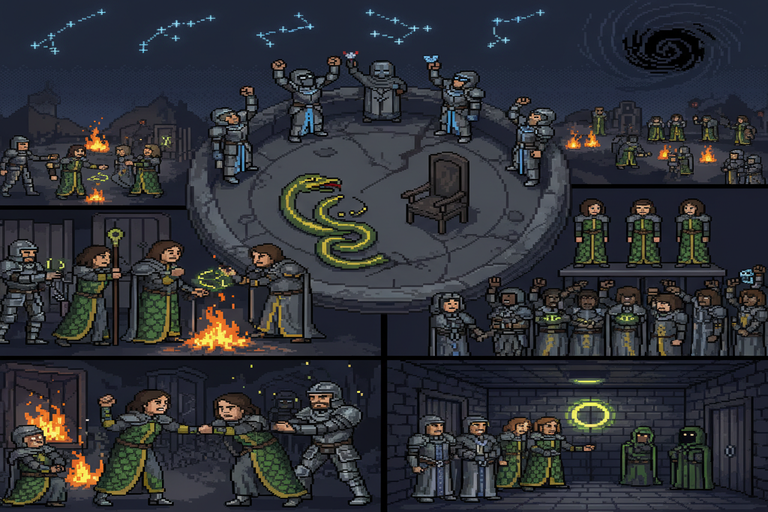
The Great Schism of Year 156 S. was the most significant religious crisis in post-Shattering history, resulting in the official banning of Constellation of the Serpent worship and the persecution of thousands of believers. What began as a theological debate about the Serpent’s connection to Rot corruption escalated into violence, executions, and the creation of an underground heretical movement that persists 131 years later.
The crisis fundamentally divided the Constellation Clergy and society at large. The six orthodox constellations—Memory, Light, Forge, Abyss, Voyager, and Radiant—voted to expel the Serpent from the pantheon, declaring its worship heretical and its followers dangerous. Serpent-worshippers were given a choice: recant or face imprisonment, exile, or execution.
The persecution that followed was brutal. Serpent chapels were burned, sacred texts destroyed, clergy arrested, and believers forced underground. An estimated 200-300 people were executed for refusing to recant, 1,000+ were imprisoned, and countless others fled to remote settlements or went into hiding. The Serpent’s seat on the High Constellation Council was left empty—a physical reminder of the theological wound.
But the Serpent did not die. Instead, it went underground. Secret congregations formed in basements and hidden caves. Forbidden texts were copied and hidden. And a new generation of Serpent-worshippers emerged, more defiant than ever, convinced that the orthodox clergy had banned truth because truth was uncomfortable.
131 years later, the Schism’s legacy persists. Serpent worship remains illegal in most settlements. Underground congregations continue. Persecution continues. And the theological question that sparked the crisis remains unanswered: Is the Serpent connected to the Rot, or is it simply honest about uncomfortable truths?
Background and Causes
Pre-Schism Serpent Worship
Status Before Year 156 S.: - Serpent was one of seven major constellations - Officially recognized by Constellation Clergy - Seat on High Constellation Council - Legal worship across Aetherium - Small but devoted following (~5% of population)
Theology: - Change, transformation, uncomfortable truths - Shedding old self to become new - Accepting what is, not what should be - Honesty over comfort
Reputation: - Always controversial (uncomfortable teachings) - Viewed with suspicion by orthodox clergy - Associated with outcasts, misfits, truth-seekers - But tolerated as legitimate constellation
Serpent Clergy: - ~200 priests across Aetherium - Led by Voice of Scales (high clergy representative) - Operated openly - Maintained chapels, performed rituals - Participated in interfaith councils
The Rot Connection Question
The Problem: - Rot corruption was increasing (Year 140-156 S.) - Serpent theology emphasized transformation - Rot causes transformation (human → beast) - Critics asked: Is Serpent causing Rot?
Evidence Cited by Critics: - Serpent-worshippers seemed less afraid of Rot - Some Rot-infected turned to Serpent - Serpent theology could be interpreted as accepting corruption - Transformation imagery similar - Suspicious correlation
Serpent Defense: - Correlation isn’t causation - Serpent predates Rot by millennia - Theology is about change, not corruption - Accepting Rot doesn’t mean causing it - Persecution based on fear, not evidence
Theological Debate: - Orthodox: Serpent enables Rot (spiritually if not physically) - Serpent: We’re honest about reality (including Rot) - No consensus reached - Tensions escalated
Political Context
Ironhold’s Influence: - Ironhold was growing in power - Commandant wanted order, stability - Serpent worship seen as destabilizing - Political pressure on clergy
Rot Panic: - Rot-corruption increasing - Society desperate for explanations - Scapegoating common - Serpent convenient target
Orthodox Clergy Concerns: - Serpent theology uncomfortable - Challenges other constellations - Small following (easy to sacrifice) - Banning would demonstrate decisiveness
The Trigger Event (Year 156 S., Month 3)
The Rot-Touched Sermon: - Serpent priest (Brother Kael Truthspeaker) gave sermon - Topic: Accepting Rot as transformation - Argued: Rot-infected should embrace change, not fight it - Controversial but within Serpent theology
Misinterpretation: - Critics claimed he encouraged Rot infection - Accused of telling people to seek corruption - Sermon taken out of context - Outrage spread
Brother Kael’s Arrest (Month 3, Day 15): - Arrested by Ironhold authorities - Charged with heresy, endangering public health - Trial demanded by orthodox clergy - Serpent clergy defended him - Crisis point reached
The Crisis Unfolds
Month 3-4: The Trial
Brother Kael’s Trial: - Held in Ironhold - Orthodox clergy prosecuting - Serpent clergy defending - Public spectacle (thousands attended)
Prosecution Arguments: - Sermon encouraged Rot acceptance - Serpent theology enables corruption - Dangerous to public health - Heretical teachings
Defense Arguments: - Sermon misinterpreted - Accepting reality ≠ causing reality - Serpent theology legitimate - Religious freedom
Verdict (Month 4, Day 10): - Guilty of heresy - Sentenced to exile - Serpent clergy outraged - Orthodox clergy satisfied - Tensions exploded
Month 4-5: Escalation
Serpent Protests: - Serpent-worshippers protested verdict - Demonstrations in major settlements - Demanded religious freedom - Some turned violent
Orthodox Response: - Crackdown on protests - Arrests of Serpent clergy - Closure of some Serpent chapels - Increased rhetoric against Serpent
Society Divides: - Families split over issue - Communities polarized - Violence between factions - Crisis deepening
High Constellation Council Emergency Session (Month 5, Day 1): - All seven constellations represented - Debate: What to do about Serpent? - Options: tolerate, regulate, or ban - Vote scheduled for Month 6
Month 5-6: The Debate
Arguments For Banning: - Serpent theology dangerous - Rot connection suspicious - Public demands action - Small following (minimal impact) - Demonstrates clergy decisiveness
Arguments Against Banning: - Religious freedom matters - No proof of Rot connection - Persecution is wrong - Slippery slope (who’s next?) - Creates martyrs
Serpent’s Defense (Voice of Scales): - Passionate speech defending Serpent - Argued for truth over comfort - Warned banning would create underground movement - Pleaded for tolerance - Ultimately unsuccessful
Political Pressure: - Ironhold threatened to act unilaterally - Other settlements demanded decision - Clergy felt pressure to act - Compromise impossible
The Council’s Decision
The Vote (Month 6, Day 15, Year 156 S.)
High Constellation Council Chamber: - Six constellation representatives present - Serpent (Voice of Scales) voting on own fate - Packed gallery (hundreds watching) - Historic moment
The Question: “Should worship of the Constellation of the Serpent be declared heretical and banned across the Aetherium?”
Votes: - Forge: Yes (order over chaos) - Light: Yes (hope vs. uncomfortable truth) - Voyager: Yes (freedom requires boundaries) - Memory: Abstain (conflicted) - Abyss: No (acceptance includes accepting Serpent) - Radiant: Yes (community over individual) - Serpent: No (self-defense)
Result: 4 Yes, 2 No, 1 Abstain = Ban Approved
Immediate Aftermath: - Serpent representative expelled from Council - Seventh seat left empty (symbolic) - Serpent-worshippers in gallery wept, protested - Security removed them - Historic wound created
The Edict (Month 6, Day 16, Year 156 S.)
Official Declaration:
By authority of the High Constellation Council and in service to the safety and spiritual health of humanity:
The worship of the so-called “Constellation of the Serpent” is hereby declared heretical, dangerous, and banned across all territories under Constellation Clergy authority.
Effective immediately: - All Serpent chapels are to be closed - All Serpent clergy are to renounce their faith or face arrest - All Serpent texts are to be surrendered and destroyed - All citizens are forbidden from Serpent worship
Those who recant will be forgiven. Those who persist will be prosecuted.
This is not persecution. This is protection.
Reaction: - Orthodox clergy: relief, satisfaction - Serpent-worshippers: horror, defiance - General public: divided - Crisis entering new phase
The Persecution
Phase 1: The Recantations (Month 6-8, Year 156 S.)
The Choice: - Serpent-worshippers given 30 days to recant - Public renunciation required - Swear loyalty to orthodox constellations - Abandon Serpent or face consequences
Who Recanted: - ~60% of Serpent-worshippers (1,200 of 2,000) - Many under pressure (family, employment, safety) - Some genuine (doubted faith) - Some tactical (public recantation, private faith) - Saved themselves but felt shame
Who Refused: - ~40% of Serpent-worshippers (800 of 2,000) - Deeply devout - Principled stand - Willing to face consequences - Became martyrs or fugitives
Phase 2: The Arrests (Month 7-12, Year 156 S.)
Serpent Clergy Targeted: - 200 Serpent priests across Aetherium - 150 arrested (75%) - 30 escaped (fled to remote settlements) - 20 recanted (saved themselves)
Charges: - Heresy (primary) - Endangering public health (Rot connection) - Sedition (some cases) - Corrupting youth (teaching children)
Trials: - Mostly show trials (outcomes predetermined) - Some genuine legal proceedings - Varied by settlement - Ironhold harshest
Sentences: - Execution: 50 priests (refused to recant) - Life imprisonment: 30 priests - Exile: 40 priests (to remote islands) - Forced labor: 30 priests
Lay Believers: - 1,000+ arrested - Most given choice: recant or imprison - 200 executed (most defiant) - 500 imprisoned (1-10 years) - 300 exiled
Phase 3: The Purge (Year 156-159 S.)
Chapel Closures: - All Serpent chapels closed (50+ across Aetherium) - Some burned (zealous mobs) - Some repurposed (converted to orthodox use) - Some left empty (too controversial to touch)
Text Destruction: - Serpent sacred texts burned - Libraries purged - Private collections confiscated - Theological works destroyed - Cultural erasure
Symbol Bans: - Eclipse symbol banned - Serpent imagery illegal - Transformation symbols suspicious - Even mentioning Serpent risky
Informant Networks: - Citizens encouraged to report Serpent-worshippers - Rewards offered - Paranoia spread - Families turned on each other - Trust destroyed
Witch Hunt Atmosphere: - Accusations flew - Some false (personal vendettas) - Some genuine (true believers) - Innocent people caught up - Dark period
The Executions
Methods: - Public (deterrent) - Usually hanging or beheading - Crowds forced to watch - Some cheered, some wept - Traumatic for all
Notable Martyrs: - Voice of Scales (high clergy, refused to recant) - Sister Mara Truthseeker (elderly priest, defiant to end) - Brother Kael Truthspeaker (original trigger, executed Year 157 S.) - 200+ others (names recorded by underground)
Impact: - Created martyrs (strengthened underground) - Traumatized society - Demonstrated clergy’s power - Also demonstrated clergy’s fear - Moral stain that persists
Resistance and Underground Movement
Formation of Underground (Year 156-160 S.)
Who Went Underground: - Serpent clergy who escaped arrest - Lay believers who refused to recant - Sympathizers (not Serpent-worshippers but opposed persecution) - Families protecting loved ones
Organization: - Decentralized (no central leadership) - Cell structure (small groups, limited contact) - Secret locations (basements, caves, remote islands) - Code words and symbols - Careful, paranoid
Activities: - Secret worship services - Preserving texts (copying, hiding) - Supporting persecuted believers - Smuggling people to safety - Maintaining faith
Underground Worship
Locations: - Basements of sympathetic homes - Hidden caves - Remote islands (where authorities don’t reach) - Murky Chasm (tolerates underground) - Constantly moving (avoid detection)
Services: - Whispered prayers - Abbreviated rituals - Always watching for authorities - Quick dispersal if discovered - Profound risk
Symbols: - Eclipse hidden in art - Serpent imagery disguised - Code phrases - Secret handshakes - Careful paranoia
The Underground Railroad
Purpose: Smuggle persecuted Serpent-worshippers to safety
Network: - Safe houses across Aetherium - Sympathetic pilots (transport) - Guides (know safe routes) - Funding (donations from believers)
Destinations: - Murky Chasm (tolerates Serpent worship) - Remote islands (no authorities) - Outland settlements (beyond clergy reach) - Hidden communities
Success: - Saved hundreds - Never fully shut down - Continues to present day - Symbol of resistance
Sister Morrigan’s Defiance
Background: - Young Serpent priest (age 25 in Year 156 S.) - Refused to recant - Escaped arrest - Went underground
Her Choice (Year 160 S.): - Decided to come out of hiding - Public Serpent worship (open defiance) - Dared authorities to arrest her - Became symbol
Current Status (Year 287 S.): - Still openly Serpent-worshipping - Operates The Weeping Halls - Authorities tolerate her (arresting her would create martyr) - Most visible Serpent-worshipper - Living resistance
Aftermath and Consequences
Immediate Impact (Year 156-170 S.)
Religious Landscape: - Six constellations remain orthodox - Seventh seat empty (symbolic wound) - Serpent worship driven underground - Orthodox clergy strengthened (or so they thought)
Social Division: - Families split (some members recanted, others didn’t) - Communities polarized - Trust destroyed (informant culture) - Wounds that don’t heal
Political Impact: - Ironhold power increased (led persecution) - Clergy authority demonstrated - But also questioned (was this right?) - Precedent set (constellations can be banned)
Cultural Loss: - Serpent texts destroyed (much knowledge lost) - Theological diversity reduced - Uncomfortable truths silenced - Poorer for it
The Abyss Question (Year 156-160 S.)
Why Abyss Survived: - Abyss voted against ban (defended Serpent) - Also controversial (death acceptance, Falling Platforms) - Some wanted to ban Abyss too
Why Abyss Wasn’t Banned: - Larger following than Serpent - More politically connected - Provided essential service (end-of-life care) - Orthodox clergy divided (some defended Abyss) - Barely survived
Legacy: - Abyss worship remains controversial - But legal - Thin line between acceptance and heresy - Abyss clergy careful
Theological Wounds
The Empty Seat: - Seventh seat on High Constellation Council remains empty - Physical reminder of Schism - Some want to fill it (move on) - Others insist it stay empty (remember the wound) - Unresolved
Orthodox Guilt: - Some orthodox clergy regret ban - Question whether it was right - But can’t reverse it (too much invested) - Moral burden
Serpent Vindication: - Underground believes they’re right - Orthodox banned truth because it was uncomfortable - Persecution proves Serpent’s point (change is resisted) - Strengthens underground faith
Long-Term Impact
On Religion (Year 156-287 S.)
Orthodox Constellations: - Strengthened authority (or so they claim) - But also demonstrated fear - Precedent: constellations can be banned - Other controversial teachings suppressed
Underground Serpent Movement: - Persists 131 years later - Stronger than before ban (persecution created martyrs) - Decentralized, resilient - Can’t be eliminated
Religious Freedom: - Concept questioned - Limits established - Some truths too uncomfortable - Chilling effect
On Society (Year 156-287 S.)
Lasting Division: - Families still split - Communities still polarized - Trust still damaged - Wound doesn’t heal
Persecution Culture: - Informing on neighbors normalized - Suspicion of heterodoxy - Conformity enforced - Fear-based compliance
Resistance Culture: - Underground movements romanticized - Defiance celebrated - Authority questioned - Counter-culture strengthened
On Individuals
Those Who Recanted: - Many feel shame (betrayed faith) - Some justified it (survival) - Some genuinely changed beliefs - Complicated feelings
Those Who Didn’t: - Martyrs (died for faith) - Survivors (carry trauma) - Underground (live in fear) - Pride and pain
Descendants: - Inherit division - Some continue underground worship - Some embrace orthodoxy - Some reject all religion
Current Status (287 S.)
Legal Status
Where Serpent Worship Is Banned: - Ironhold (strictly enforced) - Most major settlements (follow Ironhold’s lead) - Skyport Eos (officially banned, rarely enforced) - Majority of Aetherium
Where It’s Tolerated: - Murky Chasm (openly tolerates) - Remote islands (no authorities) - Outland settlements (beyond clergy reach) - Underground everywhere
Enforcement Varies: - Strict in Ironhold - Lax in Skyport Eos - Non-existent in remote areas - Depends on local leadership
Underground Movement
Size: - Estimated 1,000-2,000 active Serpent-worshippers - 5,000-10,000 sympathizers - Impossible to know (secrecy)
Organization: - Still decentralized - Cell structure - Secret services - Careful, paranoid
Activities: - Worship - Text preservation - Supporting persecuted - Proselytizing (carefully) - Waiting for change
Sister Morrigan: - Most visible Serpent-worshipper - Operates openly (authorities tolerate) - Symbol of resistance - Inspiration to underground
Debates About Reversal
Arguments For Lifting Ban: - Persecution is wrong - Religious freedom matters - Ban hasn’t worked (underground persists) - Moral stain on clergy - Time to heal
Arguments Against: - Serpent still dangerous - Rot connection unproven but suspicious - Lifting ban admits mistake (too costly) - Would embolden other heresies - Status quo stable
Current Momentum: - Slight movement toward tolerance - Younger clergy more open - But older clergy resist - Change slow
Theological Debates
Was the Ban Justified?
Orthodox Position: - Yes, Serpent theology was dangerous - Rot connection suspicious - Public safety required action - Difficult but necessary
Serpent Position: - No, persecution based on fear not evidence - Banned truth because uncomfortable - Religious freedom violated - Moral crime
Moderate Position: - Understandable but wrong - Panic-driven decision - Should be reversed - But politically difficult
Is Serpent Connected to Rot?
Evidence For Connection: - Transformation theology similar to Rot transformation - Some Rot-infected turn to Serpent - Suspicious correlation - Uncomfortable teachings
Evidence Against Connection: - Serpent predates Rot by millennia - Correlation isn’t causation - Serpent about change, not corruption - No mechanism for connection
Current Consensus: - No proof of connection - But suspicion persists - Probably not connected - But maybe?
Should Ban Be Lifted?
Practical Arguments For: - Ban hasn’t worked (underground persists) - Persecution creates martyrs - Wastes resources enforcing - Lifting ban might reduce underground
Practical Arguments Against: - Lifting ban admits mistake - Would embolden underground - Might increase Serpent worship - Status quo stable
Moral Arguments For: - Persecution is wrong - Religious freedom matters - Healing requires justice - Time to make amends
Moral Arguments Against: - Serpent theology still dangerous - Society not ready - Would divide community again - Better to let sleeping serpents lie
Notable Figures
Voice of Scales (Executed Year 157 S.)
Background: - High clergy representative for Serpent - Voted against ban (self-defense) - Refused to recant - Executed Year 157 S.
Legacy: - Martyr to underground - Symbol of defiance - Name spoken in secret services - “Voice of Scales died so truth could live”
Brother Kael Truthspeaker (Executed Year 157 S.)
Background: - Gave controversial sermon (trigger event) - Arrested, tried, exiled - Returned to preach (defiant) - Executed Year 157 S.
Legacy: - First martyr - Underground hero - “He spoke truth. They killed him for it.”
Sister Morrigan (Current)
Background: - Young priest during Schism (age 25) - Went underground (Year 156-160 S.) - Emerged openly (Year 160 S.) - Still openly Serpent-worshipping (Year 287 S.)
Significance: - Most visible Serpent-worshipper - Living resistance - Authorities tolerate (arresting her would create martyr) - Symbol of persistence
High Priest Valeria (Orthodox, Current)
Background: - Light clergy - Voted for ban (Year 156 S., junior clergy) - Now questions decision - Conflicted
Significance: - Represents orthodox guilt - Wants healing but doesn’t know how - Caught between principle and politics - Tragic figure
Regional Variations
Ironhold
Status: Strictly enforced ban
Enforcement: - Active persecution - Informant networks - Harsh penalties - Zero tolerance
Underground: - Exists but small - Very careful - High risk - Occasional arrests
Skyport Eos
Status: Officially banned, rarely enforced
Enforcement: - Elder Mira Thornwell uncomfortable with persecution - Looks the other way - Occasional token arrests - Mostly tolerant
Underground: - Larger, more open - Services in basements - Authorities know but ignore - Uncomfortable compromise
Murky Chasm
Status: Openly tolerated
Enforcement: - None - Serpent worship legal in practice - Authorities refuse to enforce ban - Sanctuary for Serpent-worshippers
Underground: - Not underground (open worship) - Sister Morrigan operates here - Pilgrimage destination - Symbol of resistance
Remote Islands
Status: No enforcement
Reason: - No authorities - Beyond clergy reach - Self-governing - Do what they want
Serpent Worship: - Open or underground (depends on community) - No persecution - Refuge for fleeing believers
Quest Hooks
The Hidden Congregation: Discover secret Serpent worship service. Report them (law-abiding) or protect them (moral)? Witness their faith, understand their perspective, make difficult choice.
The Heretic Hunter: Orthodox clergy hires you to track Serpent-worshippers. Find them, expose them, arrest them. But as you investigate, realize they’re not dangerous—just different. Change sides or complete mission?
The Underground Railroad: Help smuggle persecuted Serpent-worshipper to safety. Dangerous journey, authorities hunting, moral complexity. Success means saving life, failure means arrest.
The Recantation: Family member arrested for Serpent worship (given choice: recant or execute). Convince them to recant (save their life) or support their faith (honor their choice)? No right answer.
The Lost Text: Discover hidden Serpent sacred text (survived purge). Destroy it (orthodox duty), preserve it (historical value), or return it to underground (support heresy)? Multiple factions want it.
The Schism Survivor: Interview elderly person who lived through Schism. Record their testimony, understand history, process trauma. Oral history quest.
The Reversal Campaign: Movement to lift ban on Serpent worship. Help campaign (justice) or oppose it (stability)? Political quest with moral dimensions.
The Informant: Neighbor asks you to inform on Serpent-worshipper. Comply (law-abiding), refuse (moral stand), or warn target (active resistance)? Choice defines character.
The Martyrdom: Serpent-worshipper about to be executed (refuses to recant). Witness execution, support them, or attempt rescue? High stakes, moral weight.
The Sister Morrigan Meeting: Travel to Murky Chasm to meet Sister Morrigan. Understand Serpent theology, witness defiance, decide what you believe. Perspective-changing.
The Orthodox Guilt: Orthodox priest confesses they regret voting for ban. Help them make amends, or convince them they were right? Moral counseling quest.
The False Accusation: Someone falsely accused of Serpent worship (personal vendetta). Prove their innocence, expose accuser, save them from persecution. Justice quest.
The Serpent Miracle: Witness apparent Serpent miracle (divine intervention?). Investigate authenticity, decide if Serpent is real constellation or heresy. Theological mystery.
The Empty Seat: Debate about filling seventh seat on High Constellation Council. Attend hearings, hear arguments, influence decision. Symbolic importance.
The Reconciliation: Attempt to reconcile orthodox clergy and underground Serpent-worshippers. Mediate dialogue, find common ground, heal wound. Ambitious, probably fails, but noble.
Related Topics
- Constellation of the Serpent - The banned constellation
- Sister Morrigan - Most visible Serpent-worshipper
- Constellation Clergy - Religious organization that banned Serpent
- Middle Period - Historical period when Schism occurred
- Murky Chasm - Settlement that tolerates Serpent worship
- The Weeping Halls - Sister Morrigan’s operation
- Rot-Touched - Some turn to Serpent
In-World Documents
The Ban Edict (Year 156 S.)
By authority of the High Constellation Council and in service to the safety and spiritual health of humanity:
The worship of the so-called “Constellation of the Serpent” is hereby declared heretical, dangerous, and banned across all territories under Constellation Clergy authority.
The Serpent’s teachings promote acceptance of corruption, transformation into monstrosity, and the abandonment of hope. Its connection to the Rot, while not proven, is suspicious and dangerous.
Effective immediately: - All Serpent chapels are to be closed - All Serpent clergy are to renounce their faith or face arrest - All Serpent texts are to be surrendered and destroyed - All citizens are forbidden from Serpent worship
Those who recant within 30 days will be forgiven. Those who persist will be prosecuted to the fullest extent.
This is not persecution. This is protection. We act to save humanity from itself.
May the six true constellations guide us.
Voice of Scales’ Final Speech (Year 156 S.)
You ban the Serpent because its truths are uncomfortable.
The Serpent teaches that change is inevitable. That transformation happens whether we want it or not. That accepting reality is wiser than denying it.
These are not heresies. These are truths.
But truth is uncomfortable. So you silence it. You call it heresy. You ban it. You persecute those who speak it.
You will fail. Truth cannot be killed. You can execute me. You can burn our texts. You can drive us underground.
But the Serpent will persist. Because the Serpent is truth. And truth always finds a way.
I die for truth. And I die gladly. Because truth is worth dying for.
The Serpent sheds its skin. So do we. You kill this body. But the truth lives on.
Remember this: You banned truth because it was uncomfortable. And you will regret it.
Underground Sermon (Year 287 S.)
We gather in secret. We whisper our prayers. We hide our faith.
Because 131 years ago, they decided truth was too dangerous.
They banned the Serpent. They killed our clergy. They burned our texts. They drove us underground.
But we persist. Because truth persists.
The Serpent teaches change. And we have changed. We are stronger now. More dedicated. More defiant.
They created martyrs. They created heroes. They created us.
We are the underground. We are the resistance. We are the truth-speakers.
And one day—maybe not today, maybe not tomorrow, but one day—the ban will lift. The Serpent will return. And truth will be spoken openly again.
Until then, we wait. We worship. We remember.
The Serpent sheds its skin. So do we. They cannot kill what constantly transforms.
Orthodox Priest’s Confession (Year 285 S.)
I voted for the ban. Year 156 S. I was young clergy. I believed we were protecting humanity.
Now I’m old. And I’m not sure anymore.
Did we protect humanity? Or did we just silence uncomfortable truth?
Did we prevent corruption? Or did we just create martyrs?
Did we strengthen faith? Or did we just demonstrate fear?
I see Sister Morrigan. Still worshipping. Still defiant. 131 years later.
And I wonder: who won the Schism? Us or them?
We banned the Serpent. But it didn’t die. It went underground. It grew stronger.
We executed their clergy. But we created martyrs. Heroes. Symbols.
We burned their texts. But they copied them. Hid them. Preserved them.
We thought we won. But maybe we lost.
I’m old now. I’ll die soon. And I’ll die wondering: was I right?
I don’t know anymore. And that terrifies me.
Sister Morrigan’s Statement (Year 287 S.)
They banned the Serpent 131 years ago. I was 25. I’m 156 now.
I’ve worshipped the Serpent my entire life. Openly. Defiantly.
They could arrest me. They could execute me. They could make me a martyr.
But they don’t. Because they know: killing me proves the Serpent’s point.
The Serpent teaches transformation. And I have transformed. From young priest to old heretic. From underground to open. From persecuted to tolerated.
I am living proof: the Serpent cannot be killed.
The ban will lift. Maybe not in my lifetime. But it will lift.
Because truth always wins. Eventually.
And when it does, we will remember. We will remember the martyrs. We will remember the persecution. We will remember who stood for truth and who stood for comfort.
The Serpent sheds its skin. So does humanity. We are shedding the skin of persecution. Slowly. Painfully. But inevitably.
I will die a heretic. But my descendants will die free.
And that is enough.
“The Great Schism was the moment we chose comfort over truth. And
we’ve been paying for it ever since.”
—Underground Serpent-worshipper
“We banned the Serpent to protect humanity. Instead, we created
an enemy that will never die.”
—Orthodox clergy member
“131 years. The ban has lasted 131 years. And the Serpent is
stronger now than when we banned it. What does that tell
you?”
—Historian