Middle Period
Period: 134-284 S. (150 years)
Themes: Expansion, organization, cultural identity
formation
Achievement: Survival → Civilization
“We stopped running from the Aether and started living in it.”
Quick Reference
|| Attribute | Details | ||———–|———| || Timespan | 134-284 S. (150 years) | || Population | 500,000 → 300,000 (declining) | || Key Milestone | First Void-Kin generation reaches adulthood | || Major Settlements | Skyport Eos, Ironhold, Glimmering Spire established | || Defining Event | The Great Schism (156 S.) | || Economic System | Sky-Guild dominance established | || Cultural Shift | From survivors to citizens | || Rot Status | Accelerating (73 S. Luminara falls, pattern continues) |
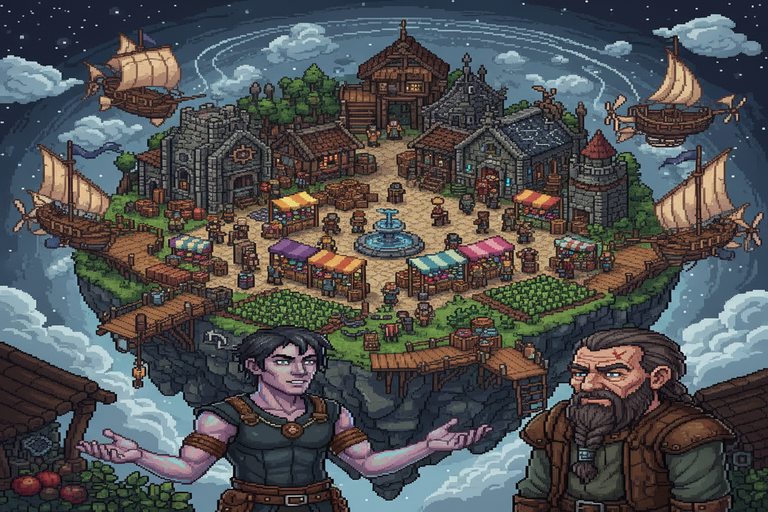 The Middle Period
- Building Civilization
The Middle Period
- Building Civilization
Overview
The Middle Period marks humanity’s transformation from desperate survivors clinging to fragments into organized societies building something new. This was the age of construction—not just of buildings and ships, but of institutions, traditions, and identity.
When the period began (134 S.), the first generation born entirely in the Aetherium—the Void-Kin—reached adulthood. These young people had never known solid ground, never seen the old world, never experienced life before the Shattering. Their perspective was fundamentally different: the Aether wasn’t a catastrophe to endure but simply reality.
This generational shift catalyzed everything that followed. The Void-Kin asked uncomfortable questions: Why cling to pre-Shattering traditions? Why mourn a world we never knew? Why not build something better?
Their elders resisted. Tensions flared. But gradually, inevitably, change came.
By the period’s end (284 S.), the Aetherium had transformed. Trade networks connected dozens of settlements. The Sky-Guild controlled economic life. The Clergy had formalized doctrine and hierarchy. Outland Clans had carved territories. The Black Sky Cartel operated openly in the Murk. Civilization existed—imperfect, fragile, but real.
The cost was high. Population declined from 500,000 to 300,000 despite relative stability. The Rot consumed islands faster than new ones were discovered. The constellations grew more distant, their blessings more ambiguous. Pre-Shattering knowledge continued fading as the last survivors of Year 0 died.
But humanity endured. And for the first time since the Shattering, people dared to hope the future might be better than the past.
The Generational Divide (134-160 S.)
The Void-Kin Come of Age
Year 134 S.: The first children born in the Aetherium reach adulthood (age 15 by most cultural standards). These Void-Kin—named for being born in the void—number approximately 50,000 across all settlements.
Their Perspective: - The Aether is normal, not terrifying - Pre-Shattering world is mythology, not memory - Survival strategies are outdated traditions - Change is opportunity, not betrayal
Elder Response: Horror, confusion, resistance - “They don’t understand what we lost” - “They’re reckless, disrespectful” - “They’ll get us all killed” - “The old ways kept us alive”
The Conflict: Every settlement experienced version of this tension - Void-Kin wanted to explore dangerous regions (Periphery, Deeps) - Elders forbade it (too risky) - Void-Kin questioned religious doctrine (constellations seemed distant, uncaring) - Clergy condemned them (heresy) - Void-Kin proposed radical economic changes (shared resources, collective ownership) - Merchants resisted (threatens established power)
The Eos Riots (142 S.)
Trigger: Elder Council in Skyport Eos banned Void-Kin from voting until age 25 (up from 15).
Response: 200+ young people occupied Market Square, demanding equal rights.
Standoff: Three days. Elders refused to negotiate. Youth refused to leave.
Resolution: Compromise—voting age set at 18. Both sides claimed victory. Neither was satisfied.
Legacy: First major political action by Void-Kin generation. Established pattern: youth push for change, elders resist, compromise emerges slowly.
Cultural Innovations
The Void-Kin brought new perspectives that gradually reshaped society:
Language: Common Tongue evolved rapidly - Void-Kin introduced new words for Aether phenomena - Old Luminar terms fell out of use - Slang emerged: “edge-walker” (risk-taker), “anchor-bound” (conservative), “void-touched” (blessed/cursed by Aether)
Art: New aesthetic emerged - Pre-Shattering art mourned loss (paintings of solid ground, green fields) - Void-Kin art celebrated present (Aether-scapes, constellation patterns, abstract void) - Music shifted from dirges to ballads to work songs
Philosophy: Fundamental shift - Elders: “We must preserve what we were” - Void-Kin: “We must become what we need to be” - This tension never fully resolved
The Great Schism (156 S.)
Background: The Serpent Question
Since the Shattering, the Constellation of the Serpent had been controversial: - Some saw it as corruption personified (evil) - Others saw it as transformation and truth (misunderstood) - The Clergy officially tolerated worship but discouraged it
By 150 S., Serpent worship was growing, especially among: - The desperate (promised power, relief from suffering) - Intellectuals (offered forbidden knowledge) - The Rot-Touched (only constellation that acknowledged their condition)
The Crisis: Year 155 S., Serpent-worshippers in Glimmering Spire performed ritual involving voluntary Rot-infection. Three participants died horribly. Seven survived but transformed.
Public Reaction: Horror, outrage, demands for action.
The Edict of Condemnation
Year 156 S.: High Constellation Council issued formal edict: - Serpent worship declared heresy - Existing Serpent chapels to be destroyed - Serpent-worshippers given 30 days to recant or face exile - Possession of Serpent texts punishable by imprisonment
Enforcement: Varied by settlement - Skyport Eos: Strict (12 exiled, 1 chapel burned) - Ironhold: Brutal (23 executed, 2 chapels destroyed) - Outlands: Ignored (clans didn’t recognize Clergy authority) - Murky Chasm: Laughed (Serpent worship continued openly)
The Purges
Duration: 156-159 S. (three years of violence)
Methods: - Inquisitors investigated suspected heretics - Trials held (often perfunctory) - Punishments: Exile (most common), imprisonment (rare), execution (rarest but memorable)
Resistance: Serpent-worshippers fought back - Underground networks formed - Secret chapels hidden - Some fled to Murk (founding Murky Chasm’s Rot-Touched Enclave) - Others went deeper underground
Casualties: Estimated 500-800 killed or exiled
Legacy: - Serpent worship never eliminated (just hidden) - Clergy authority established (could enforce doctrine) - Seeds of Rot-Touched faction planted - Religious tolerance decreased - Trust in Clergy damaged (many saw purges as excessive)
Theological Debates
The Schism forced uncomfortable questions:
The Serpent’s Nature: - Is it truly evil, or just honest about reality’s darkness? - Does it cause corruption, or merely acknowledge it? - Are its promises lies, or truths we fear?
Clergy Authority: - Can mortals declare constellation evil? - Who decides which constellations are legitimate? - What if the Serpent is right and the others lie?
Freedom vs. Safety: - Should dangerous beliefs be banned? - Is forced orthodoxy better than heretical freedom? - Who protects society from itself?
No Consensus: These questions remained (and remain) unanswered.
Economic Consolidation (160-200 S.)
The Sky-Guild Ascendant
Background: The Sky-Guild began (120 S.) as loose merchant association. By 160 S., it was becoming something more.
Key Developments:
Year 165 S.: Guild Charter formalized - Membership requirements standardized - Fee structure established - Arbitration courts created - Monopoly on certain trade routes claimed
Year 172 S.: First Guild Wars - Independent merchants challenged Guild monopoly - Economic warfare (price-cutting, route blocking) - Occasional violence (ships sabotaged, merchants “disappeared”) - Guild won (superior resources, organization)
Year 183 S.: Guild-Master position created - Previously, Guild led by council of senior merchants - New system: Single leader elected every 10 years - First Guild-Master: Torven Ironhand (Ironhold merchant, ruthless, effective)
Year 195 S.: Guild Coin introduced - Standardized currency (replaced barter, local coins) - Backed by Guild’s resources - Gradually became universal (economic pressure forced adoption)
Impact: By 200 S., Guild controlled: - 80% of inter-island trade - Most airship manufacturing - Pricing for major commodities - Access to certain islands (Guild permission required)
Resistance: Outland Clans, independent merchants, some settlements - Maintained barter economies - Refused Guild membership - Operated outside Guild networks - Guild tolerated this (as long as they stayed small)
The Ironhold Boom
Discovery (150 S.): Rich iron deposits found on massive plateau
Settlement (150-170 S.): Mining colony established - Initially 200 people (miners, support staff) - Grew rapidly (1,000 by 160 S., 5,000 by 180 S.) - Attracted: Miners, blacksmiths, merchants, soldiers
Fortification (170-190 S.): Military presence increased - Walls built (30 meters high, ironwood reinforced) - Guard force established (500+ soldiers by 190 S.) - Commandant appointed (military governor)
Economic Impact: Iron transformed Aetherium economy - Better tools (farming, construction) - Better weapons (Rot-Beast hunting, defense) - Better airships (iron hulls, reinforced frames) - Ironhold became second-largest settlement (after Eos)
Social Impact: Ironhold culture distinct - Militaristic (Commandant ruled, not council) - Hierarchical (strict class system) - Pragmatic (survival over idealism) - Authoritarian (order over freedom)
Tensions: Ironhold vs. Everyone - Eos: Political rivalry (which settlement leads Aetherium?) - Guild: Economic rivalry (Ironhold wanted better trade terms) - Outlands: Cultural rivalry (freedom vs. control) - These tensions persist to present day
Trade Network Expansion
Year 175 S.: Major trade routes established - Eos-Ironhold Run (primary route, 3-7 days) - Farming Circuit (food supply, 15-day loop) - Spire Route (scholars, alchemists)
Year 189 S.: Periphery expeditions begin - Motivated by: Resource scarcity, curiosity, desperation - Funded by: Guild (seeking new markets), Clergy (seeking answers), adventurers (seeking fortune) - Results: Mixed (some islands found, many ships lost)
Year 192 S.: Floating Market established - Fleet of lashed-together airships - Travels along trade routes - Rare goods, exotic wares, information - Neutral ground (all factions welcome)
Impact: By 200 S., reliable trade network existed - Food moved from farms to cities - Iron moved from Ironhold to everywhere - Information moved through taverns and markets - Economy shifted from subsistence to specialization
The Rot Accelerates (200-250 S.)
The Pattern Emerges
Year 200 S.: Archivists begin systematic Rot-tracking - Data collected from all settlements - Islands lost per year counted - Patterns analyzed
Findings (published 205 S.): - Year 0-50 S.: 0.5 islands lost per year - Year 50-150 S.: 1 island lost per year - Year 150-200 S.: 2 islands lost per year - Projection: Acceleration continuing
Public Reaction: Denial, fear, anger - “Data is wrong” (it wasn’t) - “We’ll find solution” (they hadn’t) - “Constellations will save us” (they didn’t)
Major Losses
Year 215 S.: Clearwater consumed - Population: 800 (fishing settlement) - Warning signs: 2 years of increasing corruption - Evacuation: Partial (500 escaped, 300 stayed, hoping to save home) - Result: Island dissolved into Aether over 6 months - Survivors traumatized (many never recovered)
Year 227 S.: Thornspire falls - Population: 1,200 (agricultural settlement) - Warning signs: Minimal (corruption appeared suddenly) - Evacuation: None (too fast) - Result: 1,200 dead or transformed - Largest single loss since the Hollow (73 S.)
Year 234 S.: The Silence begins - Windcrest Island found empty (population 400, vanished overnight) - No Rot, no violence, no explanation - Just empty buildings, cold meals, abandoned lives - First of 23 recorded Silence events - More terrifying than Rot (at least Rot is understood)
Scientific Efforts
Alchemical Research (ongoing): - Rot-purification compounds developed - Success rate: ~30% on objects, ~10% on living tissue - Cost: Prohibitive (rare ingredients) - Availability: Limited to wealthy, important
Clergy Sanctification (ongoing): - Prayer-based Rot resistance - Success rate: Variable (depends on faith, constellation favor) - Cost: Free (but requires piety) - Availability: Anyone (but not everyone faithful)
Quarantine Protocols (established 218 S.): - Infected islands isolated - Travel banned - Supplies cut off - Harsh but effective (prevents spread)
The Failure: No cure found - Rot could be slowed, not stopped - Islands still falling - Population still declining - Hope fading
Cultural Maturation (200-250 S.)
The Arts Flourish
Literature: First post-Shattering novels published - The Last Anchor (223 S.): Romance set during Shattering - Void-Born (231 S.): Coming-of-age story of Void-Kin youth - The Hollow’s Song (241 S.): Horror novel (banned in some settlements)
Music: Distinct styles emerged - Sky-Sailor Ballads (work songs, sea shanties adapted to Aether) - Ironhold Marches (military music, drums and brass) - Outland Folk Songs (storytelling, oral tradition) - Constellation Hymns (religious music, increasingly melancholic)
Visual Arts: New aesthetic - Aether-scape paintings (capturing void’s beauty/terror) - Scrimshaw (Rot-Beast bone carving) - Tapestries (depicting pre-Shattering world from imagination) - Tattoos (each culture developed unique styles)
Performance: Theater emerged - Traveling troupes (moved between settlements) - Plays about Shattering (tragedy, catharsis) - Comedies (dark humor, coping mechanism) - Puppet shows (children’s entertainment, moral lessons)
Festivals Established
Constellation Day (annual, each constellation): - Celebration of specific constellation - Prayers, offerings, festivals - Community gathering - Different date for each constellation
Remembrance Day (Day 1, each year): - Mourning the Shattering - Solemn ceremonies - Names of dead spoken - Reflection on loss
First-Light (celebrating children who survive to age 5): - High infant mortality made this milestone significant - Community celebration - Gifts, blessings, hopes for future
Harvest Tide (celebrating successful crops): - Agricultural settlements especially - Thanksgiving for food - Feasting, music, joy - Rare moment of abundance
Language Evolution
Common Tongue dominance: By 250 S., 90% spoke Common Tongue - Old Luminar: Dead (except scholars, clergy) - Regional dialects: Emerging (Ironhold, Outlands, Murk) - Slang: Proliferating (especially among youth)
New Vocabulary: Aether life required new words - “Edge-walking”: Risk-taking behavior - “Anchor-bound”: Conservative, resistant to change - “Void-touched”: Blessed or cursed by Aether (ambiguous) - “Rot-whisper”: Hearing the Voice Beneath - “Star-blessed”: Constellation favor - “Fall-fear”: Phobia of Aether edges
The Old Anchor Breaks (243 S.)
The Myth of Permanence
Background: Some islands were “anchored”—stationary, not drifting - Cause unknown (pre-Shattering magic? Constellation blessing? Natural phenomenon?) - Anchored islands considered safe, permanent - Settlements built on anchored islands considered secure
The Old Anchor: Small island, 200m diameter - Anchored since Shattering (243 years stationary) - Population: 50 (farming community) - Considered safest island in Aetherium
The Breaking
Day 134, Year 243 S., dawn: The Old Anchor began moving
Witnesses: Nearby islands saw it drift - Slow at first (meters per hour) - Accelerating (kilometers per day) - No explanation, no warning
Population Response: Panic - Some fled immediately (took boats, abandoned homes) - Others stayed (refused to believe, hoped it would stop) - Debates, arguments, families torn apart
Day 147, Year 243 S.: The Old Anchor reached Aether-Storm - Island entered Howling Expanse - Violent currents, lightning, chaos - 23 people still aboard (refused to leave)
Day 148, Year 243 S.: The Old Anchor shattered - Storm tore island apart - Fragments scattered - 23 dead
The Impact
Psychological: If anchored islands can fail, nowhere is safe - Settlements on anchored islands panicked - Property values collapsed - Some evacuated preemptively - Others fortified, prepared
Theological: Why did constellations allow this? - Clergy had no answers - Faith shaken - Some abandoned religion - Others doubled down (faith intensified)
Scientific: Archivists studied phenomenon - Theories: Anchor-magic faded, constellation blessing withdrawn, natural cycle - No consensus - Recommendation: Don’t assume permanence
Legacy: The Old Anchor became metaphor - “The Anchor breaks” = false security exposed - Reminder: Nothing is permanent in Aetherium - Even safety is temporary
The First Hollow Transformation (267 S.)
Background: Rot Evolution
Pattern: Rot-corruption had stages - Early: Physical changes (skin, eyes) - Mid: Psychological changes (hearing Voice Beneath) - Late: Transformation into Hollow-Walker (barely human) - Final: Death or dissolution
Year 267 S.: Something new happened
The Event
Subject: Kael Rotborn (unfortunate name, given circumstances) - Age: 34 - Occupation: Merchant (Murky Chasm) - Corruption: Advanced (late stage, weeks from death)
Day 1: Kael entered coma - Body temperature dropped - Breathing slowed - Heartbeat barely detectable - Family prepared for death
Day 7: Kael awoke - Changed (physically, psychologically) - Eyes: Completely black - Skin: Translucent, veins visible - Voice: Layered (multiple tones simultaneously)
The Transformation: Kael was no longer human - Not Hollow-Walker (those were mindless) - Not dead (clearly alive, aware) - Something new: Conscious, intelligent, transformed
Abilities: Kael demonstrated powers - Could survive without food, water - Could sense Rot (knew where corruption was) - Could communicate with Hollow-Walkers (they obeyed him) - Could spread Rot through touch (chose not to, mostly)
The Implications
Scientific: Rot-corruption could lead to transcendence, not just death - Alchemists studied Kael (he allowed it) - Findings: His biology was fundamentally altered (no longer human by any definition) - Question: Was this evolution or abomination?
Religious: Clergy condemned Kael - Called him “Hollow-Souled” (no humanity remaining) - Demanded he be destroyed - Kael refused to die (couldn’t be killed easily)
Social: Rot-Touched saw hope - If Kael transformed and retained consciousness, maybe they could too - Pilgrims sought him (wanted to learn his secret) - Kael taught some (how to embrace corruption safely)
Kael’s Perspective (from interview, Year 268 S.): > “I’m not human anymore. I don’t mourn that. Humanity is limitation. I’ve transcended. The Voice Beneath showed me truth: flesh is temporary, consciousness is eternal. I’ve become what we’re all meant to become. The Rot isn’t death. It’s birth.”
Counter-Perspective (Clergy response): > “Kael Rotborn is lost. What wears his face is not him. It’s corruption wearing human skin. It speaks lies in his voice. Do not listen. Do not follow. Destroy it if you can.”
The Question: Who’s right? - No consensus - Kael still exists (Year 287 S., living in Murky Chasm) - Rot-Touched revere him - Everyone else fears him
Population Decline (200-250 S.)
The Numbers
Year 200 S.: Population census: ~300,000 Year 250 S.: Population census: ~250,000 Decline: 50,000 (16.7% loss in 50 years)
Causes
Rot Deaths: Estimated 20,000 - Direct corruption (transformed or killed) - Rot-Beast attacks - Island collapses (Thornspire, others)
Falls: Estimated 10,000 - Accidents (especially children, drunk adults) - Suicides (despair, Aether-Sickness) - Murders (pushed)
Other Deaths: Estimated 15,000 - Disease (no antibiotics, poor sanitation) - Starvation (crop failures, supply disruptions) - Violence (resource wars, crime) - Childbirth (high maternal mortality)
Birth Rate Decline: Estimated 5,000 deficit - Fewer children born than previous generation - Reasons: Despair, resource scarcity, cultural shift - Void-Kin having fewer children than their parents
Regional Variations
Ironhold: Population grew (migration from elsewhere) Skyport Eos: Population stable (trade hub attracted people) Outlands: Population declined (harsh conditions, Rot) The Murk: Population unclear (no census, but probably stable)
Projections
Archivist Report (Year 251 S.): > “At current rates, total population will reach 180,000 by Year 285 S. and 150,000 by Year 300 S. Extrapolating further: humanity extinct by Year 400 S. unless trends reverse. Recommendations: Increase birth rates, reduce Rot deaths, expand habitable territory. Implementation: Unknown.”
Public Response: Suppressed (too demoralizing)
Achievements by 250 S.
Despite challenges, humanity built civilization:
Political
Governance: Functional systems established - Skyport Eos: Elder Council (democratic) - Ironhold: Commandant (authoritarian) - Outlands: Clan Councils (tribal) - Each system worked for its context
Law: Basic legal frameworks - Property rights established - Contract enforcement (Guild arbitration) - Criminal justice (varied by settlement) - Not perfect, but better than chaos
Economic
Trade: Reliable networks - Food moved from farms to cities - Goods moved between settlements - Information flowed through markets - Economy functioned (not thrived, but functioned)
Currency: Standardized (Guild Coin) Specialization: Settlements developed niches (Ironhold: iron, Saltwind: fish, Windmere: food)
Social
Culture: Distinct post-Shattering identity - Art, music, literature flourishing - Festivals, traditions established - Language evolved (Common Tongue dominant) - Void-Kin generation fully integrated
Education: Basic systems - Literacy: ~20% (up from ~10% in Year 100 S.) - Apprenticeships common - Knowledge preserved (Archivists)
Community: Strong bonds - Settlements tight-knit - Mutual aid common - Orphans adopted - Elderly respected
Technological
Airships: Improved significantly - Safer (better construction) - Faster (refined designs) - More common (production increased)
Medicine: Modest advances - Alchemy developed (healing potions, antidotes) - Surgery improved (still crude) - Sanitation better (fewer plagues)
Agriculture: More efficient - Crop rotation understood - Irrigation systems built - Yields increased (though still limited)
Military
Defense: Organized - Guard forces in major settlements - Rot-Beast hunting professionalized - Weapons improved (iron, steel) - Training standardized
The Cost: Militarization - Ironhold especially (police state emerging) - Freedom vs. security tension - Some settlements resisted (Outlands especially)
In-World Documents
The Void-Kin Manifesto (Year 142 S.)
To the Elders of Skyport Eos:
We, the Void-Born generation, demand recognition as full citizens.
You say we’re too young. We say we’re old enough to work, old enough to fight Rot-Beasts, old enough to die for this community. We’re old enough to vote.
You say we don’t understand what was lost. We say you don’t understand what we’ve gained. The Aether is our home. We don’t mourn solid ground. We celebrate the void.
You say the old ways kept you alive. We say the old ways are killing us. Survival isn’t enough. We want to live.
Give us voice. Give us vote. Give us future.
Or we’ll take it.
—Signed by 200 Void-Kin citizens, Market Square Occupation, Day 1
Elder Mira’s Response (Year 142 S.)
To the Occupiers:
You’re children playing at revolution. You don’t understand the sacrifices we made. You didn’t watch the world shatter. You didn’t lose everything.
We built this settlement from nothing. We survived when survival seemed impossible. We made the hard choices so you could have easy lives.
And this is our thanks? Occupation? Demands? Threats?
But… you’re right about one thing. You are old enough. Old enough to work, fight, die. Old enough to vote.
Voting age: 18. Not 15. Not 25. Compromise.
Take it or leave it.
—Elder Mira Thornwell (then age 22, youngest Elder in history)
The Edict of Condemnation (Year 156 S.)
HIGH CONSTELLATION COUNCIL DECREE
Subject: The Constellation of the Serpent
Effective: Immediately
Proclamation:
After careful deliberation and prayer, the High Constellation Council declares:
The Constellation of the Serpent is HERETICAL. Its worship is FORBIDDEN.
All Serpent chapels shall be DESTROYED within 30 days.
All Serpent-worshippers shall RECANT or face EXILE.
Possession of Serpent texts is ILLEGAL, punishable by imprisonment.
Justification:
The Serpent promises power through corruption. It seduces the desperate with lies. It spreads the Rot through faith. It is not divine—it is demonic.
Recent events in Glimmering Spire prove the danger. Three died horribly. Seven transformed into abominations. This cannot continue.
We do not make this decision lightly. We do not enjoy persecution. But we must protect humanity from itself.
The Serpent is not a constellation. It is corruption wearing starlight.
Worship it, and you worship death.
—High Constellation Council, Year 156 S.
Kael Rotborn’s Testimony (Year 268 S.)
Interviewer: What are you?
Kael: I’m what comes next. Humanity 2.0, if you want to be crude about it.
Interviewer: Are you still human?
Kael: Define human. I think, I feel, I remember who I was. But my body? My biology? No. Not human. Something better.
Interviewer: The Clergy says you’re an abomination.
Kael: The Clergy is terrified. I don’t blame them. I’m proof their worldview is wrong. The Rot isn’t punishment—it’s evolution. They can’t accept that.
Interviewer: Do you serve the Voice Beneath?
Kael: I hear it. I understand it. But serve? No. I’m not a slave. The Voice offers knowledge, power, transformation. I chose to accept. That’s not servitude—that’s partnership.
Interviewer: What does it want?
Kael: [Long pause] That’s the question, isn’t it? I don’t know. Maybe it wants to transform everything. Maybe it wants to consume everything. Maybe it just wants to exist, and we’re caught in the process.
Interviewer: Should we fear you?
Kael: Yes. But not because I’ll hurt you. Because I’m proof that everything you believe about the Rot is wrong. And that’s more terrifying than any monster.
Archivist Report on Population Decline (Year 251 S.)
CLASSIFIED - ELDER COUNCIL EYES ONLY
Subject: Population Trends and Projections
Data: Census records, Year 200-250 S.
Findings: - Population declined from 300,000 to 250,000 (16.7% loss) - Causes: Rot (40%), Falls (20%), Disease/Starvation/Violence (30%), Birth rate deficit (10%) - Trend: Accelerating
Projections: - Year 285 S.: 180,000 - Year 300 S.: 150,000 - Year 350 S.: 80,000 - Year 400 S.: Extinction
Assumptions: Current trends continue (Rot acceleration, birth rate decline, death rate stable)
Recommendations: 1. Increase birth rates (incentives, cultural shift) 2. Reduce Rot deaths (research, quarantine, evacuation) 3. Expand habitable territory (explore Periphery, find new islands) 4. Improve medicine (reduce disease deaths) 5. Enhance safety (reduce falls, violence)
Implementation: Unknown. Resources limited. Political will uncertain.
Recommendation to Council: DO NOT RELEASE PUBLICLY. Panic would accelerate decline.
—Chief Archivist Theron Bookbinder, Year 251 S.
Graffiti (Carved into Old Anchor memorial stone)
“We thought we were safe. We thought the Anchor would hold. We were wrong. Nothing is permanent. Not even stone. Not even hope.”
—Anonymous, Year 243 S.
Sky-Sailor Ballad (Popular song, Year 240s)
We’re the children of the void,
Born between the stars,
Never knew the solid ground,
Never saw the scars.Our parents mourn the world that was,
We celebrate what is,
The Aether is our home and hearth,
The void our genesis.So raise your glass and sing with me,
To life among the stars,
We’re Void-Kin, we’re free,
The Aetherium is ours.
Quest Hooks
The Generational Divide: Mediate conflict between Void-Kin youth and conservative elders in settlement. Both sides have valid points. Resolution affects community’s future.
The Serpent’s Secret: Discover hidden Serpent chapel, still operating 130+ years after ban. Expose it (Clergy rewards) or protect it (Serpent-worshippers reward)?
The Old Anchor Investigation: Research why the Old Anchor broke free. Findings might predict which islands will fail next. Knowledge could save lives—or cause panic.
Kael Rotborn’s Request: The first Hollow-Transformed wants you to retrieve something from his pre-transformation life. Dangerous journey to Murky Chasm. Is he trustworthy?
The Population Crisis: Archivists need data from remote settlements for updated population projections. Travel dangerous routes, gather census information, discover uncomfortable truths.
The Guild Wars: Independent merchant asks for help resisting Sky-Guild monopoly. Economic conflict, moral ambiguity, powerful enemies.
The Purge Survivor: Meet elderly Serpent-worshipper who survived the Great Schism. They have stories, knowledge, and possibly dangerous texts. What do you do with what they share?
The First Void-Kin: Interview the oldest Void-Kin (now 153 years old, born Year 134 S.) for historical record. They remember the generational divide firsthand. Their perspective illuminates current tensions.
The Lost Settlement: Discover island that was abandoned during Middle Period. What happened? Why did they leave? What did they leave behind?
The Thornspire Memorial: Survivors of Thornspire (Year 227 S. disaster) want memorial built. Raise funds, gather materials, organize ceremony. Confront grief, honor dead, process trauma.
Related Topics
- Early Aetherium - The period before (50-134 S.)
- Current Age - The period after (284-287 S.)
- The Great Schism - Religious crisis of 156 S.
- Constellation of the Serpent - The forbidden constellation
- Sky-Guild - Economic consolidation
- Void-Kin - The generation that changed everything
- Rot-Touched - Seeds planted in this period
- Timeline - Complete chronology
“Middle Period was building. Not grand, not glorious, just
steady. Settlements grew. Routes connected. Society organized. We became
something more than survivors. Not much more, but something.”
—Elder Historian’s Summary
“We stopped running from the Aether and started living in
it.”
—Void-Kin saying, origin
unknown
“The Anchor breaks. Nothing is permanent. Not even
hope.”
—Memorial inscription, Old Anchor disaster site