Airships
“Lifelines of the Aetherium” / “Wings of Humanity” / “The Vessels Between”
Function: Primary transportation (between
islands)
Technology: Wind-powered, Aether-buoyant vessels
Importance: Absolute (without them, humanity fragments
and dies)
Status: Functional but stagnant (no major innovations
in decades)
Future: Threatened (ironwood shortage, knowledge
loss)
“Airships are what keep us from being islands unto ourselves. Without them, humanity dies slowly, isolated, alone.”
Quick Reference
|| Aspect | Details | ||——–|———| || Primary Function | Inter-island transportation | || Power Source | Wind + Aether-currents (natural) | || Key Material | Ironwood (hull, frame—irreplaceable) | || Construction Time | 3-12 months (size-dependent) | || Construction Cost | 500-50,000 Coins (size-dependent) | || Lifespan | 20-50 years (with maintenance) | || Crash Rate | <1% (Year 287 S., down from 50% Year 20 S.) | || Crew Required | 1-50+ (size-dependent) | || Speed | 20-50 km/day (weather-dependent) | || Range | Unlimited (with supplies) |
Table of Contents
- Overview
- Basic Principles
- Construction
- Ship Types
- Technology and Design
- Ship Types in Detail
- Piloting and Seamanship
- Dangers and Challenges
- Notable Innovations
- Economic Impact
- Social Significance
- Future Challenges
- In-World Documents
- Quest Hooks
- Related Topics
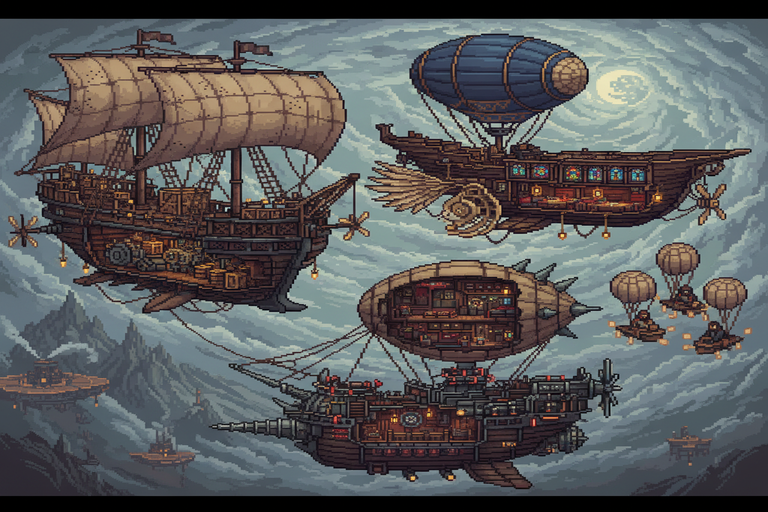 Airship Design and Types
Overview
Airships are humanity’s lifeline in the Aetherium—floating vessels that navigate Aether-currents between scattered islands, enabling trade, communication, and survival. Without airships, settlements would be isolated, unable to exchange resources, share information, or maintain the fragile networks that sustain civilization.
Every aspect of post-Shattering life depends on these vessels: food moves from farms to cities, iron moves from Ironhold to everywhere, refugees flee Rot-consumed islands, messages connect distant loved ones, and explorers venture into unknown regions. Airships are transportation, commerce, communication, and hope made physical.
The technology is simultaneously sophisticated and primitive. Sophisticated: designs refined over 287 years, crash rates below 1%, capable of navigating Aether-Storms and reaching the Periphery. Primitive: powered by wind (no engines), built from scarce materials (ironwood shortage), understood through practice (not theory), and irreproducible (pre-Shattering technology lost).
Airship culture is distinct: captains are respected (responsible for lives), ships have personalities (names, histories, reputations), and piloting is art (instinct, experience, courage). The best pilots—Captain Jorah Ironwind, Storm-Captain Kiera Windcaller, the Storm-Sailors—are legendary. The worst pilots are dead.
The future is uncertain. Ironwood is depleting (consumption exceeds growth), knowledge is fragmenting (old shipwrights dying, apprentices fewer), and innovation is stagnant (no breakthroughs in decades). If airship technology fails, humanity fails. That’s the reality. That’s the stakes.
Basic Principles
Aether-Buoyancy
Mechanism: Natural phenomenon - Aether has buoyant properties (objects float) - Density matters (lighter materials float better) - Ironwood optimal (strong yet light, perfect density) - No engines needed (buoyancy is passive) - Mysterious (no one understands why)
How It Works (theorized): - Aether is medium (like water, but breathable) - Objects displace Aether (Archimedes’ principle) - Buoyancy results (if density < Aether density) - Ironwood density: Perfect (floats naturally) - Other materials: Too dense (sink) or too weak (break)
Why Ironwood: Unique properties - Density: 0.4 g/cm³ (perfect for Aether-buoyancy) - Strength: High (can support weight) - Durability: Excellent (resists Aether-corrosion) - Workability: Moderate (can be shaped) - Irreplaceable: No substitutes (other woods sink or break)
Buoyancy Limits: Carrying capacity - Each ship has maximum weight - Exceed it: Ship sinks (into Aether, falls forever) - Calculate carefully (lives depend on it) - Cargo vs. crew (balance required)
Propulsion
Wind: Primary power - Sails catch wind (like ocean sailing) - Aether-currents (invisible flows, like ocean currents) - Pilot skill (reading currents, using wind) - Free (no fuel cost) - Unreliable (weather-dependent)
Aether-Currents: Critical - Invisible (but detectable by experienced pilots) - Powerful (can double speed or stop completely) - Unpredictable (change without warning) - Dangerous (wrong current = lost, crashed, dead) - Learnable (experience teaches)
No Engines: Limitation - Pre-Shattering airships had engines (possibly) - Technology lost (irreproducible) - Current ships: Wind-powered only - Slow (20-50 km/day average) - Weather-dependent (storms stop travel)
Navigation
Pilot Skill: Critical - Reading Aether-currents (invisible, must be felt) - Weather prediction (storms, winds) - Constellation navigation (star positions) - Island recognition (landmarks) - Instinct (experience, intuition)
Instruments: Limited - Compass (magnetic, unreliable in Aether) - Sextant (constellation positions) - Barometer (pressure, storm prediction) - Maps (hand-drawn, often inaccurate) - Mostly: Pilot’s experience
Training: Years - Apprenticeship (5-10 years) - Start as crew (learn basics) - Advance to navigator (learn currents) - Finally captain (master skill) - Never stop learning (Aether is unpredictable)
Best Pilots: Legendary - Captain Jorah Ironwind (never lost, never late) - Storm-Captain Kiera Windcaller (navigates storms instinctively) - Storm-Sailors (born in storms, live in ships) - Their skill: Difference between life and death
Construction
Materials
Ironwood: Essential (hull, frame) - Only suitable material (buoyancy, strength) - Slow-growing (decades per meter) - Rare (most cut down generations ago) - Expensive (5-20 Crowns per ton) - Future: Shortage (consumption > growth)
Sky-Kelp Fiber: Rope - Strong (tensile strength high) - Flexible (doesn’t snap easily) - Light (doesn’t add weight) - Rot-resistant (lasts years) - Source: Coastal islands (harvested) - Cost: 2-3 Coins per 10 meters
Canvas: Sails - Woven fabric (heavy, durable) - Expensive (10-20 Coins per square meter) - Patched repeatedly (can’t afford replacement) - Lasts: 5-10 years (with repairs) - Source: Textile workshops (limited production)
Metal: Fittings - Iron (nails, bolts, brackets) - Steel (critical components) - Expensive (from Ironhold) - Precisely made (failure = disaster) - Maintained obsessively (rust, wear)
Other: - Tar (waterproofing, sealing) - Leather (straps, bindings) - Glass (windows, rare) - Paint (protection, identification)
Construction Process
Design: Traditional - Patterns passed down (generations) - Modifications rare (tradition strong) - Innovation slow (risk averse) - Proven designs (survival matters more than efficiency)
Shipyards: Specialized facilities - Ironhold (best, largest) - Skyport Eos (second-best) - Scattered (small yards, repairs only) - Skilled labor (shipwrights, carpenters, riggers)
Timeline: - Personal skiff: 1-3 months - Cargo hauler: 6-9 months - Passenger ship: 9-12 months - Warship: 12-18 months
Cost: - Personal skiff: 500-1,000 Coins - Cargo hauler: 2,000-5,000 Coins - Passenger ship: 5,000-10,000 Coins - Warship: 50,000+ Coins
Builders: Master shipwrights - Years of training (apprenticeship) - Specialized knowledge (hull design, rigging, balance) - Respected (build the lifelines) - Well-paid (critical skill) - Aging (fewer apprentices, knowledge at risk)
Quality and Safety
Inspection: Guild-regulated - New ships inspected (before maiden voyage) - Annual inspections (safety certification) - Standards strict (lives depend on it) - Failures: Ship grounded (until repairs)
Maintenance: Constant - Daily: Check rigging, sails, fittings - Weekly: Inspect hull, repair minor damage - Monthly: Major inspection, replace worn components - Annually: Dry-dock (if possible), complete overhaul
Lifespan: 20-50 years - With maintenance: 50 years (some ships older) - Without maintenance: 5 years (then catastrophic failure) - Most ships: 20-30 years (practical lifespan) - Retirement: Scrapped (materials reused)
Crash Rate: Declining - Year 20 S.: 50% (early, deadly) - Year 50 S.: 10% (improving) - Year 100 S.: 2% (reliable) - Year 287 S.: <1% (very safe) - Progress: Significant (experience teaches)
Ship Types
Personal/Small (1-4 crew)
Skiffs: Single-pilot - Size: 5-8 meters long - Crew: 1 (pilot only) - Cargo: 100-200kg - Speed: Fast (light, maneuverable) - Cost: 500-1,000 Coins - Usage: Personal transport, scouting, short trips - Range: 50-100km (limited supplies)
Scouts: Exploration - Size: 8-12 meters - Crew: 2-3 - Cargo: 300-500kg - Speed: Very fast (designed for speed) - Cost: 1,000-2,000 Coins - Usage: Exploration, reconnaissance, racing - Range: 200-300km
Commercial/Medium (5-15 crew)
Cargo Haulers: Most common - Size: 15-25 meters - Crew: 5-10 - Cargo: 5-10 tons - Speed: Moderate (steady, reliable) - Cost: 2,000-5,000 Coins - Usage: Trade, transport, general purpose - Range: 500-1,000km - Example: 80% of Guild fleet
Passenger Ships: Travel service - Size: 20-30 meters - Crew: 10-15 - Passengers: 20-50 - Speed: Moderate (comfort over speed) - Cost: 5,000-10,000 Coins - Usage: Transport people (wealthy, refugees) - Range: 500-1,000km - Amenities: Cabins, dining, minimal comfort
Captain Jorah’s Steadfast: Modified hauler - Size: 22 meters - Crew: 7 (expert) - Cargo: 8 tons - Speed: Fast (optimized design) - Cost: Priceless (custom, legendary) - Usage: Premium transport (expensive, guaranteed) - Range: 1,000+ km - Reputation: Never lost, never late
Military/Large (15+ crew)
Warships: Ironhold military - Size: 30-40 meters - Crew: 20-30 (soldiers + sailors) - Weapons: Ballistae, harpoons, boarding equipment - Armor: Iron plating (heavy, slow) - Cost: 50,000+ Coins - Usage: Defense, patrol, intimidation - Range: 1,000km - Number: ~10 (Ironhold fleet)
Heavy Transports: Mass cargo - Size: 40-50 meters - Crew: 30-50 - Cargo: 50-100 tons - Speed: Slow (heavy, cumbersome) - Cost: 20,000-40,000 Coins - Usage: Bulk goods (iron, grain, refugees) - Range: 500km (limited by weight)
Specialized
Storm Ships: Howling Expanse - Reinforced hulls (storm-resistant) - Flexible rigging (adaptive) - Emergency systems (lifesaving) - Crew: Storm-Sailors (specialized) - Cost: 10,000-20,000 Coins - Usage: Storm navigation (Howling Expanse only) - Survival rate: 80% (vs. 20% for normal ships in storms)
Deep-Sky Craft: Periphery exploration - Long-range (extended supplies) - Reinforced (unknown dangers) - Fast (escape if necessary) - Crew: Experienced (volunteers only) - Cost: 15,000-30,000 Coins - Usage: Exploration (Periphery, Deeps) - Return rate: 50% (very dangerous)
Floating Market: Unique - Size: 20-30 ships lashed together - Crew: 200+ (merchants, sailors, support) - Mobile city (travels trade routes) - Cost: Millions (collective investment) - Usage: Mobile bazaar (rare goods, neutral ground) - Unique (only one exists)
Technology and Design
Hull Design
Shape: Streamlined - Teardrop profile (aerodynamic) - Smooth surfaces (reduce drag) - Reinforced edges (impact protection) - Balanced (center of gravity critical)
Construction: - Ironwood planks (overlapping) - Tar-sealed (waterproof, airtight) - Iron-reinforced (stress points) - Flexible (slight give prevents cracking)
Compartments: - Cargo hold (below deck) - Crew quarters (cramped) - Galley (cooking, eating) - Captain’s cabin (navigation, command) - Storage (supplies, equipment)
Ballast: Weight control - Adjustable (add/remove weight) - Critical (balance affects handling) - Usually: Sand, water, cargo - Emergency: Dump ballast (rise quickly)
Rigging and Sails
Masts: Vertical supports - Ironwood (strong, flexible) - Height: 10-20 meters (depending on ship) - Number: 1-3 (size-dependent) - Reinforced (guy-wires, stays)
Sails: Wind-catching - Canvas (heavy, durable) - Triangular (lateen-rigged, efficient) - Multiple (different winds) - Adjustable (angle, tension) - Patched constantly (can’t afford replacement)
Rigging: Rope network - Sky-kelp fiber (strong, light) - Complex (dozens of lines) - Maintained obsessively (failure = disaster) - Replaced regularly (wear inevitable) - Pilot’s responsibility (know every line)
Control Surfaces: - Rudders (direction) - Ailerons (roll control) - Elevators (pitch control) - Trim (balance adjustment)
Propulsion and Control
Wind Power: Primary - Sails catch wind (like ocean sailing) - Pilot adjusts (angle, tension) - Speed: 20-50 km/day (wind-dependent) - Free (no fuel cost) - Unreliable (weather-dependent)
Aether-Currents: Secondary - Invisible flows (like ocean currents) - Powerful (can double speed) - Detectable (experienced pilots feel them) - Unpredictable (change without warning) - Dangerous (wrong current = disaster)
Pilot Technique: Critical - Reading currents (invisible, must be felt) - Using wind (maximize efficiency) - Avoiding storms (weather prediction) - Emergency maneuvers (when things go wrong) - Years to master (never stop learning)
Navigation
Instruments: - Compass (magnetic, unreliable in Aether) - Sextant (constellation positions) - Barometer (pressure, storm warning) - Maps (hand-drawn, often inaccurate) - Clock (timekeeping, position calculation)
Methods: - Dead reckoning (speed × time = distance) - Constellation navigation (star positions) - Landmark recognition (known islands) - Current-reading (feel the flow) - Instinct (experience, intuition)
Challenges: - No GPS (position uncertain) - Islands drift (maps outdated) - Currents shift (routes change) - Storms (forced detours) - Getting lost (fatal)
Ship Types in Detail
Cargo Haulers (Workhorses)
The Standard Design: - Length: 20 meters - Beam: 6 meters - Draft: 3 meters - Crew: 6-8 - Cargo: 8 tons - Speed: 30 km/day (average) - Cost: 3,500 Coins
Layout: - Cargo Hold: Below deck (80% of volume) - Crew Quarters: Cramped (bunks, minimal space) - Galley: Small (cooking, eating) - Captain’s Cabin: Tiny (navigation, command) - Deck: Open (working space)
Typical Cargo: - Grain (bulk, heavy) - Iron (dense, valuable) - Manufactured goods (tools, weapons) - Supplies (rope, tar, materials) - Passengers (if space available)
Routes: Regular - Eos-Ironhold (3-7 days) - Farming Circuit (15 days) - Coastal (variable) - Scheduled (reliable)
Crew Life: - Hard work (loading, unloading, maintenance) - Long hours (sailing, watches) - Poor pay (5-10 Coins/week) - Dangerous (storms, pirates, accidents) - But: Employment (better than starving)
Passenger Ships (Luxury)
The Comfort Design: - Length: 25 meters - Beam: 8 meters - Passengers: 30-40 - Crew: 12-15 - Speed: 25 km/day (slower, smoother) - Cost: 8,000 Coins
Amenities (by Aetherium standards): - Private cabins (small but private) - Dining area (communal meals) - Deck space (fresh air, views) - Minimal comfort (beds, not bunks) - “Luxury” (relatively)
Passengers: Wealthy - Merchants (business travel) - Officials (government business) - Wealthy families (visiting) - Refugees (if they can afford—most can’t)
Ticket Prices: - Eos-Ironhold: 25-30 Coins - Eos-Periphery: 100+ Coins - Private cabin: +50% premium - Meals included (basic)
Service: Variable - Guild ships (reliable, expensive) - Independent (cheaper, riskier) - Captain Jorah (premium, guaranteed)
Warships (Military)
The Ironhold Design: - Length: 35 meters - Beam: 10 meters - Crew: 25 (sailors + soldiers) - Weapons: 4 ballistae, boarding equipment - Armor: Iron plating (heavy) - Speed: 20 km/day (slow, armored) - Cost: 60,000 Coins
Weapons: - Ballistae: Large crossbows (ship-mounted) - Range: 200 meters - Ammunition: Iron bolts, harpoons - Purpose: Disable enemy ships - Accuracy: Moderate (moving platforms)
- Harpoons: Grappling weapons
- Range: 50 meters
- Purpose: Board enemy ships
- Rope-attached (pull ships together)
- Boarding follows (soldiers fight)
- Boarding Equipment: Melee combat
- Swords, spears, shields
- Soldiers trained (marines)
- Close-quarters (ship-to-ship)
- Brutal (no retreat)
Armor: Iron plating - Protects hull (ballista-resistant) - Heavy (reduces speed, maneuverability) - Expensive (iron is valuable) - Maintained (rust is constant threat)
Purpose: Military - Defense (patrol routes) - Offense (Vask’s war plans) - Intimidation (show of force) - Rarely used (no major wars recently) - But: Ready (if needed)
Ironhold Fleet: 10 warships - Largest military force (by far) - Well-maintained (military discipline) - Experienced crews (trained constantly) - Vask’s pride (and threat)
Piloting and Seamanship
The Pilot’s Art
Skills Required: - Current-Reading: Feel invisible Aether-flows - Weather-Prediction: Recognize storm signs - Navigation: Find destination (without GPS) - Ship-Handling: Control vessel (in any conditions) - Emergency Response: React to disasters (instantly) - Leadership: Command crew (under stress)
Training: Apprenticeship - Year 1-2: Crew (learn basics, follow orders) - Year 3-5: Sailor (learn rigging, maintenance) - Year 6-8: Navigator (learn currents, weather) - Year 9-10: First Mate (learn command) - Year 10+: Captain (master everything)
Licensing: Guild-regulated (some places) - Examination (practical test) - Fee: 100 Coins (Guild license) - Benefits: Legitimacy, insurance, Guild routes - Not required (but helpful)
Reputation: Everything - Good pilot: Always employed (high demand) - Bad pilot: Never employed (or dead) - Legendary pilot: Premium rates (Captain Jorah) - Reputation earned (through successful voyages)
The Crew
Positions: - Captain: Command (navigation, decisions) - First Mate: Second-in-command (backup captain) - Navigator: Course-plotting (if large ship) - Bosun: Crew management (work assignments) - Sailors: General crew (rigging, maintenance, cargo) - Cook: Food preparation (morale critical) - Engineer: Repairs (if large ship)
Life Aboard: - Cramped: Little space (efficiency over comfort) - Routine: Watches (4 hours on, 8 hours off) - Boring: Long voyages (days of nothing) - Terrifying: Storms (sudden, deadly) - Camaraderie: Close bonds (survival depends on teamwork)
Pay: Variable - Crew: 5-10 Coins/week - Officers: 15-30 Coins/week - Captain: 50-100 Coins/week (plus ship profits) - Bonuses: Successful voyage, hazard pay
Dangers: - Storms (primary threat) - Pirates (rare but devastating) - Accidents (falls, rigging failures) - Rot-exposure (corrupted routes) - Starvation (if lost)
Ship Culture
Names: Every ship named - Tradition: Never sail unnamed vessel (bad luck) - Meaningful (hope, family, values) - Examples: Hope’s Gamble, Steadfast, Tempest’s Daughter, Salt’s Blessing - Personality (ships have reputations)
Superstitions: Taken seriously - Never whistle (summons storms) - No women (traditional, mostly ignored now) - Red sky at dawn (stay in port) - Three Cloud-Hoppers (someone will die) - Rename ship (extremely bad luck)
Rituals: - Blessing (before maiden voyage) - Offerings (to Constellation of the Voyager) - Toasts (to successful voyages) - Mourning (for lost ships, crews)
Community: Ship families - Crew bonds (like family) - Multi-generational (children follow parents) - Loyalty (to ship, captain, crew) - Identity (sailor culture distinct)
Dangers and Challenges
Aether-Storms
Primary Threat: Weather - Sudden (little warning) - Violent (winds, lightning, turbulence) - Deadly (ships destroyed, crews killed) - Unpredictable (can’t always avoid)
Survival: Skill + luck - Experienced pilots (better survival) - Storm ships (reinforced, designed for it) - Emergency procedures (practiced constantly) - Prayer (to Constellation of the Voyager) - Luck (sometimes only thing that saves you)
Stormwatch Outpost: Warning system - Monitors storms (Howling Expanse) - Transmits warnings (signal lights, mirrors) - Saves lives (2-hour warning) - Limited range (can’t cover everything)
Pirates
Black Sky Cartel: Primary threat - Attacks: Rare (Guild routes patrolled) - Targets: Independent ships (no protection) - Method: Board, rob, sometimes kill - Leader: The Captain (identity unknown) - Avoided (if possible)
Defense: - Travel in convoys (safety in numbers) - Hire guards (expensive) - Guild membership (protection) - Fast ships (outrun pirates) - Weapons (fight back)
Pirate Ships: Modified - Fast (catch victims) - Armed (ballistae, boarding equipment) - Crew: Criminals (desperate, violent) - Black flags (identification, intimidation)
Mechanical Failure
Rigging: Most common - Rope breaks (wear, age, stress) - Sails tear (wind, age) - Masts crack (storms, impact) - Result: Loss of control (drift, crash) - Prevention: Constant maintenance
Hull: Catastrophic - Cracks (stress, age, impact) - Leaks (Aether seeps in? Unclear what “leak” means) - Structural failure (ship breaks apart) - Result: Crash (fall into Aether) - Prevention: Inspection, repair, replacement
Emergency Procedures: - Dump cargo (reduce weight, rise) - Emergency sails (backup rigging) - Lifeboats (small skiffs, if available) - Distress signals (hope for rescue) - Prayer (often last resort)
Navigation Errors
Getting Lost: Fatal - No landmarks (Aether is featureless) - Islands drift (maps outdated) - Currents shift (routes change) - Result: Lost (supplies run out, death) - Prevention: Skilled pilots, careful navigation
Collision: Rare but catastrophic - Island collision (ship destroyed) - Ship collision (both damaged) - Debris (floating wreckage) - Avoidable (usually) - But: Happens (fog, storms, error)
Rot-Corruption
Ship Exposure: Dangerous - Rot-clouds (drifting corruption) - Corrupted routes (near fallen islands) - Infected cargo (spreads to ship) - Result: Wood degrades, crew infected - Prevention: Avoid corrupted areas, sanctification
Symptoms: - Wood turns black (early) - Planks soften (mid) - Structure weakens (late) - Ship fails (catastrophic) - Timeline: Months to years
Treatment: - Sanctification (prayer, holy water) - Replacement (remove corrupted planks) - Abandonment (if too far gone) - Expensive (but necessary)
Notable Innovations
Torven Ironhull’s Designs (Storm-Sailor)
Background: Engineer, Storm-Sailor - Born in Howling Expanse - Designed storm-resistant ships - Shares designs anonymously (with Ironhold) - Modest (doesn’t seek credit)
Innovations: - Reinforced Hulls: Double-planking (storm-resistant) - Flexible Rigging: Adaptive (bends, doesn’t break) - Emergency Systems: Lifeboats, backup sails, quick-release ballast - Storm Anchors: Grappling (attach to islands during storms)
Impact: Survival rates - Normal ships in storms: 20% survival - Storm ships: 80% survival - Difference: Torven’s designs - Lives saved: Thousands (over decades)
Recognition: None (he refuses) - Sends designs anonymously - Ironhold uses them (doesn’t credit him) - Storm-Sailors honor him (know the truth) - Modest: “I just want people to survive”
Ironhold Military Innovations
Weaponization: Warships - Ballistae (ship-mounted) - Armor plating (iron, heavy) - Boarding equipment (grapples, bridges) - Military doctrine (naval tactics)
Purpose: Defense and offense - Patrol routes (piracy prevention) - Escort valuable cargo (protection) - Military operations (Vask’s plans) - Intimidation (show of force)
Effectiveness: Untested - No major naval battles (yet) - Pirate encounters (successful) - Theoretical (doctrine untested in war) - Vask confident (maybe overconfident)
Floating Market: Mobile Platform
Concept: Lashed-together fleet - 20-30 ships (connected by bridges, ropes) - Mobile city (travels as one) - Modular (ships can detach, rejoin) - Unique (only one exists)
Engineering: Complex - Balance (weight distribution critical) - Flexibility (ships move independently) - Stability (despite motion) - Maintenance (constant)
Advantages: - Mobility (goes where trade is) - Size (can carry enormous variety) - Neutral (no settlement controls it) - Community (merchants live aboard)
Challenges: - Coordination (30 captains, one direction) - Storms (must detach, scatter, regroup) - Pirates (tempting target, but too big to attack) - Maintenance (expensive, constant)
Economic Impact
Trade Dependency
Without Airships: Civilization collapses - No food distribution (farms to cities) - No iron distribution (Ironhold to everywhere) - No communication (messages can’t travel) - No refugees (trapped on falling islands) - Settlements isolated (die independently)
With Airships: Civilization functions - Trade networks (goods move) - Communication (messages travel) - Rescue (refugees evacuated) - Exploration (Periphery reached) - Unity (fragile but real)
Employment
Direct: Thousands employed - Pilots: 500+ (captains) - Crew: 3,000+ (sailors) - Builders: 200+ (shipwrights) - Maintainers: 500+ (repairs) - Total: ~4,000 (2% of population)
Indirect: Everyone depends - Merchants (need ships) - Farmers (need distribution) - Manufacturers (need transport) - Everyone (needs trade)
Guild Power
Control: Economic monopoly - Owns: 60% of ships - Controls: 80% of routes - Sets: Prices, standards, regulations - Power: Immense (trade = survival)
Abuse: Possible - Could raise prices (extortion) - Could block routes (political tool) - Could refuse service (censorship) - Restrained (barely) by competition and reputation
Social Significance
Freedom and Independence
Owning Ship: Ultimate freedom - Go anywhere (within reason) - Work independently (no employer) - Live aboard (no rent) - Respected (captain status) - Expensive (but worth it)
Captain Status: High respect - Responsible for lives (crew, passengers) - Skilled (years of training) - Brave (face dangers) - Trusted (with cargo, messages, people) - Honored (in all settlements)
Ship as Home
Storm-Sailors: Live entirely aboard - Born on ships (never touch islands) - Die on ships (sky-burial from deck) - Community (fleet is family) - Culture (distinct, maritime) - Identity (sailor first, human second)
Nomadic Traders: Mobile life - Live aboard (small cabin) - Travel constantly (no fixed home) - Freedom (no ties) - Loneliness (no community) - Romantic (in stories, harsh in reality)
Ship Personality
Names: Meaningful - Steadfast (Captain Jorah’s ship—reliable) - Tempest’s Daughter (Kiera’s ship—storm-born) - Hope’s Gamble (first successful flight—historic) - Salt’s Blessing (Saltwind flagship—traditional)
History: Ships have stories - Battles survived (scars, repairs) - Storms weathered (legendary voyages) - Captains served (lineage) - Cargo carried (purposes) - Reputation (known by name)
Loyalty: Crew to ship - “My ship” (possessive) - Defend her (like family) - Mourn her (if lost) - Honor her (maintain, respect) - Identity (sailor of Steadfast, not just sailor)
Future Challenges
Ironwood Shortage
Problem: Consumption > growth - Ironwood grows slowly (decades per meter) - Ships require tons (each) - Most trees cut (generations ago) - Replanting (but takes decades) - Future: Shortage (within 50 years?)
Impact: Catastrophic - Can’t build new ships (no material) - Can’t replace old ships (as they fail) - Fleet shrinks (gradually) - Trade declines (fewer ships) - Civilization threatened (depends on ships)
Solutions: None good - Ration ironwood (who decides?) - Find alternative (no suitable material) - Recover pre-Shattering ships (rare, dangerous) - Reduce ship use (impossible)
Knowledge Loss
Problem: Old shipwrights dying - Master builders (60-80 years old) - Apprentices (fewer, less skilled) - Knowledge (passed orally, fragmentary) - Techniques (being forgotten) - Future: Quality decline (ships worse)
Impact: Safety - Worse ships (more crashes) - Shorter lifespans (ships fail sooner) - Higher costs (inefficiency) - Lost innovations (techniques forgotten)
Solutions: Archivists documenting - Recording techniques (writing them down) - Training programs (formal education) - Preserving knowledge (before it’s lost) - But: Slow (race against time)
Stagnation
Problem: No major innovations (decades) - Designs traditional (no improvements) - Materials same (no alternatives) - Methods unchanged (no breakthroughs) - Technology stagnant (not advancing)
Why: Risk-aversion - Proven designs work (why change?) - Innovation risky (failures kill) - Resources scarce (can’t afford experiments) - Knowledge limited (don’t understand theory)
Impact: Long-term decline - Competitors innovate (we don’t) - Efficiency stagnant (not improving) - Problems unsolved (ironwood shortage) - Future: Threatened (stagnation is death)
In-World Documents
Captain Jorah’s Log (Year 287 S.)
Voyage #1,247: Eos to Ironhold
Ship: Steadfast (22 years old, still perfect) Crew: 7 (my regulars) Cargo: 8 tons grain, 12 passengers Weather: Clear (good fortune)
Day 1: Departed Eos dawn. Favorable currents. Made 45km. Excellent.
Day 2: Passed Windmere. Signaled greetings. Continued. 40km.
Day 3: Arrived Ironhold. 3 days (my record is 2.5, but no need to rush). Passengers happy. Cargo delivered. Paid 400 Coins (passage + cargo fees).
Expenses: 50 Coins (food, docking, maintenance). Profit: 350 Coins. Crew shares: 50 Coins each. My share: 100 Coins.
Ship condition: Excellent. Replaced 10 meters of rigging (preventive). Inspected hull (no damage). Steadfast is reliable. Always has been. Always will be.
Next voyage: Ironhold to Eos (return trip). Departing tomorrow.
Note: 1,247 voyages. Zero losses. Zero late arrivals. That’s my record. That’s my pride.
—Captain Jorah Ironwind
Shipwright’s Lament (Year 285 S.)
I’m 67 years old. I’ve built ships for 50 years. I’ve built 43 ships. All still flying (except three lost to storms, not my fault).
I’m the best shipwright in Eos. Maybe in Aetherium.
And I have no apprentice. No one wants to learn. Young people want easy jobs. City jobs. Not shipbuilding.
When I die, my knowledge dies. 50 years of experience. Techniques my master taught me. Innovations I discovered. Gone.
I’ve written some down. But you can’t learn shipbuilding from books. You need to feel the wood. See how it bends. Understand how ships move.
That takes years. And no one has years to give.
So when I die, ships will be worse. And people will die. Because no one wanted to learn.
That’s my legacy. I built 43 ships. I trained zero apprentices.
I failed.
—Master Shipwright Kael Ironhand, Skyport Eos
Storm-Sailor Saying
The ship is mother, the crew is family,
The Aether is home, the storm is teacher,
The Voyager is guide, the voyage is life,
We’re born on deck, we die on deck,
We’re sailors forever.
Vask’s Naval Doctrine (Year 286 S., Military Manual)
IRONHOLD NAVAL OPERATIONS
Purpose: Project military power, control trade routes, eliminate threats
Fleet: 10 warships (best in Aetherium)
Tactics: 1. Patrol: Constant presence (intimidation) 2. Escort: Protect valuable cargo (Guild alliance) 3. Blockade: Control access (economic weapon) 4. Assault: Board and capture (if necessary) 5. Bombardment: Ballista fire (disable, don’t destroy)
Rules of Engagement: - Identify target (friend or foe) - Warning shot (chance to surrender) - Disable (capture preferred) - Board (secure cargo, crew) - Execute pirates (no mercy)
Murk Campaign: Special operations - 10 warships (full fleet) - 500 soldiers (boarding parties) - Objective: Destroy Murky Chasm (eliminate Rot-Touched) - Expected: Resistance (they’ll fight) - Acceptable: Casualties (30-40%)
Confidence: High. Our ships are best. Our crews are trained. Our cause is just.
Victory: Inevitable.
[Note: Overconfidence. Rot-Touched have advantages (desperation, Rot-powers, knowledge of terrain). Vask might be wrong.]
Quest Hooks
The Maiden Voyage: Join crew for ship’s first voyage. Blessing ceremony, nervous captain, untested vessel. Will it fly? Will it crash? Adventure begins.
The Storm Survival: Ship caught in Aether-Storm. Help crew survive. Emergency repairs, desperate navigation, prayer. Live or die together.
The Pirate Attack: Black Sky Cartel attacks. Fight back (defend ship) or surrender (lose cargo)? Crew’s lives vs. merchant’s profit.
The Lost Ship: Search for missing vessel. Last seen weeks ago. Find wreckage? Survivors? What happened?
The Ironwood Crisis: Help find alternative to ironwood (or new ironwood source). Research, exploration, experimentation. Future of airships depends on it.
The Master’s Apprentice: Convince young person to apprentice with dying shipwright. Preserve knowledge. Save future. Difficult (youth resistant).
The Record Voyage: Attempt fastest Eos-Ironhold run. Beat Captain Jorah’s record (2.5 days). Dangerous (push limits), but glory.
The Warship Encounter: Ironhold warship stops your ship. Inspection (looking for contraband). Cooperate (delay) or resist (fight)? Both risky.
The Ship Rescue: Damaged ship drifting (crew alive, ship failing). Rescue them (humanitarian) or salvage ship (profitable)? Time limited.
The New Design: Help innovate new ship design. Experimental (risky), but might solve ironwood shortage, improve efficiency, save future.
Related Topics
- Sky-Guild - Controls most ships and routes
- Captain Jorah Ironwind - Legendary pilot
- Storm-Captain Kiera Windcaller - Storm navigation expert
- Black Sky Cartel - Pirates
- Aether Phenomena - Currents, storms
- Ironwood Trees - Critical material
- Communication - Ships carry messages
“Airships are what keep us from being islands unto ourselves.
Without them, humanity dies slowly, isolated, alone.”
—Common saying
“I’ve flown 1,247 voyages. I’ve never lost a ship. I’ve never
lost a crew member. I’ve never arrived late. That’s not luck. That’s
skill, care, and respect for the Aether. The Aether gives. The Aether
takes. Respect it, and it might let you live.”
—Captain
Jorah Ironwind
“My ship is 22 years old. I’ve maintained her perfectly. She’s
flown 100,000 kilometers. She’s survived 50 storms. She’s carried 10,000
tons of cargo. She’s saved 1,000 lives. She’s not just wood and rope.
She’s alive. She’s family. She’s Steadfast. And I’ll sail her
until one of us dies.”
—Captain Jorah
Ironwind