Cloud-Hoppers
Saltus nubilus / “Sky-Bunnies” / “Aerial Nuisances”
“Cloud-hoppers are like relatives: annoying, everywhere, can’t
get rid of them, but you’d miss them if they were gone.”
—Settlement saying
Quick Reference
| Attribute | Details |
|---|---|
| Type | Fauna (Aerial mammal) |
| Rarity | Common (wherever humans settle) |
| Habitat | Settlements, airship docks, island edges, ruins |
| Danger Level | Low (territorial when nesting, otherwise harmless) |
| Size | 20-30cm body length, 40cm wingspan |
| Weight | 0.5-1kg |
| Lifespan | 3-5 years (wild), 8-10 years (captive) |
| Diet | Omnivore (prefer grains, fruit, vegetables, will eat almost anything) |
| Value | Low (nuisance mostly, minor uses) |
| Intelligence | Moderate (problem-solvers, learn from experience) |
| Legal Status | Unprotected (but killing them considered bad luck) |
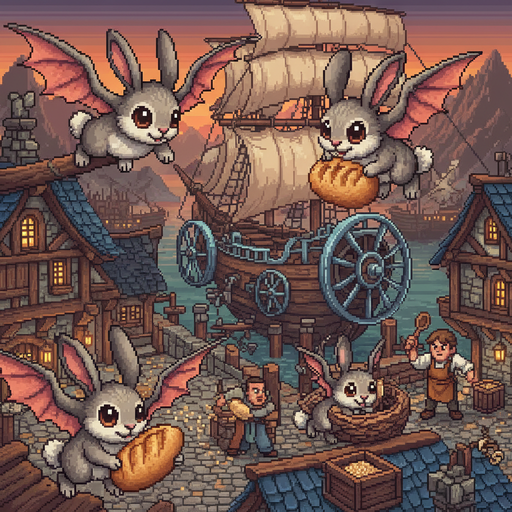 Cloud-Hoppers - Aerial
Nuisances
Cloud-Hoppers - Aerial
Nuisances
Description
Cloud-hoppers are rabbit-sized aerial mammals that “hop” through the air using membrane wings, bouncing between ships, platforms, and islands in erratic, unpredictable patterns. They are simultaneously cute and infuriating—furry, big-eyed creatures that eat stored food, nest in inconvenient places, chatter constantly, and resist all attempts at eradication. Every settlement has them. Every settlement complains about them. And yet, somehow, people tolerate them.
The creatures resemble a cross between a rabbit and a flying squirrel, with soft fur (gray, brown, or mottled), large expressive eyes, and membrane wings that stretch from forelimbs to hindlimbs. They move through the air in short, bouncing “hops”—flapping their wings rapidly to gain altitude, then gliding in an arc before flapping again. The motion is comical and inefficient, but it works. They can navigate complex environments, land on narrow perches, and somehow always find their way into sealed storage areas.
Cloud-hoppers are commensal species—they live alongside humans, dependent on human settlements for food and shelter. They nest in attics, under docks, in ship rigging, and anywhere humans don’t actively prevent them. They’re clever enough to avoid most traps, social enough to warn each other of dangers, and prolific enough that killing a few makes no difference to the population. Children love them. Adults tolerate them. And everyone agrees: life in the Aetherium includes cloud-hoppers, whether you like it or not.
Physical Characteristics
Appearance
Body: - Rabbit-like (compact, rounded) - Length: 20-30cm - Weight: 0.5-1kg - Covered in soft fur
Fur: - Colors: Gray, brown, mottled, occasionally white - Soft, dense (insulation) - Sheds seasonally (annoying) - Patterns: Variable (individuals distinguishable)
Wings: - Membrane stretched between limbs - Wingspan: 40cm - Translucent (veins visible) - Fragile (tears heal but scars remain) - Fold against body when not flying
Face: - Large eyes (excellent vision) - Small nose (twitches constantly) - Whiskers (sensitive) - Expressive ears (rotate independently) - Mouth: Small but sharp teeth
Limbs: - Four legs (adapted for grasping) - Claws (sharp, for clinging) - Forelimbs: Elongated (support wings) - Hindlimbs: Powerful (for hopping)
Tail: - Short, fluffy - Used for balance in flight - Expressive (emotional indicator)
Behavior and Ecology
Movement
The “Hop”: - Flap wings rapidly (gain altitude) - Glide in arc (lose altitude) - Flap again (repeat) - Erratic, unpredictable pattern - Inefficient but works
Landing: - Can land on narrow perches - Cling to vertical surfaces - Precision surprising - Rarely miss
Maneuverability: - Can change direction mid-flight - Dodge obstacles - Escape predators (usually) - Better than they look
Social Structure
Colonies: - Live in groups (10-50 individuals) - Loose hierarchy (dominant pairs) - Cooperative (share food, warn of danger) - Territorial (defend nesting areas)
Communication: - Chirping (contact calls) - Chattering (alarm) - Shrieking (danger) - Purring (contentment) - Body language (ears, tail)
Reproduction: - Breed year-round - 4-6 litters per year - 2-4 pups per litter - Rapid population growth
Nesting: - Build nests (soft materials) - Prefer enclosed spaces - Defend aggressively when nesting - Raise young communally
Diet
Preferences: - Grains (steal from storage) - Fruit (raid gardens) - Vegetables (eat crops) - Seeds (bird feeders, plantings)
Will Eat: - Bread, cheese, meat scraps - Garbage - Paper (if desperate) - Soap (why?) - Almost anything organic
Foraging: - Clever (open containers) - Persistent (try repeatedly) - Opportunistic (exploit any opening) - Wasteful (take bites, move on)
Interaction with Humans
As Pests
Problems They Cause: - Eat stored food (significant losses) - Damage property (chewing, nesting) - Noise (constant chattering) - Droppings (everywhere, unsanitary) - Spread disease (occasionally)
Economic Impact: - Food losses: 5-10% of stored goods - Damage repairs: 10-20 coins per year per household - Disease treatment: Variable - Total: Significant but accepted
Control Attempts: - Traps (they learn to avoid) - Poison (dangerous to other species) - Predators (cats, hawks—partial success) - Sealing storage (they find ways in) - Acceptance (most common response)
As Tolerated Neighbors
Why People Tolerate Them: - Can’t eliminate them (tried, failed) - Kind of cute (children love them) - Eat sky-rats (worse pests) - Familiar (comforting presence) - Harmless mostly
Cultural Acceptance: - Part of settlement life - Complained about but accepted - Named individuals (pets, sort of) - Children feed them (parents disapprove)
Superstitions: - Killing cloud-hopper = bad luck - White cloud-hopper = very lucky - Colony leaving = disaster coming (sometimes true)
As Resources (Minor)
Meat: - Edible (gamey, small) - Not worth hunting usually - Starvation food - Some cultures eat them regularly
Fur: - Soft, warm - Too small for clothing - Used for trim, lining - Children’s toys
Pest Control: - Eat sky-rats (competition) - Eat insects - Minor benefit
Research: - Study their flight (Aether-navigation) - Study their adaptability - Minor scientific interest
Variations and Subspecies
Common Cloud-Hopper
Standard: Gray-brown, 25cm, most common
White Cloud-Hopper
Rare: Albino variant, considered lucky, 1 in 1,000
Giant Cloud-Hopper
Uncommon: 40cm, more aggressive, rare mutation
Murk Cloud-Hopper
Corrupted: Darker, more aggressive, Rot-adapted, avoid
Cultural Impact
In Children’s Culture
Beloved: - Children try to catch them (rarely succeed) - Feed them (parents disapprove) - Name them (individuals) - Cry when they die
Stories: - Children’s tales feature cloud-hoppers - Usually as tricksters or helpers - Moral lessons - Cultural touchstone
In Adult Culture
Ambivalence: - Annoying but familiar - Complain but don’t seriously try to eliminate - Part of life - Accepted nuisance
Sayings: - “Persistent as a cloud-hopper” - “Chattering like cloud-hoppers” - “Cloud-hopper luck” (mixed blessing)
Related Topics
- Sky-Rats - Worse pests
- Aether-Fish - Other common fauna
- Skyport Eos - Large population
- Airship Docks - Common habitat
In-World Documents
Children’s Rhyme
Cloud-hopper, cloud-hopper, hopping through the sky,
Stealing all our bread and grain, we wonder why.
Cloud-hopper, cloud-hopper, chattering all day,
We chase you but you hop away, and come back anyway.
Complaint (Posted in Skyport Eos)
TO WHOM IT MAY CONCERN:
The cloud-hoppers are out of control.
They’ve eaten through three bags of grain this month.
They’ve nested in my attic.
They wake me at dawn with their chattering.
They’ve chewed through my rope supplies.Can someone DO SOMETHING about this?
[Below, in different hand:]
We’ve tried. They always come back.
Just seal your storage better.
Welcome to the Aetherium.
“Cloud-hoppers are perfect symbol of life in settlements:
annoying, persistent, impossible to eliminate, but somehow endearing.
They’re pests, yes. But they’re our pests. And in a dying world, there’s
something comforting about creatures that thrive despite everything,
that adapt to whatever we throw at them, that refuse to be defeated by
mere inconvenience. Maybe we should learn from them.”
—From Fauna of the Aetherium