Sky-Rats
Rattus volans / “Wing-Vermin” / “The Plague”
“Three certainties in life: Death, corruption, and sky-rats. In
that order.”
—Pessimist’s saying
Quick Reference
| Attribute | Details |
|---|---|
| Type | Fauna (Flying vermin/rodent) |
| Rarity | Common (urban areas), abundant (poor districts) |
| Habitat | Settlements, ships, ruins, anywhere humans leave garbage |
| Danger Level | Low (disease carriers, aggressive in swarms) |
| Size | 30-40cm body length, 60cm wingspan |
| Weight | 1-2kg |
| Lifespan | 2-3 years (wild), rarely longer |
| Diet | Omnivore (prefer garbage, carrion, stored goods, will eat anything) |
| Value | None (pest, actively harmful) |
| Intelligence | Moderate (cunning, learn from experience, avoid traps) |
| Legal Status | Unprotected (killing encouraged) |
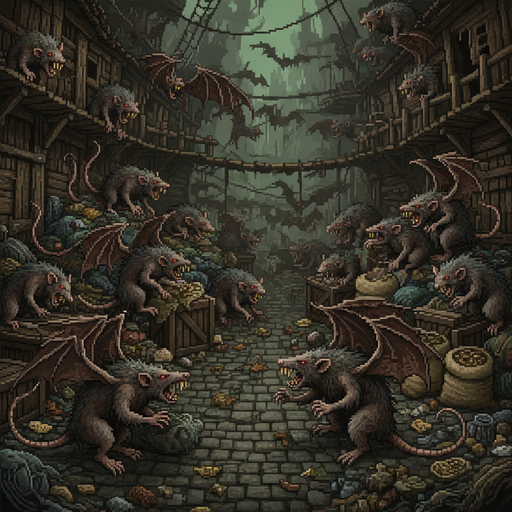 Sky-Rats - The Plague
Description
Sky-rats are exactly what they sound like—flying rodents that infest ships, settlements, and storage areas throughout the Aetherium. They are larger than terrestrial rats, with leathery wings, sharp teeth, aggressive temperaments, and an uncanny ability to survive anything humans throw at them. They breed explosively, eat everything, spread disease, and resist all attempts at eradication. Every settlement has them. Every settlement hates them. And yet they persist, thriving in humanity’s shadow like a curse that won’t lift.
The creatures are grotesque: rat-like bodies covered in patchy fur, leathery wings like bats, red eyes that glow faintly in darkness, and teeth that never stop growing (forcing them to gnaw constantly). They smell like rot and garbage, make horrible shrieking sounds, and move in jerky, unsettling patterns. Unlike cloud-hoppers (which are cute despite being pests), sky-rats are simply repulsive.
Sky-rats are commensal vermin—they live alongside humans because humans provide food (garbage, stored goods, carrion) and shelter (buildings, ships, ruins). They’re intelligent enough to avoid most traps, social enough to warn each other of dangers, and prolific enough that killing dozens makes no difference to the population. They’re disease vectors, property destroyers, and constant reminders that in the Aetherium, some problems can’t be solved—only endured.
Physical Characteristics
Appearance
Body: - Rat-like (elongated, hunched) - Length: 30-40cm (not including tail) - Weight: 1-2kg - Covered in patchy fur (mangy appearance)
Fur: - Colors: Gray, brown, black, mottled - Patchy (disease, parasites, fighting) - Oily (water-resistant but smells) - Sheds constantly (allergenic)
Wings: - Leathery membrane (like bat wings) - Wingspan: 60cm - Attached from forelimbs to hindlimbs - Often torn or scarred - Fold against body when not flying
Head: - Rat-like (pointed snout) - Red eyes (glow faintly in darkness) - Large ears (excellent hearing) - Whiskers (sensitive) - Teeth: Yellow, constantly growing, sharp
Tail: - Long (30-40cm), hairless - Scaly, prehensile - Used for balance, grasping - Often damaged (fights, accidents)
Claws: - Sharp (for clinging, fighting) - Four limbs - Can grip surfaces - Scratch causes infection (dirty claws)
Behavior and Ecology
Movement
Flight: - Flapping (rapid, noisy) - Gliding (short distances) - Erratic patterns (hard to predict) - Maneuverability: High - Speed: Moderate (can outrun humans, not birds)
Climbing: - Excellent climbers - Scale walls, ropes, chains - Access anywhere - Difficult to exclude
Burrowing: - Chew through wood, fabric, soft materials - Create nests in walls, attics, holds - Damage structures - Expensive to repair
Social Structure
Colonies: - Live in groups (20-100 individuals) - Loose hierarchy (dominant pairs) - Cooperative (share food, warn of danger) - Aggressive to outsiders
Communication: - Squeaking (contact) - Shrieking (alarm) - Chattering (aggression) - Ultrasonic (humans can’t hear)
Reproduction: - Breed continuously - Litter every month - 6-10 pups per litter - Sexual maturity: 2 months - Population explosion potential
Nesting: - Build nests (shredded materials) - Prefer enclosed, dark spaces - Defend aggressively - Raise young communally
Diet
Preferences: - Garbage (primary food source) - Carrion (dead animals, including other sky-rats) - Stored goods (grains, dried meat, anything) - Fresh food (if accessible)
Will Eat: - Literally anything organic - Paper, cloth, leather (if desperate) - Soap, candles (why?) - Each other (when starving) - Absolutely indiscriminate
Foraging: - Nocturnal primarily - Opportunistic (take any chance) - Persistent (try repeatedly) - Wasteful (contaminate more than they eat)
As Disease Vectors
Diseases Carried
Sky-Pox: - Viral infection - Symptoms: Fever, rash, respiratory distress - Mortality: 10-20% - Spread by sky-rat bites, droppings
Rot-Fever: - Bacterial infection - Symptoms: High fever, delirium, organ failure - Mortality: 30-40% (untreated) - Spread by contaminated food
Various Parasites: - Fleas, mites, worms - Transfer to humans - Cause itching, illness - Difficult to eliminate
Plague (Rare but devastating): - Bacterial (carried by fleas on sky-rats) - Symptoms: Fever, swelling, death - Mortality: 60-80% - Epidemic potential
Prevention: - Avoid sky-rat contact - Don’t eat contaminated food - Control populations (difficult) - Quarantine infected individuals
Control Methods
Traps
Effectiveness: Low - Sky-rats learn to avoid - Must be reset constantly - Catch few relative to population - Expensive (time, materials)
Types: - Snap traps (kill instantly) - Cage traps (capture alive) - Glue traps (cruel, effective) - Net traps (aerial)
Poison
Effectiveness: Moderate - Kills some - Others avoid (learn from dead) - Secondary poisoning risk (cats, children) - Controversial
Types: - Grain-based (they eat it) - Slow-acting (spreads through colony) - Fast-acting (they avoid it)
Predators
Cats: - Natural predators - Effectiveness: Moderate - Sky-rats fight back (dangerous for cats) - Some cats won’t hunt them
Hawks/Raptors: - Hunt sky-rats - Effectiveness: Low (rats hide) - Some settlements encourage - Limited impact
Cloud-Hoppers: - Compete for food - Occasionally kill young sky-rats - Minor control
Exclusion
Effectiveness: High (but difficult) - Seal all entry points - Metal screens on vents - Secure storage - Constant vigilance - Expensive but works
Uses (Desperate)
As Food
Edibility: Yes (technically) - Disease risk: High - Taste: Gamey, unpleasant - Texture: Tough, stringy - Preparation: Must cook thoroughly - Desperation level: Extreme
Who Eats Them: - Starving people - Some Murk residents (pragmatic) - Survival situations - Not by choice
Alchemy and Research
Kael Greythorn’s Studies: - Sky-rats survive Rot exposure better than most mammals - Some infected rats don’t die - Studying resistance mechanism - Potential applications for Rot-resistance
Body Parts: - Organs (alchemical experiments) - Blood (disease research) - Tissue samples (corruption studies) - Scientific value only
Cultural Impact
Symbolism
Negative: - Represent decay, disease, poverty - “Sky-rat infested” = slum - Used as insults - Symbol of everything wrong
Persistence: - Can’t be eliminated - Always return - Survive anything - Grudging respect for resilience
In Art and Literature
Common Themes: - Plague, decay, persistence - Metaphor for problems that won’t go away - Horror elements (swarms, disease) - Rarely positive
Sayings: - “Like sky-rats in a granary” (infestation) - “Sky-rat luck” (bad luck) - “Breed like sky-rats” (reproduce rapidly)
Encounter Scenarios
The Infestation
Setup: Settlement overrun with sky-rats
Complication: Population explosion - Thousands of rats - Disease outbreak - Food supplies threatened - Panic spreading
Challenge: Control population without poisoning community
The Diseased Swarm
Setup: Sky-rats spreading plague
Complication: Epidemic starting - Rats are vectors - Must eliminate them - But they’re everywhere - Time critical
Challenge: Stop epidemic before it spreads
The Giant Rat
Setup: Unusually large sky-rat (2m long) spotted
Complication: Is it mutation? Different species? Rot-corruption? - Aggressive, dangerous - Killing normal rats - Community terrified
Challenge: Hunt and eliminate (or study?)
Related Topics
- Cloud-Hoppers - Better pests
- Sky-Pox - Disease they carry
- Skyport Eos - Large population
- The Underbelly - Infested
In-World Documents
Public Health Notice
SKY-RAT WARNING
Sky-rat population increasing.
Disease risk elevated.Precautions: - Seal food storage - Avoid sky-rat contact - Report large colonies - Seek treatment if bitten
Do not feed them.
Do not handle them.
Do not let children play with them.They are not pets. They are plague vectors.
Exterminator’s Log
Day 1,247 of fighting sky-rats.
Killed 50 today. Probably 100 born.
Set 20 traps. They’ll avoid them by tomorrow.
Tried poison. Killed 200. Population unchanged.
They’re winning. They’ve always been winning.
I’ll keep fighting anyway. It’s my job.
But they’ll be here long after I’m dead.
“Sky-rats are unkillable, unstoppable, and unavoidable. They’re
the Aetherium’s most successful species—more successful than humans,
honestly. We build cities. They infest them. We store food. They eat it.
We try to eliminate them. They multiply. They’ve won. We just haven’t
accepted it yet. Maybe we should learn from them: adapt, persist,
survive no matter what. Or maybe we should just keep setting traps and
hoping. Either way, the sky-rats will be here tomorrow.”
—From Fauna of the Aetherium