Communication
“Connecting the Scattered” / “The Speed of Information” / “Voices Across the Void”
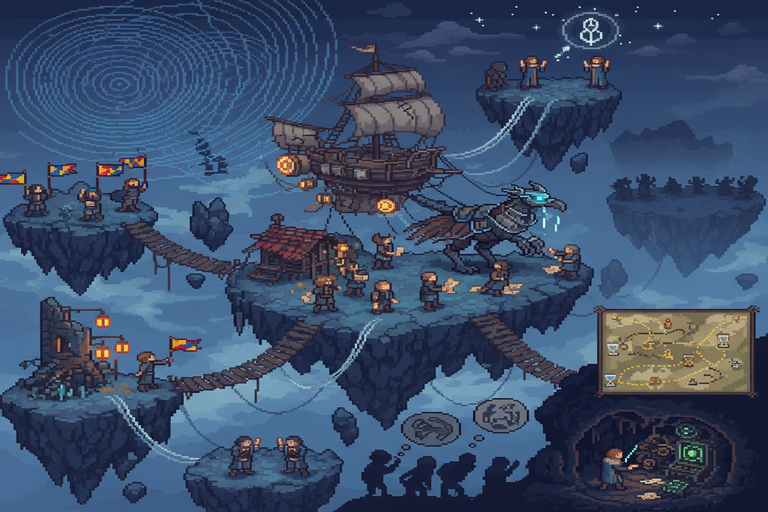
Challenge: Settlements separated by kilometers of Aether
Solution: Multiple methods (none instant)
Reality: Information travels at speed of airships
Impact: Isolation, delays, rumors, independence
“In world of instant death, communication takes weeks. By time you get warning, crisis already happened. We adapt or die.”
 Communication in the
Aetherium
Communication in the
Aetherium
Quick Reference
|| Method | Range | Speed | Reliability | Cost | Literacy Required | ||——–|——-|——-|————-|——|——————-| || Direct Speech | Line of sight | Instant | High | Free | No | || Signal Flags | Visual (1-5km) | Instant | Moderate | Low | No | || Signal Lights | Visual (10-50km) | Instant | Moderate | Low | No | || Messenger Ships | Unlimited | Days-weeks | High | High | No | || Written Messages | Unlimited | Days-weeks | High | Moderate | Yes | || Echo Zones | Special locations | Instant | Low | Free | No | || Constellation Prayers | Divine | Variable | Very Low | Free | No |
Table of Contents
- Overview
- Communication Methods
- Specialized Communication Systems
- Information Control
- Long-Distance Communication Challenges
- Pre-Shattering Communication (Lost Technology)
- Communication and Society
- Communication and Power
- Innovation Attempts
- Social Impact
- In-World Documents
- Quest Hooks
- Related Topics
Overview
Communication in the Aetherium is fundamentally limited by distance and technology. Unlike the pre-Shattering Apogee, where instant global communication was routine, modern Aetherium relies on methods that range from immediate (but short-range) to slow (but long-range). Information travels at the speed of airships—which means news from distant settlements arrives days or weeks late, crisis warnings often come after the crisis, and isolation is the default state.
This communication gap shapes everything: settlements develop independently, rumors spread faster than facts, local governance is necessary because central coordination is impossible, and personal letters become precious connections to distant loved ones.
The loss of instant communication is one of the Apogee’s most mourned technologies. Archivists preserve fragmentary texts describing constellation-resonance devices that transmitted thoughts across the world instantaneously. Current attempts to recreate this technology have all failed. We’re limited to what we have: flags, lights, ships, and hope that messages arrive before they’re obsolete.
Communication Methods
Direct Speech
Range: Line of sight (10-100 meters depending on wind, ambient noise)
Advantages: - Instant (no delay) - Free (no cost) - Reliable (if conditions allow) - Nuanced (tone, body language) - Private (if quiet)
Disadvantages: - Very short range (limited to immediate area) - Weather-dependent (wind carries voices away) - No record (unless written down) - Requires physical presence (can’t communicate with distant settlements)
Usage: Primary method within settlements - Market negotiations - Personal conversations - Council meetings - Teaching - Everyday life
Amplification: Rare - Speaking horns (metal cones, increase range to ~200 meters) - Echo chambers (architectural, specific buildings) - Shouting (crude but effective)
Signal Flags
System: Navigator’s Code (standardized) - Developed Year 25 S. (early post-Shattering) - Universal adoption by Year 50 S. - 47 basic signals (expanded over time) - Color-coded (meaning varies by color) - Position-coded (meaning varies by position)
Range: Visual distance - Clear conditions: 5km - Hazy conditions: 1-2km - Storms: Useless (can’t see) - Night: Difficult (requires illumination)
Common Signals: - Red flag, top position: Danger/Emergency - Green flag, middle: All clear/Safe passage - Blue flag, bottom: Request assistance - Yellow flag, waving: Attention required - Black flag: Distress (immediate help needed) - White flag: Surrender/Truce - Multiple flags: Complex messages (combinations)
Ship-to-Ship: Primary use - Airships communicate while traveling - Warnings (storms, pirates, Rot-clouds) - Greetings (friendly vessels) - Identification (Guild ships, military, independent) - Coordination (fleet movements)
Settlement-to-Ship: Secondary use - Harbor signals (docking instructions) - Weather warnings (storms approaching) - Market information (prices, availability) - News (major events)
Limitations: - Weather (fog, storms obscure) - Distance (beyond visual range useless) - Literacy (not required, but complex messages difficult) - Standardization (some settlements use local variants)
Signal Lights
Types:
Lanterns: Portable - Oil-burning (expensive fuel) - Shuttered (can flash patterns) - Colors (filters change meaning) - Range: 1-5km at night
Bonfires: Stationary - Large fires (visible far) - Smoke signals (day) - Light signals (night) - Range: 10-30km - Cost: High (fuel consumption)
Mirrors: Day only - Reflect sunlight (or constellation-light) - Flash patterns (coded messages) - Range: 20-50km in clear conditions - Stormwatch Outpost primary use
Lighthouse: Rare - Permanent structures (few exist) - Skyport Eos lighthouse (mysteriously still glows, no fuel) - Navigation aid (guides ships) - Warning system (color changes indicate danger)
Codes: Standardized - Short flashes: Dots - Long flashes: Dashes - Patterns spell words (slow but functional) - Complex messages possible (time-consuming) - Emergency codes (universally recognized)
Emergency Signals: - Three flashes: Help needed - Continuous flashing: Extreme danger - Red light: Fire/Rot/Immediate threat - No light (expected light): Settlement in trouble
Limitations: - Line of sight required (islands, mountains block) - Weather-dependent (storms, fog obscure) - Night/day specific (some methods only work in specific conditions) - Interpretation (codes must be known)
Messenger Ships
System: Dedicated transport - Ships carry messages (physical delivery) - Guild operates regular routes (scheduled) - Independent messengers (expensive but available) - Military couriers (priority, restricted)
Speed: Days to weeks - Eos to Ironhold: 3-7 days (150km) - Eos to Murky Chasm: 7-10 days (250km) - Eos to Periphery: 20+ days (500km+) - Weather delays common (storms, currents)
Cost: - Guild service: 5-10 Coins (standard message) - Private courier: 20-50 Coins (dedicated ship) - Military: Not available to civilians - Emergency: 100+ Coins (immediate departure)
Reliability: High (if ship survives) - 98% delivery rate (normal routes) - 90% delivery rate (dangerous routes) - 50% delivery rate (Periphery, Deeps) - Lost ships: Messages lost too
Message Types: - Personal letters (family, friends) - Business contracts (trade, agreements) - Official communications (government, Guild) - News (events, information) - Emergency warnings (often arrive too late)
Guild Monopoly: Controversial - Controls most routes (economic power) - Can delay messages (political tool) - Can read messages (privacy concerns) - Can refuse service (censorship) - Alternatives exist (but expensive, dangerous)
Written Messages
Materials: - Paper: Expensive (10 Bits per sheet) - Ink: Moderate cost (5 Bits per bottle) - Parchment: Very expensive (animal skin, rare) - Slate: Reusable (cheap but heavy)
Literacy: Limited - ~40% can read/write (up from 20% in Year 100) - Urban areas: 60% literate - Rural areas: 20% literate - Wealthy: 90% literate - Poor: 10% literate
Scribes: Professional writers - Available in major settlements - Write letters for illiterate (1-5 Coins) - Read letters aloud (1 Coin) - Trusted (confidentiality expected) - Sometimes corrupt (sell information)
Preservation: Valuable - Paper is expensive (letters kept, reused) - Important documents (contracts, deeds, wills) - Historical records (Archivists preserve) - Personal letters (treasured)
Formats: - Personal letters (family, friends) - Business contracts (trade, agreements) - Official proclamations (government announcements) - News sheets (rare, expensive, major settlements only) - Books (extremely rare, mostly pre-Shattering)
Echo Zones
Nature: Aether phenomenon - Pockets where sound repeats endlessly - Mysterious (no one understands why) - Rare (few known locations) - Dangerous (your voice trapped forever)
Usage: Message boards - Shout message into Echo - Sound repeats (hours, days, years) - Others visit, hear message - Public (anyone can hear) - Unreliable (Echo might fade, distort)
Known Locations: - The Whispering Canyon (near Skyport Eos) - Echo Shard (Periphery) - The Voice Chamber (Murky Chasm) - Three others (locations secret)
Etiquette: - Keep messages brief (don’t pollute Echo) - Important information only - No secrets (everyone can hear) - Respect previous messages (don’t shout over)
Dangers: - Prolonged exposure (psychological effects) - Hearing own voice forever (disturbing) - Sensitive information (becomes public) - Echo madness (some people can’t leave, trapped listening)
Constellation Prayers
Method: Divine communication - Pray to constellation (request information) - Sometimes answered (rarely) - Information revealed (visions, dreams, insights) - Unreliable (gods are silent)
Success Rate: Very low - Pre-Shattering: 80% (constellations answered reliably) - Year 100 S.: 40% (declining) - Year 250 S.: 10% (crisis) - Year 287 S.: <5% (catastrophic)
When It Works: Valuable - Instant (no delay) - Accurate (divine knowledge) - Comprehensive (gods see everything) - Free (no cost except faith)
When It Doesn’t: Useless - No response (silence) - Ambiguous response (unclear) - Wrong response (misinterpreted) - False hope (psychological, not divine)
Usage: Desperate situations - Lost travelers (pray for guidance) - Urgent warnings (pray for divine message) - Important decisions (pray for wisdom) - Last resort (when other methods failed)
Specialized Communication Systems
Storm-Sailor Signals
Hand Signs: Complex vocabulary - 200+ signs (full language) - Used in storms (shouting impossible) - Fast (instant communication) - Requires training (years to master) - Cultural (Storm-Sailor identity)
Whistles: Piercing sounds - Carry through wind (storms can’t drown) - Patterns encode meaning (simple messages) - Emergency signals (universally recognized) - Range: 500 meters in storm
Flags: Clan-specific - Each clan has unique patterns - Identification (friend or foe) - Status (hunting, trading, fleeing) - Warnings (danger, Rot, pirates)
Lights: Storm navigation - Colored lanterns (meaning varies by color) - Flash patterns (encoded messages) - Constellation-light reflection (mirrors, even in storms) - Critical for survival
Military Communication
Ironhold System: Highly organized - Chain of command (clear hierarchy) - Standardized signals (no ambiguity) - Encrypted messages (officers only) - Fast response (dedicated couriers) - Discipline (failure = punishment)
Signal Codes: Military-specific - Attack patterns (coordinated strikes) - Retreat signals (organized withdrawal) - Status reports (unit conditions) - Intelligence (enemy movements) - Emergency (immediate response required)
Messenger Corps: Elite unit - Fast ships (best vessels) - Skilled pilots (best navigators) - Priority (other ships yield) - Dangerous (targeted by enemies) - Honored (critical role)
Encryption: Officers only - Coded language (substitution cipher) - Changed regularly (security) - Decryption keys (held by commanders) - Captured messages (useless without key) - Paranoia (Vask trusts no one)
Criminal Networks
Dead Drops: Physical locations - Hidden spots (known only to network) - Messages left (picked up later) - Untraceable (no direct contact) - Slow (hours to days delay) - Secure (if location secret)
Murk Argot: Coded language - Criminal slang (verbal obfuscation) - Double meanings (innocent-sounding) - Constantly evolving (security through change) - Insider knowledge (must be taught) - The Captain uses this (identity protection)
Symbols: Underground marks - Carved, chalked, painted (subtle) - Meanings (safe house, danger, goods available, watch out) - Locations (Underbelly, Murky Chasm, black markets) - Recognition (criminals know, authorities don’t) - Constantly changing (authorities learn, criminals adapt)
Black Sky Cartel: Sophisticated network - Couriers (dedicated, loyal, well-paid) - Encryption (coded messages) - Dead drops (multiple locations) - Signals (flags, lights, symbols) - Better than Guild (ironically)
Information Control
Sky-Guild Control
Messenger Routes: Monopoly - Guild operates most regular routes - Can delay messages (political tool) - Can read messages (privacy violation) - Can refuse service (censorship) - Power (information is power)
Official Policy: Neutrality - “We deliver all messages” (claimed) - “We don’t read private correspondence” (claimed) - “We serve all customers equally” (claimed)
Reality: Manipulation - Guild reads sensitive messages (absolutely) - Guild delays inconvenient news (regularly) - Guild shares information with allies (constantly) - Guild censors when profitable (occasionally) - Everyone knows (but can’t prove)
Alternatives: Expensive - Independent couriers (Captain Jorah, others) - Private ships (if you own one) - Personal travel (deliver message yourself) - Criminal networks (if desperate)
Settlement Censorship
Varies by Location:
Skyport Eos: Moderate - Elder Council reviews sensitive information - Censors panic-inducing news (Rot projections, population decline) - Allows criticism (democratic tradition) - Balances transparency and stability
Ironhold: Strict - Commandant Vask controls all information - Censors dissent (criticism forbidden) - Propaganda (official narrative only) - Surveillance (monitors communications) - Oppressive (but “necessary for security”)
Outlands: Minimal - Clans value free speech - No censorship (information shared openly) - Rumors common (no fact-checking) - Misinformation spreads (but so does truth)
Murky Chasm: None - Anything goes (no authority) - Truth, lies, secrets all shared - Information economy (knowledge is currency) - Dangerous (knowing wrong thing can kill you)
Information Trading
Black Market: Vex specializes - Buys secrets (pays well) - Sells information (charges more) - Brokers deals (connections are valuable) - Discretion (guaranteed, usually) - Dangerous (some information kills)
Prices (Vex’s rates): - Minor gossip: 1-5 Coins - Useful intelligence: 10-50 Coins - Critical secrets: 100+ Coins - Dangerous knowledge: Favors (more valuable than coins)
The Archivists: Knowledge preservation - Collect information (historical, scientific, cultural) - Preserve texts (fragments, copies) - Share knowledge (make accessible) - Free (public service) - Trusted (neutral, honest)
Long-Distance Communication Challenges
Delay
Problem: Information travels slowly - Eos to Ironhold: 3-7 days minimum - Eos to Periphery: 20+ days - By time message arrives: Situation changed
Impact: Crisis management - Storm warnings (arrive after storm) - Rot alerts (arrive after corruption spreads) - Emergency requests (arrive too late) - Time-sensitive decisions (made with old information)
Adaptation: Local autonomy - Settlements govern themselves (can’t wait for central authority) - Captains make decisions (can’t consult headquarters) - Individuals act independently (can’t ask permission) - Necessary (but fragments society)
Distortion
Problem: Rumors spread faster than facts - Exciting news (spreads quickly, exaggerated) - Boring truth (spreads slowly, ignored) - By time fact arrives: Rumor is believed
Examples: - “Ironhold is invading!” (rumor, spreads in hours) - “Ironhold is considering military exercises” (fact, arrives in days) - Everyone believes rumor (fact is boring)
Impact: Misinformation - Panic (based on false information) - Decisions (based on rumors, not facts) - Conflicts (misunderstandings escalate) - Trust (eroded by constant misinformation)
Mitigation: Difficult - Official sources (but delayed) - Trusted messengers (but expensive) - Multiple confirmations (but time-consuming) - Skepticism (but exhausting)
Isolation
Problem: Remote settlements rarely contacted - Periphery settlements (weeks away) - Small islands (not on major routes) - Dangerous locations (messengers avoid) - Result: Isolation (months without news)
Impact: Independence - Develop own solutions (can’t ask for help) - Preserve own traditions (no cultural exchange) - Make own decisions (no coordination) - Sometimes thrive (self-sufficiency) - Sometimes die (no one knows until later)
The Silence Events: Extreme example - 23 islands found empty (populations vanished) - No one knew (until discovery, weeks/months later) - No warning (couldn’t call for help) - No explanation (still) - Isolation can be fatal
Pre-Shattering Communication (Lost Technology)
Constellation-Resonance Devices
Description (from fragmentary texts): - Transmitted thoughts/words instantly - Global range (anywhere to anywhere) - Required trained operators (Star-Readers) - Powered by unknown source (still mystery) - Expensive but widespread (Apogee era)
How It Worked (theorized): - Astral Geometry (constellation connection) - Resonance (thoughts transmitted through stellar medium) - Reception (other device receives, translates) - Instant (no delay, regardless of distance) - Lost (irreproducible)
Why It’s Lost: - Devices destroyed (Shattering) - Knowledge lost (Star-Readers died) - Constellations silent (can’t establish connection) - Technology irreproducible (too advanced) - Attempts failed (all of them)
Impact of Loss: Catastrophic - Coordination impossible (settlements isolated) - Warnings delayed (crises worsen) - Unity impossible (can’t maintain global society) - Humanity fragmented (literally and socially)
Returner Goal: Recover this technology - Find Luminar Archives (instructions might be there) - Recreate devices (if possible) - Restore instant communication (reconnect humanity) - Controversial (might repeat Apogee’s mistakes)
Communication and Society
Personal Letters
Significance: Precious - Connection to distant loved ones - Only way to maintain relationships (across islands) - Treasured (read repeatedly) - Preserved (kept for years) - Sometimes only thing sustaining hope
Frequency: Rare - Cost (10-20 Coins per letter including delivery) - Delay (weeks for round trip) - Most people: 1-2 letters per year (to distant family) - Wealthy: Monthly letters (can afford) - Poor: Never (too expensive)
Content: Emotional - “I miss you” (universal) - “I’m alive” (reassurance) - “Come home” (longing) - “Things are hard here” (honesty) - “I love you” (always)
Example Letter (common format):
Dear Mother,
I’m alive. Work is hard but I’m managing. The settlement is safe (for now). I miss you. I miss home. I’ll visit when I can afford passage.
How are you? How is father? How is little sister? I think of you constantly.
I’m sending 20 Coins (half my savings). Use it for food, medicine, whatever you need. I’ll send more when I can.
I love you. I’ll write again soon (when I can afford it).
Your son
Delivery: Emotional moment - Messenger arrives (excitement) - Letter delivered (hands shaking) - Read immediately (or savored) - Reread constantly (connection to loved one) - Replied to (if affordable)
News and Information
News Sheets: Rare - Major settlements only (Eos, Ironhold) - Published irregularly (when enough news) - Expensive (5 Coins per sheet) - Read aloud (in taverns, markets) - Shared (one sheet, many listeners)
Content: - Major events (wars, disasters, discoveries) - Trade information (prices, routes, availability) - Official announcements (laws, policies) - Gossip (popular, unreliable) - Advertisements (services, goods)
Tavern News: Primary source - Travelers share information (free) - Pilots report (what they’ve seen) - Merchants gossip (trade intelligence) - Exaggerated (stories grow in telling) - Unreliable (but entertaining)
Official Announcements: - Posted publicly (market squares) - Read aloud (for illiterate) - Discussed (community debates) - Sometimes ignored (if unpopular)
Misinformation and Rumors
Problem: Rumors spread faster than facts - Exciting (people share) - Simple (easy to remember) - Emotional (triggers response) - Often false (but believed)
Examples (Year 287 S.): - “Ironhold is invading Murky Chasm” (rumor, spreads in days) - “Ironhold is planning military exercises near Murk” (fact, arrives in weeks) - “The Rot has cure” (rumor, false hope) - “Alchemist Kael claims progress on Rot research” (fact, qualified) - “Constellations are dead” (rumor, terrifying) - “Constellation prayer success rate declining” (fact, statistical)
Impact: Panic, decisions based on false information, conflicts from misunderstandings
Mitigation: Difficult - Trust reliable sources (but who?) - Wait for confirmation (but time-sensitive) - Verify independently (but expensive) - Accept uncertainty (but uncomfortable)
Communication and Power
Information is Power
Who Controls Information: - Sky-Guild (messenger routes) - Authorities (censorship) - Criminals (secrets) - Archivists (historical knowledge) - Individuals (personal secrets)
How It’s Used: - Political (manipulate, control, influence) - Economic (trade intelligence, market manipulation) - Social (reputation, gossip, relationships) - Military (intelligence, strategy) - Personal (secrets, leverage, protection)
The Game: Everyone plays - Hoard valuable information (sell it) - Share useless information (misdirect) - Spread misinformation (manipulate) - Seek truth (expensive, difficult) - Trust no one (paranoia justified)
The Archivist Exception
Philosophy: Knowledge should be free - Preserve information (historical, scientific) - Share openly (make accessible) - No censorship (truth matters) - No profit (public service)
Reality: Complicated - Some knowledge is dangerous (Luminar Archives) - Some information causes panic (extinction projections) - Some secrets protect people (identities, locations) - Balance required (transparency vs. safety)
Respect: Universal - Archivists trusted (neutral, honest) - Information reliable (verified, sourced) - Access free (anyone can ask) - Limitations (won’t share dangerous knowledge)
Innovation Attempts
Signal Towers
Concept: Relay stations - Tall towers (maximize visual range) - Signal lights/flags (relay messages) - Chain of towers (extend range) - Theoretically: Could connect distant settlements
Attempts: Several - Year 180 S.: Eos-Ironhold chain (5 towers) - Year 190 S.: Expansion attempted (10 more towers) - Year 195 S.: Project abandoned (too expensive, maintenance difficult)
Failures: - Cost (building, staffing towers) - Maintenance (constant repairs) - Weather (storms destroy towers) - Limited capacity (simple messages only) - Not worth it (ships more reliable)
Existing: Few - Stormwatch Outpost (weather warnings) - Ironhold military (tactical communications) - Three others (private, specific purposes)
Carrier Birds
Attempts: Multiple - Cloud-Hoppers (native birds) - Trained (homing instinct) - Message capsules (attached to legs) - Released (fly to destination)
Problems: - Navigation (birds don’t navigate Aether well) - Predators (Sky-Rats, Storm-Serpents eat them) - Weather (storms kill them) - Range (limited, short distances only) - Reliability (50% arrival rate)
Current Use: Limited - Short distances (island to island, <10km) - Non-critical messages (can afford loss) - Backup system (if ships unavailable) - Stormwatch Outpost (12 birds, emergency use)
Success Rate: 50% (too low for critical messages)
Aether-Current Messaging
Theory: Messages in bottles - Sealed container (waterproof, airtight) - Released into Aether-current (drifts) - Hopefully reaches destination (eventually) - Picked up by whoever finds it
Reality: Useless - No control (currents unpredictable) - No targeting (might go anywhere) - No timeline (might take years) - No reliability (might never arrive) - Desperation method only
Usage: Last resort - Stranded travelers (hoping for rescue) - Dying messages (final words) - Time capsules (messages to future) - Rarely successful (but sometimes)
Social Impact
Delayed News
Reality: Events are weeks old when heard - Births (baby is weeks old when grandparents hear) - Deaths (funeral is over when family learns) - Crises (resolved or worsened by time news arrives) - Opportunities (gone by time you hear about them)
Adaptation: Acceptance - “News is history” (common saying) - React to what you know (not what’s happening) - Make decisions with old information (best you can do) - Hope for the best (can’t do more)
Regional Variation
Independence: Forced by communication limits - Settlements develop own solutions (can’t coordinate) - Cultures diverge (limited exchange) - Traditions vary (no standardization) - Languages diverge (dialects emerging) - Unity difficult (fragmentation natural)
Advantages: - Diversity (cultural richness) - Resilience (if one settlement fails, others continue) - Innovation (different approaches, some work) - Freedom (no central control)
Disadvantages: - Coordination impossible (can’t unite against threats) - Redundancy (everyone solves same problems separately) - Conflicts (misunderstandings, different values) - Weakness (divided, not united)
Personal Connections
Maintaining Relationships: Difficult - Family separated (by distance) - Friends lost touch (can’t afford letters) - Lovers apart (years without contact) - Loneliness (isolation is default)
Precious Moments: Communication succeeds - Letter arrives (connection renewed) - Traveler brings news (loved one is alive) - Signal seen (settlement is safe) - Prayer answered (divine message received) - Hope sustained (we’re not alone)
In-World Documents
Guild Messenger’s Log (Year 287 S.)
Route: Skyport Eos to Ironhold Duration: 5 days (good weather) Cargo: 47 letters, 12 business contracts, 3 official documents
Day 1: Departed Eos at dawn. Weather clear. Aether-currents favorable. Made good time.
Day 2: Passed Windmere Farms. Signaled greetings. Continued.
Day 3: Storm warning from Stormwatch. Detoured south. Lost half day.
Day 4: Weather cleared. Resumed course. Ironhold visible by evening.
Day 5: Arrived Ironhold. Delivered messages. Collected return cargo (23 letters, 8 contracts). Departed immediately.
Return: 4 days (favorable currents). Total trip: 9 days.
Earnings: 235 Coins (delivery fees). Expenses: 50 Coins (fuel, food, docking). Profit: 185 Coins.
Notes: Read three letters (Guild policy, checking for sensitive information). One mentioned Vask’s war plans (reported to Guild-Master). Two were personal (boring, ignored).
Privacy is myth. Everyone knows. No one admits it.
—Messenger Kael Swiftwind
Personal Letter (Typical Example)
Dearest Mara,
It’s been six months since I left for Ironhold. I miss you every day. Every hour. Every moment.
Work is hard. The forges are hot, the hours long, the overseers harsh. But I’m earning. Saving. In two years, I’ll have enough to return. To buy a house. To marry you.
Two years. It feels like forever. But I’ll endure. For us. For our future.
How are you? How is your mother? Did the harvest succeed? Is the settlement safe?
I’m sending this letter with Guild messenger. It cost 15 Coins (half a week’s wages). Worth it. To know you’ll read my words. To know you’ll know I’m thinking of you.
I love you. I’ll love you forever. Wait for me. I’m coming home.
Yours always, Torven
[Note: Letter took 7 days to arrive. Mara’s response took 8 days to return. 15 days for one exchange. They endured this for two years. Then married. Still together, Year 287 S.]
Echo Zone Message (The Whispering Canyon)
[Echo repeats endlessly. Message recorded Year 285 S. Rescue never came. Fragment 47-Delta found Year 286 S. One body. He died alone. Echo still repeats his plea.]
Vask’s Communication Directive (Ironhold, Year 286 S.)
TO ALL IRONHOLD CITIZENS
SUBJECT: Communication Protocols
EFFECTIVE IMMEDIATELY:
- All outgoing messages must be approved by military censors
- All incoming messages will be reviewed for sensitive content
- Unauthorized communication with enemy settlements (Murky Chasm, Rot-Touched) is FORBIDDEN
- Violation of these protocols is punishable by imprisonment
JUSTIFICATION: Security. We’re preparing for military action. Information leaks endanger lives. Temporary measures. For your protection.
COMPLIANCE: Mandatory.
Note: “Temporary” measures still in effect Year 287 S. Underground resistance uses criminal networks to communicate. [Vask knows. Can’t stop it. Paranoia intensifies.]
Archivist’s Note on Communication Loss
Subject: The Cost of Losing Instant Communication
Pre-Shattering: Luminar Council could coordinate globally, instantly. Crisis anywhere = response everywhere, immediately.
Post-Shattering: Settlements isolated. Crisis in Eos? Ironhold learns days later. Too late to help.
Impact: - Coordination impossible (can’t unite) - Crises worsen (no fast response) - Isolation default (connection is effort) - Humanity fragmented (literally, socially)
Question: If we recovered instant communication, would it save us?
Answer: Maybe. Or maybe it would enable tyrants (Vask could control everything). Or maybe it would spread panic (bad news travels instantly). Or maybe it would help (coordination, unity, hope).
Conclusion: Technology is tool. Tools can build or destroy. Depends on who wields them.
We lost instant communication. Maybe that’s tragedy. Maybe that’s mercy.
—Chief Archivist Theron Bookbinder, Year 251 S.
Quest Hooks
The Delayed Warning: Carry urgent message (Rot outbreak, storm, invasion). Race against time. Will you arrive before disaster?
The Intercepted Letter: Discover Guild is reading private messages. Expose them (privacy rights) or use it (intelligence gathering)?
The Echo Rescue: Hear distress call in Echo Zone. Rescue mission (might be too late). Investigate (who was it? Can they be saved?).
The Communication Network: Help build signal tower chain (connect settlements). Expensive, difficult, possibly worthwhile.
The Lost Message: Important message never arrived (ship lost). Reconstruct message, deliver it late, deal with consequences.
The Censorship: Help resistance bypass Vask’s communication controls. Smuggle messages, use criminal networks, risk imprisonment.
The Instant Device: Discover pre-Shattering communication device (still functional!). Who gets it? Guild? Military? Archivists? Everyone wants it.
The Information Trade: Work for Vex (information broker). Gather secrets, sell intelligence, navigate dangerous knowledge economy.
The Reunion: Deliver letter that reunites separated family. Emotional, meaningful, reminder of why communication matters.
The Last Message: Dying person’s final words (to distant loved one). Deliver message. Provide closure. Honor the dead.
Related Topics
- Sky-Guild - Controls messenger routes
- Airships - Primary message transport
- The Archivists - Preserve knowledge
- Pre-Shattering Technology - Lost instant communication
- Echo Zones - Natural communication phenomenon
“In world of instant death, communication takes weeks. By time
you get warning, crisis already happened. We adapt or die.”
—Common observation
“I sent letter to my mother six months ago. Still no reply. She
might be dead. She might have never received it. She might have replied
and her letter is lost. I don’t know. That’s communication in the
Aetherium. Uncertainty is default.”
—Personal reflection
“Pre-Shattering,
they could talk to anyone, anywhere, instantly. We can’t imagine it. We
send letters that take weeks, hope they arrive, wait months for replies.
That’s normal to us. To them, it would be nightmare. Perspective
matters.”
—Archivist’s observation