Languages
“Tongues of the Shattered Sky”
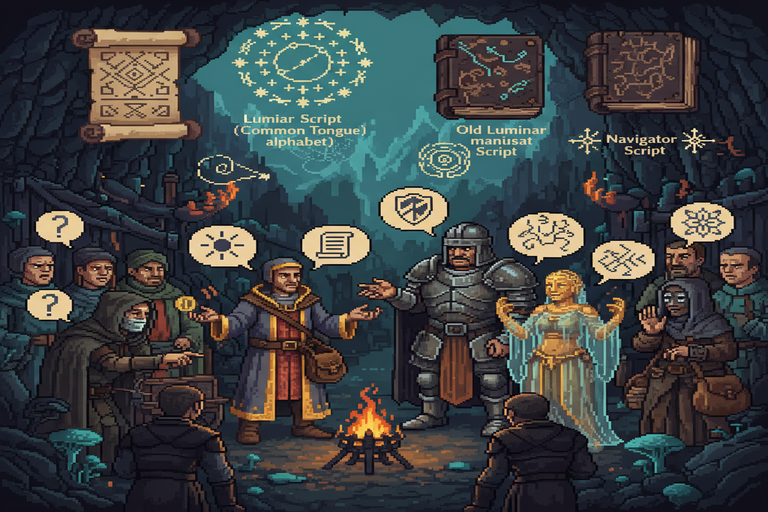 Languages of the
Aetherium
Languages of the
Aetherium
Common Tongue
Name: Aeridian (or just “Common”) Status: Universal language (all settlements speak) Origin: Pre-Shattering trade language (survived, evolved) Script: Luminar Script (alphabetic, 32 letters) Literacy: ~40% (clergy-educated, wealthy, necessary professionals)
Regional Dialects
Eos Dialect
Characteristics: Clear, formal, closest to “proper” Common Influences: Clergy terminology, diplomatic language Status: Prestige dialect
Ironhold Cant
Characteristics: Clipped, military terminology, direct Influences: Command structure, efficiency focus Distinctives: Rank integration (addressing = rank + name)
Murk Argot
Characteristics: Coded, criminal slang, constantly evolving Influences: Black Sky Cartel, need for secrecy Outsiders: Incomprehensible (intentional) Example: “Veil the shadow” = hide stolen goods
Storm-Tongue
Characteristics: Terse, weather terminology, clan-specific Influences: Navigation necessity, limited contact Distinctives: No word for “ground” (concept foreign)
Ancient Languages
Old Luminar
Status: Dead language (scholarly only) Speakers: Archivists, clergy scholars, researchers Uses: Reading pre-Shattering texts Script: Luminar Script (same as Common, older grammar) Knowledge: Rare, valuable
Star-Script
Status: Ceremonial (constellation rituals) Appearance: Stylized, constellation-based symbols Uses: Religious texts, sacred architecture Understanding: Clergy learns, others recognize visually Power: Claimed magical (unverified)
Specialized Languages
Trade Cant
Purpose: Inter-settlement commerce Features: Numbers, goods, prices (universal terms) Simplified: Grammar minimal (communication priority) Users: Merchants, Guild members, traders
Navigator’s Code
Purpose: Aerial navigation communication Features: Weather, directions, warnings (standardized) Critical: Safety requires understanding Learning: All pilots must know
Thieves’ Cant
Purpose: Criminal communication Features: Code words, gestures, symbols Secret: Taught selectively Regional: Varies by organization
Non-Verbal Communication
Storm-Sailor Signals
Method: Hand signals, flags, lights Necessity: Wind too loud for speech Complex: Full conversations possible Clan-Specific: Each clan has variations
Underground Marks
Users: Underbelly residents, homeless, criminals Method: Scratched symbols (walls, doorways) Meanings: “Safe house,” “Guard patrol,” “Food here,” etc. Hidden: Unnoticed by authorities
Constellation Gestures
Religious: Prayer positions, blessing signs Universal: Across dialects/regions Examples: - Hand over heart (Shepherd—protection) - Fingers to forehead (Light—clarity) - Closed fist (Broken Chain—resistance)
Literacy
Who Reads
Clergy: Universal literacy (job requirement) Wealthy: Educated children (privilege) Guild Members: Contracts necessity (learns reading) Military Officers: Reports, orders (Ironhold requirement) Common Folk: Mostly illiterate (oral tradition)
Education
Clergy Schools: Free but limited spots Private Tutors: Wealthy only Apprenticeship: Learns job-specific reading Self-Taught: Rare but possible
Lost Languages
Pre-Shattering Diversity
Historical: Multiple languages existed Shattering: Most died (speakers lost, texts destroyed) Fragments: Occasional discovered texts (untranslatable) Archivists: Attempt reconstruction (limited success)
Evolution
Constant: Languages change (new words, meanings shift)
New Terms: - Rot-related (Stage 1-4, Rot-Touched, etc.) - Technology (Aether-specific aviation terms) - Post-Shattering concepts (sky-island, corruption-zone)
Lost Terms: - Ground-travel words (roads, vehicles) - Pre-Shattering tech (mostly) - Forgotten concepts
Language and Identity
How Dialect Marks You
Eos Dialect: Educated, proper, trustworthy Ironhold Cant: Military, disciplined, harsh Murk Argot: Criminal, dangerous, clever Storm-Tongue: Exotic, brave, strange No Accent: Void-Kin (native Common speakers)
Code-Switching
Practice: Change dialect based on audience Merchants: Master this (speak to everyone) Criminals: Hide origins (blend in) Educated: Speak “proper” in public, dialect in private Survival Skill: Speaking “right” dialect matters
Unique Vocabulary
Post-Shattering Concepts
Sky-Island: Floating land fragment Aether-Current: Invisible flow in void Rot-Touched: Corrupted individual Sky-Strider: Professional wanderer The Fall: Death by falling into void Constellation-Light: Starlight (used for time)
Lost Concepts
Road: No longer exists (paths on islands, but not roads) Ocean: Gone (Aether replaced it) Horizon: Meaningless (void extends infinitely) Seasons: Unclear (Aether doesn’t have traditional seasons) Ground: Storm-Sailors don’t have this word
Rot Terminology (Extensive)
Stage 1-4: Corruption progression Hollow: Terminal transformation The Voice: Voice Beneath Sanctification: Rot-cleansing ritual Corruption Field: Rot-radiating area Amalgam: Fused horror
Related Topics
- Common Tongue - Universal language
- Bright-Folk - Shaped Common Tongue
- Sun-Touched - Musical influence
- Veil-Born - Preserve Veil-Tongue
- Storm-Sailors - Storm-Tongue speakers
- The Archivists - Preserve old languages
In-World Documents
Common Tongue Grammar (Teaching Text)
BASIC COMMON TONGUE
Subject-Verb-Object (standard) Example: “I see ship.”
Simplified grammar (trade necessity) Minimal conjugation Context determines tense
“I see ship” = present “I see ship yesterday” = past “I see ship tomorrow” = future
Efficient. Clear. Universal.
Murk Argot Examples
“Veil the shadow” = Hide stolen goods “Falling someone” = Murder “The Captain’s eye” = Being watched “Bridge-walker” = Outsider (insult) “Rot-blessed” = Corrupted (neutral term) “Sky-clean” = Uncorrupted (suspicious) “Void-weight” = Dead body “Singing” = Informing to authorities “The Captain’s coin” = Bribe “Edge-walker” = Someone about to die “Murk-born” = Native to the Chasm (badge of honor) “Bright-blood” = Someone from Eos/Ironhold (derogatory)
Dialogue Examples: Eos Dialect vs Murk Argot
Eos Formal Dialect: > “Good morning, Captain. I trust your journey was uneventful? I would be honored to discuss potential trade arrangements at your earliest convenience.”
Same Sentiment in Murk Argot: > “Captain. You fall? Nah? Good. Let’s talk coin when you’re ready.”
Eos Formal: > “I’m afraid I must decline your generous offer. The risk exceeds my tolerance, and I have family to consider.”
Murk Argot: > “Too hot. I’m out. Got edge-walkers at home.”
Eos Formal: > “The authorities are investigating suspicious activity in the lower districts. I recommend discretion.”
Murk Argot: > “The Captain’s eye is on the Underbelly. Veil everything.”
Storm-Sailor Vocabulary
Storm-Sailors have 47 words for different types of wind. They have 23 words for different Aether-current conditions. They have no word for “ground.”
Language reflects life. Their life is air.
Examples of Wind Words: - Keth-wind: Gentle, steady wind from above (good for sailing) - Murr-wind: Turbulent, unpredictable gusts - Shal-wind: Cold wind that precedes storms - Veth-wind: Warm updraft (dangerous near island edges) - Kora-wind: The wind that carries voices (eerie, avoided) - Thren-wind: Dead air, no movement (terrifying to Storm-Sailors)
Examples of Aether-Current Terms: - Bright-current: Fast, visible current (safe to ride) - Ghost-current: Invisible, only felt (requires skill) - Rot-current: Current flowing from corrupted areas (avoid) - Spiral-current: Circular current (can trap ships) - Deep-current: Downward-pulling current (deadly)
Ironhold Cant Examples
Military Terminology Integration: > “Rank-Captain Ironwind, sir!” (Rank always precedes name) > “Status: green, sir.” (Report format: Status first, elaboration after) > “Orders received. Executing.” (Acknowledgment must be verbal and immediate) > “Hostile contact, bearing three-seven, distance close.” (Precise, no emotion)
Civilian Adaptation: > Even non-military Ironhold residents adopt clipped speech: > “Market. Bread. Three loaves.” (Instead of: “I’d like to buy three loaves of bread at the market.”) > “Status?” (Instead of: “How are you?”) > “Acknowledged.” (Instead of: “I understand.”)
Ironhold Slang: - Wall-side: Safe, protected (literal: inside the walls) - Out-side: Dangerous, unprotected (literal: outside the walls) - Rank-less: Civilian (neutral term) - Soft: Someone from outside Ironhold (derogatory) - Hard: Ironhold native (compliment) - Rust: Corruption, Rot, or moral weakness - Steel: Strength, purity, reliability
Overheard Conversations: Dialect in Action
Scene: Skyport Eos Market
Bright-Folk merchant speaking to Ironhold guard: > “Good sir, I assure you, these star-blossoms are freshly harvested. The quality is exceptional, and the price reflects the difficulty of—”
Guard interrupts in Ironhold Cant: > “Price. Now.”
Merchant (switching to simpler Common): > “Ah. Ten coins. Each.”
Guard: > “Acknowledged. Taking five.”
Scene: Murky Chasm Alley
Two smugglers in Murk Argot: > “The Captain’s eye on the docks?” > > “Nah. Bright-blood singing, though. Veil everything till the Turning.” > > “Void-weight?” > > “Already fell. Clean.” > > “Good. Coin tomorrow.”
Translation for outsiders: > “Are authorities watching the docks?” > > “No. But someone from Eos is informing. Hide everything until next month.” > > “The body?” > > “Already disposed of in the Aether. No evidence.” > > “Good. Payment tomorrow.”
Scene: Storm-Sailor Ship
Captain to crew (Storm-Tongue with hand signals): > “Keth-wind, bearing high-sun. Bright-current below. Ride it three-marks, then veth-wind shift. Watch for murr-wind at edge-zone.”
Translation: > “Steady wind from above. Fast current below us. Follow it for three hours, then expect warm updrafts. Watch for turbulence near the island’s edge.”
Language Learning Difficulty
For Native Common Speakers:
Easy to Learn: - Trade Cant (designed for simplicity) - Navigator’s Code (standardized, practical) - Basic Eos Dialect (formal Common)
Moderate Difficulty: - Ironhold Cant (requires understanding military culture) - Thieves’ Cant (requires trust to be taught) - Old Luminar (dead language, but grammar similar to Common)
Difficult: - Murk Argot (constantly evolving, context-dependent) - Storm-Tongue (requires understanding of aerial navigation) - Star-Script (ceremonial, symbolic rather than phonetic)
Nearly Impossible: - Pre-Shattering lost languages (no living speakers, fragmentary texts) - The Voice Beneath’s language (if it even is a language)
Language and Power
Who Controls Language:
The Clergy: Preserves Old Luminar, controls Star-Script interpretation - Power: Can declare texts “heretical” or “orthodox” - Gatekeeping: Only clergy can read oldest religious texts - Influence: Shapes how constellations are understood
The Archivists: Document and preserve all languages - Power: Decide what gets recorded for posterity - Knowledge: Understand multiple dialects and dead languages - Neutral: Share knowledge freely (mostly)
The Black Sky Cartel: Controls Murk Argot evolution - Power: Outsiders can’t understand criminal communications - Exclusion: Not teaching outsiders maintains criminal advantage - Innovation: Constantly create new terms to stay ahead of authorities
The Sky-Guild: Standardizes Trade Cant and Navigator’s Code - Power: Control communication in commerce and travel - Regulation: Can fine pilots who don’t use proper terminology - Safety: Standardization prevents miscommunication accidents
Language Death and Preservation
Languages Lost in the Shattering:
Scholars estimate 40-60 distinct languages existed pre-Shattering. Only Common (Aeridian) survived widespread.
Why Common Survived: - Already the trade lingua franca - Spoken across all regions pre-Shattering - Simple grammar made it easy to teach children - Necessity: Survivors from different regions needed to communicate
Languages Partially Preserved: - Veil-Tongue: Veil-Born ethnic group maintains fragments - Storm-Tongue: Evolved from pre-Shattering coastal language - Old Luminar: Preserved in religious texts
Languages Completely Lost: - Names unknown (no records survived) - Occasional inscriptions found in ruins (untranslatable) - Archivists’ greatest regret: “We lost entire ways of thinking when those languages died.”
Preservation Efforts: - Archivists record all dialects and slang - Clergy preserves religious languages - Storytellers maintain oral traditions - Some families teach children “old words” from pre-Shattering
The Future of Language
Current Trends:
Simplification: Common is becoming simpler - Grammar rules relaxing - Vocabulary shrinking (fewer words for pre-Shattering concepts) - Efficiency prioritized over elegance
Dialect Divergence: Isolated islands developing unique speech - Without regular contact, language evolves separately - Some islands’ dialects becoming mutually unintelligible - Reunification after decades apart requires “translation”
New Vocabulary: Post-Shattering concepts require new words - Rot-related terminology expanding rapidly - Aether navigation terms proliferating - Constellation worship creating new religious vocabulary
Language Mixing: Trade increases borrowing - Murk Argot terms entering mainstream slang - Storm-Tongue wind-words adopted by pilots - Ironhold military terms spreading to other settlements
Archivists’ Prediction: > “In 200 years, Common will have fractured into mutually unintelligible regional languages. Unless the Sky-Guild maintains trade routes and enforces linguistic standardization, humanity will lose the ability to communicate across the Aetherium. We will become isolated not just by distance, but by language itself.”
Quest Hooks
The Untranslatable Text: Archivists discover pre-Shattering text in unknown language. Need linguist or magical translation.
The Spy’s Dialect: Infiltrate Murky Chasm, but Murk Argot is incomprehensible. Find teacher or risk exposure.
The Lost Clan: Storm-Sailor clan isolated for 50 years. Their Storm-Tongue dialect has diverged. Negotiate peace treaty despite language barrier.
The Heretical Inscription: Old Luminar text in ruins contradicts Clergy teachings. Translate secretly or report to authorities?
The Voice’s Words: Rot-corrupted individual speaks in unknown language. Is it pre-Shattering tongue or something else?
The Standardization Debate: Sky-Guild wants to ban regional dialects for “safety.” Cultural preservation vs practical necessity.
The Code-Breaker: Black Sky Cartel’s Murk Argot has been cracked by Ironhold intelligence. Cartel needs new code system.
The Silenced Tongue: Entire settlement’s population loses ability to speak (Silence phenomenon). Communicate via writing, but many are illiterate.
The Star-Script Secret: Ancient Star-Script inscription might contain cure for Rot. Only one elderly priest can read it, and they’re dying.
The Translator’s Dilemma: Hired to translate negotiations between factions. Mistranslation could start war. Accurate translation reveals terrible truth.
“Common Tongue connects us across the shattered Aetherium. It’s
the language of trade, of survival, of shared humanity. But dialects
distinguish us—mark where we’re from, who we are, what we’ve
experienced. Language is identity. Language is power. Language is what
keeps humanity human, even when the world is broken.”
—From Linguistic Studies by Archivist Scholar