Bright-Folk
“People of the Center” / “The Majority” / “Children of the Sun”
“We’re the ones who kept going. Who built new lives on the
fragments. Who refused to give up. That’s what it means to be
Bright-Folk: stubborn hope.”
—Elder Mira
Thornwell
Quick Reference
| Attribute | Details |
|---|---|
| Origin | Central continental peoples (pre-Shattering) |
| Population | ~100,000 (55-60% of total Aetherium population) |
| Primary Locations | Skyport Eos, major settlements, Bright Reaches, farming communities |
| Physical Traits | Olive to light brown skin, dark hair (brown/black), medium build, varied features |
| Cultural Values | Pragmatism, commerce, community, tradition, adaptability, hope |
| Language | Common Tongue (primary speakers, shaped its development) |
| Religion | Constellation Clergy (orthodox, devout) |
| Occupations | Merchants, farmers, craftsmen, administrators, majority of all professions |
| Reputation | Practical, optimistic, dominant culture, sometimes naive about dangers |
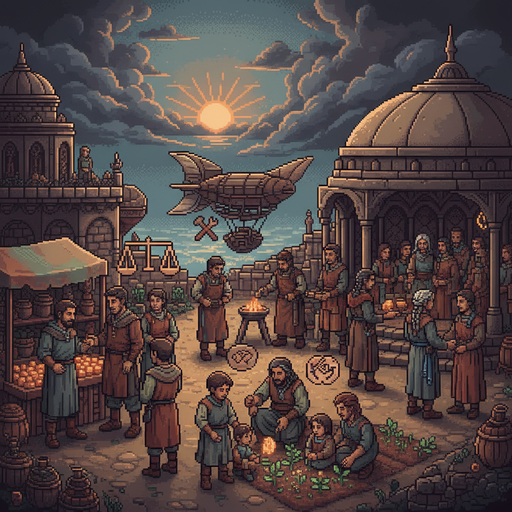 The Bright-Folk -
Children of the Center
The Bright-Folk -
Children of the Center
Overview
The Bright-Folk are the majority population of the Aetherium, descended from the central continental peoples of Terrum Solidus. They are characterized by their pragmatic merchant culture, their dominance in major settlements and the Sky-Guild, and their stubborn optimism despite living in a dying world. When people think of “typical” Aetherium citizens, they’re usually thinking of Bright-Folk.
Pre-Shattering, the Bright-Folk’s ancestors inhabited the central regions of Terrum Solidus—the fertile plains, river valleys, and coastal areas where the great cities and trade networks flourished. They were merchants, farmers, craftsmen, and administrators who built the economic foundation of pre-Shattering civilization. When the world shattered, they were the ones who adapted most successfully, rebuilding trade networks, establishing settlements, and creating the economic and social structures that define the current age.
Post-Shattering, Bright-Folk have become the cultural majority. They dominate the Sky-Guild, control most major settlements, and their values—pragmatism, commerce, community—shape Aetherium society. They’re the ones who built Skyport Eos, who established trade routes, who created the systems that keep humanity alive. They’re not the strongest (that’s Iron-Blood), not the most mystical (that’s Veil-Born), not the most adaptable (that’s Sun-Touched), but they’re the most numerous and the most organized.
Physical Characteristics
Appearance
Skin: Olive to light brown, range of tones, Mediterranean-like
Hair: Dark (brown to black), straight or wavy, thick
Eyes: Brown (most common), hazel, dark green
Build: Medium (neither stocky nor tall), practical proportions
Height: Average 165-175cm (men 170-180cm, women 160-170cm)
Features: Varied (mixed ancestry), no single “look”
Aging: Moderate (visible aging by 40s, gray hair by 50s)
History and Origins
Pre-Shattering
Ancestral Homeland: Central Terrum Solidus - Fertile plains, river valleys, coastal regions - Temperate climate, abundant resources - Major cities, trade hubs - Heart of civilization
Culture: - Merchant-oriented - City-builders - Pragmatic, adaptable - Dominated Luminar Council - Economic powerhouse
Population: Majority (60-70% of pre-Shattering humanity)
The Shattering
Impact: - Lost 70% (same as general population) - Cities destroyed - Trade networks collapsed - Survivors scattered
Advantages: - Large population (more survivors) - Widespread distribution (found everywhere) - Adaptability (merchant mindset) - Organizational skills (rebuilt quickly)
Post-Shattering Adaptation (0-287 S.)
Rebuilding: - Established Skyport Eos (first major trade hub) - Founded Sky-Guild (economic organization) - Created Common Tongue (unified language) - Rebuilt civilization (practical focus)
Dominance: - Numerical majority - Economic control (Sky-Guild) - Cultural influence (Common Tongue, trade customs) - Political power (Elder Councils)
Current Status: Majority population, dominant culture, facing challenges (Rot, refugees, resource scarcity)
Culture and Values
Core Values
Pragmatism: - What works matters more than what’s ideal - Practical solutions over philosophical purity - Results over intentions - “Good enough” is acceptable
Commerce: - Trade is lifeblood - Everything has price - Negotiation is art form - Economic thinking dominant
Community: - Collective good over individual - Help neighbors (enlightened self-interest) - Strong social bonds - “We survive together”
Tradition: - Respect for past (but not bound by it) - Maintain customs (when practical) - Pass knowledge to children - Balance old and new
Hope: - Stubborn optimism - Belief in better future - Refuse to surrender to despair - “We’ve survived this long”
Adaptability: - Change when necessary - Learn from experience - Flexible thinking - Survival trait
Social Structure
Family: - Nuclear families (parents + children) - Extended family ties (strong) - Multi-generational homes (common) - Family businesses (traditional)
Community: - Elder Councils (governance) - Consensus-based decisions - Community gatherings (regular) - Mutual aid networks
Class: - Merchants (upper-middle) - Craftsmen (middle) - Laborers (lower) - Mobility possible (through work)
Gender: - Egalitarian (post-Shattering necessity) - Women work, lead, fight - Practical equality - Some traditional holdouts
Daily Life
Typical Day
Dawn: - Wake early - Breakfast (simple) - Morning prayers (for faithful) - Begin work
Morning: - Work (trade, farming, crafting) - Market activity (buying, selling) - Social interaction (business and pleasure)
Midday: - Brief meal - Continue work - Hottest part of day
Afternoon: - Work continues - Children play (supervised) - Elders socialize
Evening: - Family meal (important) - Community gathering (frequent) - Stories, music, conversation - Early to bed (work tomorrow)
Work
Occupations: - Merchants (20%) - Farmers (25%) - Craftsmen (20%) - Laborers (20%) - Administrators (5%) - Other (10%)
Work Ethic: - Hard work valued - Laziness condemned - Success through effort - Pride in craft
Business: - Family businesses common - Apprenticeships (learn trade) - Guild memberships (Sky-Guild) - Reputation matters
Relationship with Other Peoples
With Veil-Born
Respect: For mystical knowledge
Wariness: Find them strange, unsettling
Distance: Don’t integrate well
Trade: Minimal (Veil-Born not merchant-minded)
With Iron-Blood
Cooperation: Strong (economic-military alliance)
Tension: Bright-Folk value freedom, Iron-Blood value order
Intermarriage: Common (especially in Ironhold)
Respect: Mutual (different strengths)
With Sun-Touched
Affinity: Both adaptable, both widespread
Competition: Sometimes (trade, resources)
Intermarriage: Very common (similar cultures)
Blending: Many Bright-Folk have Sun-Touched ancestry
With Void-Kin
Curiosity: About post-Shattering generation
Concern: About their differences
Hope: That they’re humanity’s future
Tension: Generational (old vs. new)
In Major Settlements
Skyport Eos
Majority: 70% of population
Roles: Merchants, administrators, craftsmen
Culture: Defines settlement character
Leadership: Elder Council (mostly Bright-Folk)
Ironhold
Minority: 40% of population (Iron-Blood majority)
Roles: Merchants, Guild officials, craftsmen
Culture: Adapted to military environment
Tension: With Iron-Blood authoritarianism
Windmere Farms
Majority: 80% of population
Roles: Farmers, laborers
Culture: Rural Bright-Folk traditions
Life: Simpler, more traditional
Cultural Contributions
Language
Common Tongue: - Bright-Folk primary speakers - Shaped its development - Merchant vocabulary dominant - Simplified grammar (for trade)
Economics
Sky-Guild: - Founded and dominated by Bright-Folk - Merchant culture embedded - Trade practices standardized - Economic thinking
Governance
Elder Councils: - Bright-Folk political model - Consensus-based - Practical, slow, stable - Adopted by many settlements
Religion
Orthodox Clergy: - Bright-Folk dominate clergy - Traditional worship - Conservative theology - Mainstream religion
Stereotypes
How Others See Them
Positive: - Practical, reliable, hardworking - Good at trade, building, organizing - Optimistic, hopeful - Majority (normal)
Negative: - Naive (about dangers) - Soft (compared to Murk dwellers) - Greedy (merchant culture) - Boring (compared to others)
How They See Themselves
Positive: - Survivors, builders, hope-keepers - Practical, adaptable, successful - Foundation of civilization - Reason humanity survives
Negative: - Sometimes too cautious - Sometimes too focused on profit - Sometimes miss bigger picture - But trying their best
Challenges and Future
Current Challenges
Refugee Crisis: - Influx overwhelming - Resources strained - Compassion vs. capacity - Difficult decisions
Economic Pressure: - Resources scarce - Prices rising - Trade disrupted (Rot) - Sustainability concerns
Cultural Erosion: - Mixing with other peoples - Traditions fading - Identity less distinct - Not necessarily bad but changing
The Rot: - Threatening settlements - Disrupting trade - Killing people - Existential threat
Future Prospects
Optimistic View: - Bright-Folk will adapt (always have) - Rebuild (always do) - Survive (track record good) - Lead humanity forward
Pessimistic View: - Too comfortable (unprepared for crisis) - Too optimistic (ignoring reality) - Too numerous (more to lose) - Extinction coming
Realistic View: - Will survive (probably) - Will change (definitely) - Will lead (likely) - Will suffer (certainly)
Related Topics
- Skyport Eos - Primary settlement
- Sky-Guild - Dominated by Bright-Folk
- Elder Mira Thornwell - Bright-Folk leader
- Common Tongue - Their language
- Veil-Born - Other ethnic group
- Iron-Blood - Other ethnic group
- Sun-Touched - Other ethnic group
- Void-Kin - New generation
In-World Documents
Bright-Folk Saying
“We’re not the strongest. We’re not the smartest. We’re not the bravest.
But we’re still here.
That counts for something.”
Elder’s Teaching
What does it mean to be Bright-Folk?
It means we came from the center. The heart of the old world. The cities, the trade, the civilization.
When the world broke, we broke with it. We lost everything.
But we rebuilt. We adapted. We created new trade, new cities, new civilization.
We’re not special. We’re not chosen. We’re just… persistent.
We keep going. We keep building. We keep hoping.
That’s what Bright-Folk do. That’s what we’ve always done.
And that’s what we’ll keep doing until the last island falls.
“Bright-Folk are the Aetherium’s backbone—not the strongest or
most interesting, but the most numerous and most organized. They’re the
merchants who keep trade flowing, the farmers who keep people fed, the
craftsmen who keep civilization functioning. They’re practical,
optimistic, and stubborn. They’re the reason humanity didn’t collapse
completely after the Shattering. They’re not
heroes. They’re just people doing their best in impossible
circumstances. And somehow, that’s enough.”
—From Peoples of the Aetherium by Historian Elias
Stormchaser