Ironwood Trees
Ferrum ligneus / “Steel-Wood” / “The Last Forest”
“Ironwood keeps us flying. Without it, we’re grounded. Without
it, we’re extinct.”
—Pilot’s saying
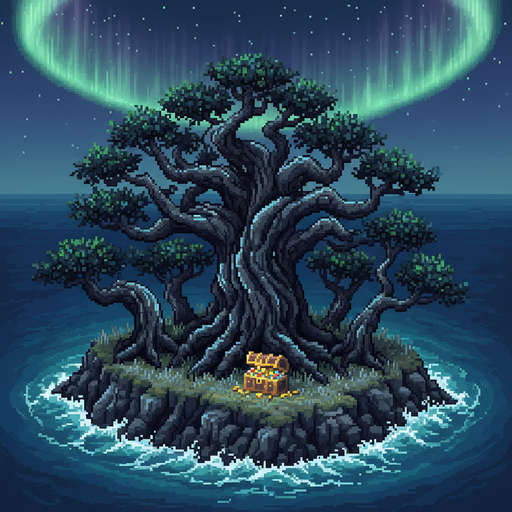 Ironwood Trees -
Precious Resource
Ironwood Trees -
Precious Resource
Quick Reference
| Attribute | Details |
|---|---|
| Type | Flora (Tree) |
| Rarity | Rare (wild), Uncommon (cultivated) |
| Habitat | Stable islands with deep soil, agricultural zones |
| Danger Level | None (beneficial) |
| Growth Rate | Extremely slow (1cm diameter per year, 50+ years to maturity) |
| Height | 15-20 meters (mature), 25m+ (ancient) |
| Value | Extremely High (500-2,000 coins per mature tree) |
| Lifespan | 500+ years (ancient specimens 800+ years) |
| Cultivation | Possible but generational (plant for grandchildren) |
| Legal Status | Protected (illegal logging in most areas, death penalty some places) |
Description
Ironwood trees are humanity’s lifeline in the Aetherium—dense, incredibly strong trees whose wood is essential for airship construction, building, and survival. The wood is so dense it sinks in water and feels heavy even in the Aether’s reduced gravity. It’s resistant to rot, fire, and corruption, and when properly worked, it lasts centuries. Without ironwood, airships couldn’t fly, buildings couldn’t stand, and civilization would collapse.
The trees are distinctive: tall (15-20 meters), with dark gray bark that looks almost metallic, and silver-green leaves that shimmer in the light. They grow painfully slowly—a tree trunk gains only 1cm in diameter per year, meaning a mature tree suitable for harvesting (30cm diameter) is at least 30 years old, and prime specimens (50cm+) are 50+ years old. This makes every tree precious and every harvest a decision that affects future generations.
Pre-Shattering, ironwood forests covered entire mountain ranges. Post-Shattering, most were lost. The surviving trees are scattered across stable islands, and new forests have been planted in agricultural zones like Windmere Farms. But demand far exceeds supply: every airship needs ironwood for its hull, every building needs it for structural support, and every forge needs ironwood charcoal for high-temperature work. The math is simple and terrifying: we’re using ironwood faster than it grows.
Physical Characteristics
The Tree
Trunk: - Diameter: 20-50cm (mature), 60cm+ (ancient) - Bark: Dark gray, rough, almost metallic appearance - Texture: Hard (difficult to cut even with sharp tools) - Growth rings: Visible, extremely tight (slow growth) - Heartwood: Even denser than outer wood
Branches: - Strong, thick - Grow at upward angles (structural strength) - Can support significant weight - Difficult to break - Prized for ship masts
Leaves: - Silver-green coloration - Small, oval (5-8cm) - Waxy coating (water-resistant) - Shimmer in light (metallic sheen) - Evergreen (don’t fall in winter)
Roots: - Deep (5-10 meters) - Extensive lateral spread - Anchor islands firmly - Prevent erosion - Difficult to remove (even dead trees)
Seeds: - Acorn-like, 2-3cm - Hard shell (iron-gray) - Heavy (fall straight down) - Germination rate: 30-40% - Viable for decades
Wood Properties
Physical Characteristics
Density: - 1.2-1.5 g/cm³ (denser than most woods) - Sinks in water - Heavy even in Aether - Difficult to work (requires sharp tools)
Strength: - Tensile strength: Exceptional - Compression resistance: Excellent - Doesn’t warp or crack easily - Maintains integrity for centuries
Durability: - Rot-resistant (naturally) - Fire-resistant (chars but doesn’t burn easily) - Corruption-resistant (Stage 1-2 Rot doesn’t affect it) - Weather-resistant (doesn’t decay)
Workability: - Green wood: Workable (must be shaped before drying) - Dried wood: Extremely hard (difficult to work) - Requires skilled craftsmen - Tools dull quickly
Appearance: - Color: Dark gray to black - Grain: Tight, straight - Finish: Takes polish beautifully - Ages: Darkens over time
Uses and Applications
Airship Construction (Primary use)
Hulls: - Ironwood planks (primary material) - Strong enough to withstand Aether-pressure - Light enough to fly (in Aether) - Durable (ships last centuries) - Essential (no substitute exists)
Masts and Spars: - Ironwood branches (straight, strong) - Support sails and rigging - Flex without breaking - Critical structural components
Keels: - Densest ironwood (heartwood) - Provides ballast and stability - Anchors ship’s structure - Most valuable part
Requirements: - Average airship: 20-30 mature trees - Large ship: 50+ trees - Warship: 100+ trees - This is why ironwood is precious
Building Construction
Structural Support: - Beams, joists, supports - Buildings last centuries - Earthquake/storm resistant - Essential for major structures
Floors and Walls: - Durable, beautiful - Wealthy homes use it - Common buildings use lesser woods - Status symbol
Furniture: - High-end furniture - Lasts generations - Expensive - Heirloom quality
Fuel
Ironwood Charcoal: - Burns extremely hot - Long-lasting - Essential for forges (metalworking) - Expensive (using ironwood as fuel is controversial)
Heating: - Emergency fuel only - Too valuable to burn casually - But provides excellent heat - Last resort
Cultivation and Management
Windmere Farms Orchards
Largest Cultivation: - 2,000+ trees (various ages) - Planted over 150 years - Managed by farming communities - Primary ironwood source
Management: - Selective harvesting (oldest trees only) - Continuous replanting - Careful tending - Generational planning
Challenges: - 50-year wait for harvest - Rot-Beast threats - Theft (valuable) - Balancing harvest with sustainability
Economics: - Provides steady income - Supports community - But temptation to over-harvest - Must think long-term
Wild Groves (Rare)
Pre-Shattering Survivors: - Scattered ancient groves - 200-800 year old trees - Extremely valuable - Heavily protected
Locations: - Secret (to prevent logging) - Guarded by communities - Some on unclaimed islands - Legends of hidden forests
Conservation: - Protected by law (rarely enforced) - Protected by tradition (more effective) - Protected by remoteness (best protection)
Replanting Efforts
The Generational Project: - Plant trees for grandchildren - Won’t see harvest in lifetime - Requires faith in future - Essential for survival
Challenges: - Requires stable islands (roots need security) - Long-term commitment - Uncertain future (Rot, island stability) - Psychological difficulty (planting for others)
Success Stories: - Windmere Farms (150 years of cultivation) - Thornvale (small orchard) - Some Outland Clans (secret locations)
Threats to Supply
Over-Harvesting
The Math: - Current harvest: ~500 trees per year - Current growth to maturity: ~200 trees per year - Deficit: 300 trees per year - Unsustainable
Consequences: - Supply declining - Prices rising - Future shortage inevitable - Crisis in 20-50 years
Response: - Increased planting (helps but slow) - Conservation efforts - Search for alternatives (none found) - Rationing (unpopular)
Rot Corruption
Problem: - Rot-infected trees die - Wood becomes unusable - Entire orchards can be lost - Devastating losses
Prevention: - Quarantine infected trees - Sanctification (clergy) - Alchemical treatment - Early detection critical
Impact: - Windmere Farms lost 200 trees to Rot (280 S.) - Other orchards threatened - Accelerates shortage
Theft and Illegal Logging
Problem: - Trees extremely valuable - Temptation to steal/log illegally - Damages future supply - Difficult to prevent
Methods: - Nighttime logging - Remote groves targeted - Sell on black market - High profit
Enforcement: - Patrols (expensive) - Death penalty (some places) - Community protection (most effective) - Ongoing battle
Cultural Significance
Symbolism
Strength and Endurance: - Ironwood represents resilience - “Strong as ironwood” (highest praise) - Used in oaths and vows - Symbol of what endures
Generational Thinking: - Planting ironwood = thinking of future - “Plant trees for grandchildren” - Symbol of hope - Faith in continuity
Sacrifice: - Using ironwood means consuming future - Every tree cut is one less for next generation - Moral weight - Necessary sacrifice
In Art and Literature
Common Themes: - Strength, endurance, sacrifice - Generational responsibility - Balance between present needs and future - The cost of survival
Famous Works: - The Last Forest (poem about ironwood groves) - The Tree-Planter (story of farmer who plants for future) - Ironwood and Ash (philosophical text on sustainability)
Related Topics
- Windmere Farms - Primary cultivation
- Airship Construction - Primary use
- Garrick Stonehand - Works ironwood
- Sky-Guild - Controls distribution
- Outland Clans - Protect wild groves
In-World Documents
Windmere Farms Sign
IRONWOOD ORCHARD
These trees were planted by our grandparents.
We harvest them for our children.
Our grandchildren will harvest what we plant today.This is how we survive:
By thinking beyond ourselves.
By planting for those who come after.Respect the trees.
They are our future.
Tree-Planter’s Oath
I plant this tree knowing I will never see it harvested.
My grandchildren might. Or their grandchildren.
But I plant it anyway.
Because someone planted for me.
Because someone must plant for them.
Because that’s what it means to believe in the future.This tree will outlive me.
It will serve people I’ll never meet.
It will keep them flying, building, surviving.That’s enough.
“Ironwood trees are living reminder of what survival costs: we
consume the future to survive the present. Every tree we cut is one less
for our grandchildren. Every ship we build is built from trees that took
fifty years to grow. We’re living on borrowed time, borrowed wood,
borrowed future. The only way to pay that debt is to plant more trees
than we cut. But we don’t. We can’t. The math doesn’t work. So we plant
anyway, hoping somehow it will be enough. That’s faith in the Aetherium:
planting trees you’ll never see harvested, for people you’ll never meet,
because someone must believe in tomorrow.”
—From The Tree-Planter’s Journal