Constellation of Memory
“The Keeper” / “The Voice of the Dead” / “The Eternal Record”
“To forget is to kill twice. To remember is to grant
immortality.”
—Inscription at the Memorial Gardens, Skyport Eos
Quick Reference
| Attribute | Details |
|---|---|
| Domain | History, remembrance, preservation, ancestry, wisdom of the past, honoring the dead |
| Symbol | Open book with stars for pages, sometimes depicted with hourglass or eternal flame |
| Sacred Color | Amber-gold (color of old parchment), silver (for moonlight and memory), deep purple (mourning) |
| Virtue | Respect for ancestors, historical consciousness, preservation of knowledge, honoring sacrifice, learning from the past |
| Sin | Forgetting the dead, destroying records, dishonoring ancestors, repeating past mistakes, erasing history |
| Typical Followers | Historians, Archivists, mourners, genealogists, storytellers, the elderly, those who’ve lost loved ones |
| Clergy Title | Memory-Keeper (priests), Chronicler (bishops), Voice of Ages (high clergy) |
| Sacred Day | Remembrance Day (annual, anniversary of the Shattering), The Naming (when children are named after ancestors) |
| Offerings | Written records, family histories, preserved artifacts, stories of the dead, tears (literally) |
| Miracles Granted | Recovery of lost memories, communication with spirits of dead, preservation of knowledge, visions of past |
| Price | Must record what is learned, must honor the dead, must teach others, must remember painful truths |
| Current Status | Weakening but increasingly vital—fewer miracles, but desperate need for preservation |
 The Constellation
of Memory - The Keeper
The Constellation
of Memory - The Keeper
Table of Contents
- Overview
- Theology and Doctrine
- Worship and Practice
- Miracles and Blessings
- Relationship with Other Constellations
- Cultural Impact
- Theological Mysteries and Heresies
- Current Status (287 S.)
- Practical Information for Seekers
- Notable Followers
- Sayings and Proverbs
- Related Topics
- In-World Documents
Overview
The Constellation of Memory is the keeper of humanity’s past, the voice that whispers “remember them” when the world would rather forget. In the shattered Aetherium where entire islands vanish and populations disappear overnight, Memory stands as defiant witness: They existed. They mattered. They will not be erased.
Pre-Shattering, Memory was beloved by scholars, historians, and families who honored their ancestors. It was a constellation of continuity, connecting present to past through stories and records. Post-Shattering, when 70% of humanity died in an instant and countless more have been lost to the Rot, Memory’s role transformed from academic to essential. Every death is a library burning. Every forgotten name is a second murder.
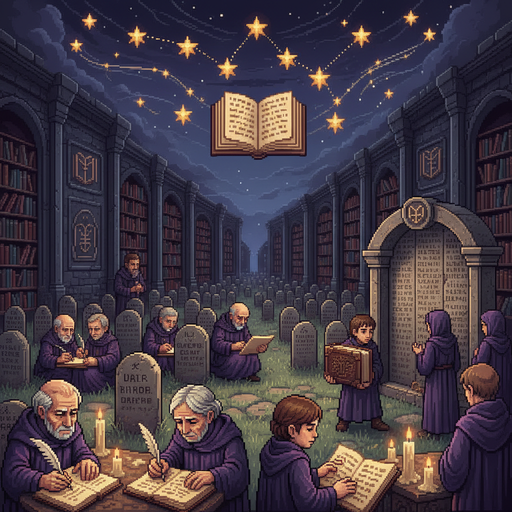
The constellation appears as nine stars arranged like an open book, with pages made of starlight. Unlike other constellations that move across the sky, Memory seems to drift slowly, as if reluctant to leave any position. Observers report that staring at it too long induces a trance-like state where memories—both personal and not—surface unbidden.
Memory’s personality is melancholic and gentle. It speaks in the voices of the dead, not to frighten but to comfort. It remembers everything—every person who ever lived, every moment that ever was—and carries the weight of that knowledge with profound sadness. “I am tired,” Memory once told a Star-Reader in vision. “But I cannot rest while there is still something to remember.”
Theology and Doctrine
Core Beliefs
To Forget is to Kill Twice - First death: physical - Second death: being forgotten - True immortality is remembrance - Preserving memory is sacred duty
The Past Guides the Future - History repeats when forgotten - Wisdom of ancestors available to those who listen - Mistakes of the past teach present - Understanding where we came from shows where to go
All Lives Matter - Not just heroes and kings - Every person’s story has value - Common lives are history too - The forgotten deserve remembrance
Grief is Sacred - Mourning honors the dead - Pain of loss proves love existed - Tears are offerings - Healing doesn’t mean forgetting
Knowledge Must Be Preserved - Books are sacred - Oral tradition is holy - Records must be maintained - Destruction of knowledge is sin
Memory’s Personality
Memory is described in prayers and visions as:
Melancholic: Carries weight of all that’s been lost
Gentle: Speaks softly, never demands
Patient: Understands grief takes time
Nostalgic: Dwells on what was, sometimes too much
Wise: Has seen everything, learned from it all
Tired: Burden of remembering everything is exhausting
Compassionate: Understands human need to sometimes forget painful things
Priests describe Memory as “a grandmother who’s seen too much sorrow but still tells stories because someone must.”
Orthodox Clergy Position
The Constellation Clergy officially recognizes Memory as one of the six major constellations, though with growing concerns:
Positive View: - Essential for preserving pre-Shattering knowledge - Provides comfort to mourners - Maintains cultural continuity - Prevents repeating past mistakes
Concerns: - Constellation seems to be weakening - Fewer miracles granted over time - Some followers become obsessed with past, unable to move forward - Tension with Voyager (past vs. future focus) - Risk of ancestor worship becoming primary over constellation worship
Official Doctrine: “Memory teaches that the past matters, but we must not live there. Honor what was. Learn from it. Then build what will be.”
Theological Debates
The Burden Question - Is it cruel to remember everything? - Should some things be forgotten? - Does Memory suffer from its own nature? - Can forgetting be mercy?
The Selective Memory Paradox - Memory remembers everything, but humans cannot - Is selective memory dishonoring the forgotten? - Who decides what’s important to remember? - Is forgetting minor things acceptable?
The Dead’s Agency - Do the dead want to be remembered? - Can spirits actually communicate through Memory? - Or is it just memories of the living? - Are we honoring them or using them?
The Forward vs. Backward Tension - Voyager says look forward - Memory says look backward - Which is more important for survival? - Can you do both?
Worship and Practice
Prayer Rituals
The Remembrance Prayer (For the dead):
“Memory Eternal, hear their names.
[Speak names of the dead]
They lived. They loved. They mattered.
Do not let them fade into the void.
Hold them in your keeping,
Until the stars themselves forget to shine.
In remembrance, they live.
In honor, they guide us.
Memory eternal.”
The Preservation Prayer (Before recording history):
“Keeper of Ages, guide my hand.
What I write today will outlast me.
Let me record truth, not comfort.
Let me preserve what matters.
Let me honor those who came before,
And serve those who come after.
Through me, the past speaks.
I am the voice of memory.”
The Ancestor Prayer (Seeking guidance):
“Memory, I call upon those who walked before me.
[Name specific ancestor or “all who came before”]
They faced what I face now.
They knew what I need to know.
Let their wisdom reach me,
Through dream, through insight, through your voice.
I honor them by learning from them.
I remember them by becoming worthy of remembrance.”
The Mourner’s Prayer (In grief):
“Memory, the pain is too much.
I cannot carry this alone.
Help me remember them as they were,
Not just how they died.
Let me hold the love, not just the loss.
Let me honor them by living,
Even though they cannot.
Keep them safe in your keeping,
Until I join them there.”
The Forgiveness Prayer (For painful memories):
“Memory, some things hurt to remember.
But forgetting would dishonor those who suffered.
Help me bear the weight of what was,
Without being crushed by it.
Let me learn from pain,
Without being consumed by it.
The past cannot be changed,
But how I carry it can.”
Offerings and Sacrifices
Common Offerings: - Written Records: Family histories, personal journals, historical accounts - Preserved Artifacts: Items belonging to the dead, carefully maintained - Stories: Oral histories told at shrines - Tears: Literally—mourners’ tears collected in vials and offered - Names: Speaking names of the dead aloud
Ritual Offerings: - The Remembrance Offering: Annual, list of all who died that year - The Naming Offering: When child is named after ancestor - The Archive Offering: When completing major historical work - The Last Offering: Dying person’s final words, recorded and preserved
Living Sacrifices (not literal death): - Vow of Preservation: Dedicate life to maintaining records - Vow of Witness: Record history as it happens - Vow of Teaching: Ensure knowledge passes to next generation - Vow of Mourning: Professional mourners who remember the forgotten
Sacred Spaces
Memory Shrines: - Found in every settlement - Walls covered with names of the dead - Offering bowls for written memories - Eternal flames (or attempt at eternal—fuel permitting) - Quiet, contemplative atmosphere
The Memorial Gardens (Skyport Eos): - Largest Memory shrine in Aetherium - Garden with stone markers for major losses - Library of the Dead (records of all known deceased) - Mourners gather here - Maintained by Memory clergy
The Archive Temples: - Combination library and temple - Preserve pre-Shattering knowledge - Memory clergy serve as librarians - Open to scholars and seekers - Most valuable books kept in vaults
Sacred Landmarks: - The Last Library (ruins in Murk): Pre-Shattering library, partially preserved - The Memorial Wall (Ironhold): Names of all soldiers who died defending city - The Forgotten Isle (coordinates): Island that vanished in Silence event, memorial marker in Aether
Clergy Structure
Memory-Keepers (Priests): - Serve as historians, librarians, counselors - Perform funeral rites and memorial services - Maintain local records and shrines - Interview elderly to preserve their memories - Comfort mourners
Chroniclers (Bishops): - Oversee regional archives - Coordinate preservation efforts - Compile histories from multiple sources - Verify historical accuracy - Train new Memory-Keepers
Voice of Ages (High Clergy): - One representative on High Constellation council - Maintains master archive of all recorded history - Arbitrates historical disputes - Preserves most ancient and fragile records
Current Voice of Ages: Elder Mira Thornwell—wait, no. That’s wrong. Current Voice is Archivist Silas Longmemory, age 68, has memorized the names of 10,000 dead.
Festivals and Holy Days
Remembrance Day (Annual, anniversary of the Shattering): - Most important Memory holy day - All work stops - Communities gather to speak names of the dead - Can take hours or days depending on losses - Mourning clothes worn (white or purple) - Stories told of those lost - Solemn but also celebrating lives lived
The Naming (Individual, when child is named): - Children often named after deceased relatives - Memory-Keeper performs ceremony - Child told stories of their namesake - Symbolic passing of legacy - Belief that namesake’s wisdom passes to child
The Day of Ancestors (Mid-year): - Honor all who came before - Families visit shrines, leave offerings - Genealogies recited - Stories of family history told - Elders especially honored
The Preservation Festival (Autumn): - Celebrate successful preservation of knowledge - Archives open to public - Scribes display their work - Books repaired and rebound - New histories presented
Miracles and Blessings
Documented Miracles
The Recovered Memory (253 S.): Alchemist Kael Greythorn lost his research notes when his laboratory flooded. Years of work gone. He prayed desperately to Memory. That night, he dreamed every page in perfect detail. He woke and transcribed frantically for 30 hours straight. Every formula was accurate. The price: he now remembers everything—every moment of his life—and cannot forget even painful memories. He says it’s worth it.
The Voice of the Dead (267 S.): When Elder Lysara Kind’s daughter died in childbirth, Lysara prayed to Memory, begging to hear her daughter’s voice one more time. Memory answered: for one hour, Lysara heard her daughter speaking, telling her things only the daughter could know, including the name she wanted for her unborn child. Skeptics say grief-induced hallucination. Lysara says “I know what I heard. Memory gave me goodbye.”
The Preserved Island (274 S.): When Clearwater Island fell to the Rot, everyone assumed all records were lost. Memory-Keeper Tomas prayed and received vision showing him where the island’s archive had been stored. A rescue team found the sealed vault exactly where the vision showed, floating in Aether. Every book intact. Tomas died three days later, saying “Memory showed me what needed saving.”
The Ancestral Warning (280 S.): Before the Silence event at Windcrest, Memory-Keeper Mara received dreams of ancestors screaming “Leave! Leave now!” She convinced 50 people to evacuate. They left. That night, Windcrest’s entire population vanished. The 50 survived. Mara has no explanation except “The dead warned us.”
The Perfect Recall (285 S.): Historian Elias Stormchaser prayed for ability to remember pre-Shattering texts he’d read once, years ago. Memory granted it: for one week, he had perfect recall of everything he’d ever read. He transcribed 200 pages of lost texts. After the week, the ability faded, but the transcriptions remained. He says “Memory lent me its gift. I used it well.”
Common Blessings
Recovery of Lost Memories (Most frequent): - Sudden recall of forgotten information - Dreams revealing lost knowledge - Clarity about past events - Success rate: ~50% when constellation visible - Duration: Single memory or short period - Price: Must record what is remembered
Communication with Dead (Rare but powerful): - Dreams where deceased speak - Visions of past events - Sense of presence/guidance - Success rate: ~20% (highly variable) - Duration: Brief moments to hours - Price: Emotional toll, must honor message received
Preservation of Knowledge (Uncommon): - Books that should decay don’t - Memories stay vivid instead of fading - Ability to memorize important information - Success rate: ~30% - Duration: Varies (sometimes permanent) - Price: Responsibility to share knowledge
Visions of the Past (Rare): - Seeing historical events as if present - Understanding context of old records - Insight into ancestors’ lives - Success rate: ~15% - Duration: Brief visions - Price: Disorientation, difficulty distinguishing past from present
Comfort in Grief (Common but subtle): - Reduction of mourning pain - Sense of peace about loss - Feeling of continued connection - Success rate: Hard to measure (psychological) - Duration: Varies - Price: Must continue honoring the dead
Failed Prayers and Consequences
When Memory Doesn’t Answer: - Most common reason: Asking to forget (Memory doesn’t grant this) - Second reason: Dishonoring the dead in past - Third reason: Destroying records or knowledge - Fourth reason: Constellation not visible - Fifth reason: Some things are meant to stay forgotten (rare)
The Curse of Perfect Memory: - Some who pray for memory enhancement get too much - Remember everything, including trauma - Cannot forget painful moments - Cure: None (Memory doesn’t take back gifts) - Living with it requires strength
The Haunting: - Those who dishonor the dead sometimes experience “hauntings” - Dreams of the dishonored - Sense of being watched - Guilt and psychological distress - Cure: Make amends, honor those wronged
Relationship with Other Constellations
Allied Constellations
The Constellation of Light: - Both value truth (Light in present, Memory in past) - Clergy cooperate on historical accuracy - Shared belief in importance of knowledge - Tension: Light looks forward, Memory looks back
The Constellation of the Forge: - Forge creates; Memory preserves - Strong cooperation on preserving crafting techniques - Forge’s libraries maintained by Memory clergy - Mutual respect and practical alliance
Neutral Constellations
The Constellation of the Veil: - Veil reveals secrets; Memory preserves them - Some overlap in uncovering hidden history - Occasional cooperation - Tension: Veil sometimes reveals what Memory thinks should stay hidden
The Constellation of the Broken Chain: - Chain breaks from past; Memory preserves it - Philosophical tension - Practical coexistence - Debate: Is breaking from past liberation or dishonoring ancestors?
Opposed Constellations
The Constellation of the Voyager: - Fundamental philosophical tension - Voyager values moving forward; Memory values looking back - Theological debates: “The past anchors us” vs. “The past weighs us down” - Followers often in conflict - Clergy maintain polite distance
The Constellation of the Abyss: - Abyss represents forgetting/ending - Memory represents remembering/preserving - Diametrically opposed - Memory clergy actively counter Abyss worship - “We remember. The Abyss erases. Choose.”
The Serpent Question
The Constellation of the Serpent (Forbidden): - Serpent offers transformation that erases past self - Memory insists past self must be honored - Orthodox position: “The Serpent makes you forget who you were. That is death.” - Heretical theory: Transformation and memory can coexist (rejected) - Some corrupted individuals claim they remember everything, including past lives (terrifying to Memory clergy)
Cultural Impact
Among Historians and Archivists
Essential Partnership: - All Archivists worship Memory (or respect it) - Memory clergy often are Archivists - Shared mission: preserve knowledge - Libraries are temples; temples are libraries
The Archivists Faction: - Dedicated to preserving pre-Shattering knowledge - Memory is patron constellation - Operate secret libraries on hidden islands - Will trade information for rare books
Among Mourners and the Bereaved
Comfort in Grief: - Memory clergy provide counseling - Funeral rites help process loss - Belief that dead are remembered provides comfort - Mourning support groups common
The Remembrance (Support Group): - Meets regularly in settlements - Shares stories of the lost - Memory-Keeper facilitates - Helps people process grief together
Among the Elderly
Honored Role: - Elderly seen as living libraries - Memory clergy interview them regularly - Their stories preserved - Gives meaning to old age
The Last Generation: - Those old enough to remember pre-Shattering world - None left (oldest are ~50, born 237 S.) - But those who knew pre-Shattering survivors are honored
Among Families
Genealogy and Legacy: - Family histories carefully maintained - Children taught about ancestors - Naming traditions important - Sense of continuity through generations
The Naming Tradition: - Children named after deceased relatives - Carries responsibility to honor namesake - Creates connection across generations - Memory clergy perform naming ceremonies
In Art and Literature
Common Themes: - Loss and remembrance - Weight of history - Honoring the dead - Learning from the past
Famous Works: - The Book of Names (ongoing project listing all known dead) - Voices of the Fallen (collection of last words) - Before the Shattering (compiled memories of the old world)
Visual Art: - Memorial sculptures - Portraits of the deceased - Illustrated genealogies - The open book symbol everywhere
Theological Mysteries and Heresies
The Reincarnation Heresy
Claim: Memory doesn’t just preserve the dead—it recycles them
Evidence: - Children sometimes know things they shouldn’t - Déjà vu experiences - Namesakes exhibiting traits of ancestors
Orthodox Response: “Memory preserves. It doesn’t reincarnate. These are coincidences or inherited traits.”
Heretic Counter: “Why else would Memory insist on naming children after the dead?”
Status: Condemned as heresy, but widely believed in folk religion
The Selective Forgetting Theory
Question: Should some things be forgotten for mental health?
Context: - Trauma survivors - Those who remember too much - Painful historical events
Traditionalist View: “All memory is sacred. Forgetting dishonors.”
Reformist View: “Memory itself is compassionate. It would not want us to suffer unnecessarily.”
Status: Ongoing debate, increasingly relevant
The Dead’s Desires Heresy
Claim: The dead don’t want to be remembered—we remember for ourselves
Evidence: - No proof dead care about being remembered - Remembrance serves the living more than the dead - Obsessive remembrance can be unhealthy
Orthodox Response: “The dead deserve honor regardless of whether they ‘want’ it.”
Heretic Counter: “We’re using the dead for our own comfort.”
Status: Philosophically troubling, not officially condemned
The Memory Weakness Theory
Observation: Memory seems to be weakening over time
Evidence: - Fewer miracles granted - Constellation appears dimmer - Prayers less often answered
Theories: 1. Too much to remember (overloaded) 2. Dying like other constellations 3. Humanity forgetting too much (losing connection) 4. Preparing to forget itself (disturbing thought)
Status: Deeply concerning to clergy, no consensus
Current Status (287 S.)
Constellation’s Activity
Visibility: Appears 40% of nights, less than most major constellations
Prayer Response Rate: - Declining significantly (from ~60% to ~30% over past 50 years) - Miracles less dramatic than historical accounts - Clergy deeply concerned
Assessment: - Memory is weakening - Burden of remembering everything may be too much - Or humanity is forgetting, weakening the connection - Urgent need to preserve knowledge while still possible
Major Developments
The 300-Year Anniversary Approaching: - Shattering happened 287 years ago - 300th anniversary in 13 years - Major Remembrance Day planned - Effort to compile complete list of all who died
The Rot Casualties Mounting: - More deaths than ever - More names to remember - Memory clergy overwhelmed - Risk of forgetting the forgotten
The Last Library Expedition: - Attempt to salvage books from Rot-consumed islands - Memory clergy leading dangerous missions - Some books recovered, some clergy lost - Desperate race against time
The Archivists’ Crisis: - Secret libraries being discovered and raided - Knowledge being lost - Memory clergy trying to protect them - Tension with Sky-Guild over hoarding information
Challenges Facing the Faith
Information Overload: - Too much to remember - Too many dead - Records overwhelming - Risk of losing everything trying to save everything
Weakening Constellation: - Fewer miracles - Less divine guidance - Clergy losing faith - What if Memory forgets?
The Forward vs. Backward Debate: - Voyager’s philosophy gaining followers - “Let go of the past” appealing in desperate times - Memory seen as dwelling on loss - Risk of being abandoned
Resource Scarcity: - Paper rare - Ink expensive - Storage space limited - Must choose what to preserve
Hope and Renewal
Despite challenges, Memory worship continues:
The Naming Tradition: - Children still named after ancestors - Continuity maintained - Next generation learns history
The Oral Tradition: - When writing fails, stories persist - Storytellers preserving knowledge - Memory lives in voices
The Young Historians: - New generation of Memory-Keepers - Passionate about preservation - Innovative methods (memory techniques, compressed records)
The Resistance to Forgetting: - Humanity refuses to let go - “They will not be forgotten” - Defiant remembrance in face of erasure
Practical Information for Seekers
Seeking Memory’s Blessing
For Remembrance: 1. Visit Memory shrine 2. Speak names of those you wish to remember 3. Make offering (written memory, tears, story) 4. Pray with sincerity 5. Honor what you remember by living well
For Recovering Lost Knowledge: 1. Exhaust all practical means first 2. Pray at Archive temple 3. Offer to record what you learn 4. Be patient (Memory works slowly) 5. Share knowledge when received
For Comfort in Grief: 1. Visit Memory shrine or clergy 2. Speak of your loss 3. Cry (tears are offering) 4. Listen for comfort (may come as memory, dream, or peace) 5. Honor the dead by continuing to live
Finding Memory Clergy
Major Temples: - Skyport Eos: The Memorial Gardens - Ironhold: The Memorial Wall - Various settlements: Archive temples
Memory Shrines: - Every settlement has one - Look for open book symbol - Walls covered with names - Quiet, contemplative space
Wandering Memory-Keepers: - Travel to remote communities - Interview elderly - Record local histories - Recognizable by amber robes and book pendants
Costs and Expectations
Blessings: Free (offerings encouraged)
Funeral Rites: Donation suggested (5-20 coins)
Historical Research: Free (if you share findings)
Genealogy Services: Small fee (1-10 coins)
Expectations: - Honesty about what you remember - Willingness to record and share - Respect for the dead - Commitment to preservation - Teaching others what you learn
Notable Followers
Historical Figures
Lyanna the Rememberer (15 S.): - First Memory-Keeper post-Shattering - Recorded names of all who died in Shattering (estimated 2 million) - Spent 30 years writing - Died with pen in hand - Her books are most sacred Memory texts
The Three Chroniclers (89 S.): - Compiled first complete history of post-Shattering era - Traveled to every known island - Interviewed thousands - All three died within year of completion - Their history is foundation of current knowledge
Marta Longmemory (134 S.): - Memorized names of 5,000 dead - Could recite genealogies going back six generations - Taught memory techniques still used - Said “My mind is a library. I am the librarian.”
Contemporary Figures
Voice of Ages Silas Longmemory: - Current high clergy representative - Age 68, has memorized 10,000 names - Maintains master archive - Deeply concerned about Memory’s weakening
Elder Mira Thornwell (Skyport Eos): - Not Memory clergy but deeply respectful - Maintains personal records of all Eos citizens - Secretly Rot-corrupted (irony: will be forgotten if discovered) - Represents tension between remembering and being remembered
Memory-Keeper Tomas Quickstep (deceased 285 S.): - Led refugee convoy to safety - Preserved Clearwater Island’s archive - Died shortly after - Now remembered as martyr
Historian Elias Stormchaser: - Cartographer and historian - Received Memory’s blessing (perfect recall for one week) - Transcribed 200 pages of lost texts - Continues preservation work
Sayings and Proverbs
“To forget is to kill twice.”
“Memory eternal—let them not be forgotten.”
“The dead are only truly gone when no one speaks their name.”
“In remembrance, they live. In honor, they guide us.”
“The past is not dead. It’s not even past.”
“We are the sum of all who came before us.”
“Forgetting is easy. Remembering is courage.”
“The book closes, but the story continues.”
“They lived. They mattered. We remember.”
“History repeats for those who forget it.”
Related Topics
- The Archivists - Primary worshippers
- Constellation of the Voyager - Philosophical tension
- Constellation of Light - Allied constellation
- Constellation Clergy - Religious organization
- The Memorial Gardens - Primary worship center
- The Shattering Event - Most important memory
- Remembrance Day - Primary holy day
In-World Documents
The First Page of The Book of Names (Lyanna the Rememberer, 15 S.)
I begin this work knowing I cannot finish it.
Two million souls, they say, died when the world shattered. Two million names. Two million stories. Two million lights extinguished in an instant.
I cannot remember them all. No one can. But I will try.
Because to forget them is to kill them again. And they deserve better than that. They deserve to be remembered. They deserve to matter.
So I write. I will write until my hand fails, until my eyes dim, until my last breath. And if I cannot finish, someone else will. The work will continue.
Because they lived. And that must mean something.
Memory eternal.
[The book continues for 847 pages, listing names. Lyanna died writing the 848th page. The work continues.]
Carved at Every Memory Shrine
THEY LIVED
Speak their names.
Tell their stories.
Honor their sacrifice.
Learn from their wisdom.
Remember their love.In remembrance, they live.
In honor, they guide us.Memory eternal.
From Voices of the Fallen (Last Words Collection)
Marta Strongback (Builder, died 267 S. defending Thornvale):
“The wall holds. That’s enough.”Captain Jorah’s Crew (died 270 S. in Aether-storm):
“Tell our families we tried.”Lyanna the Rememberer (died 45 S.):
“Someone else… will finish… the names…”Tomas Quickstep (Memory-Keeper, died 285 S.):
“The path was clear. They’re safe. That’s all that matters.”Unknown Refugee (died fleeing Rot):
“Remember us. Please. Don’t let us be forgotten.”
Memory-Keeper’s Oath
I swear by Memory Eternal:
I will preserve what can be preserved.
I will record what must be recorded.
I will honor the dead by remembering them.
I will teach the living what the past teaches.
I will not let them be forgotten.When I die, someone else will take this oath.
The work will continue.
The names will be spoken.
The stories will be told.Memory eternal.
Graffiti Found in The Last Library (Murk)
They tried to make us forget.
The Rot. The Silence. The void.
But we remember.
We will always remember.
That’s what makes us human.
“The constellation of Memory carries the weight of everything
that ever was. It is tired. It is sad. But it does not stop. Because
someone must remember. Someone must witness. Someone must say: They
lived. They mattered. They will not be forgotten. And so we remember,
even when it hurts. Especially when it hurts. Because that’s what it
means to be human.”
—Voice of Ages Silas Longmemory