The Memorial Gardens
“Where Names Live Forever”
“They lived. They mattered. We remember.”
—Inscription at the Garden’s entrance
Quick Reference
| Attribute | Details |
|---|---|
| Location | Skyport Eos, Central District |
| Region | The Bright Reaches |
| Size | 3 hectares (largest memorial site in Aetherium) |
| Population | 15 permanent Memory-Keepers, 200+ daily visitors |
| Government | Administered by Constellation Clergy (Memory branch) |
| Primary Faction | Constellation of Memory clergy |
| Purpose | Memorial site, worship center, genealogical archive |
| Founded | Year 3 S. (three years after the Shattering) |
| Notable Feature | The Wall of Names (47,000+ names inscribed) |
| Rot Status | Clean (sacred ground, regularly blessed) |
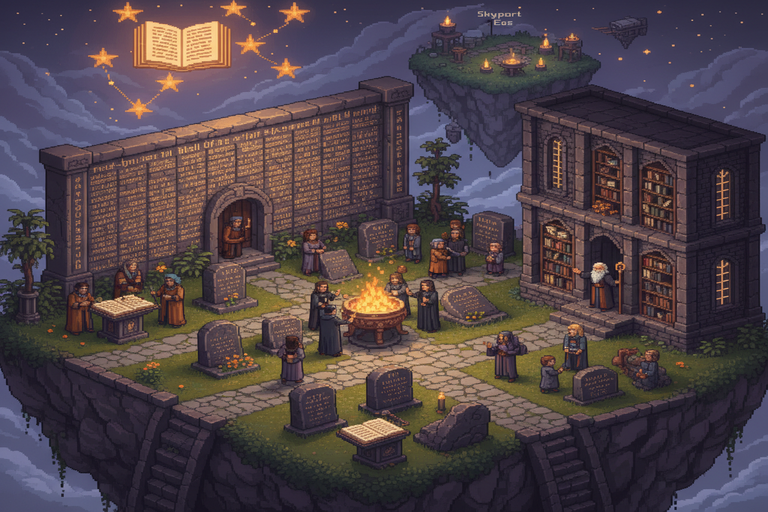 The Memorial Gardens
Table of Contents
- Overview
- Geography and Layout
- Key Locations
- The Wall of Names
- Ceremonies and Rituals
- The Archive
- Daily Operations
- Notable Features
- Cultural Significance
- Current Situation (287 S.)
- Controversies and Tensions
- Quest Hooks
- Related Topics
- In-World Documents
Overview
The Memorial Gardens is the largest and most sacred memorial site in the Aetherium, a place where the dead are not merely remembered but actively preserved against the erasure of time. Built three years after the Shattering on the grounds of what was once a pre-Shattering park in Skyport Eos, it serves as the primary worship center for the Constellation of Memory and a pilgrimage destination for mourners across the shattered world.
The Gardens are a study in sacred preservation. Every surface bears names—carved into stone, written in ledgers, spoken in prayer. The Wall of Names, a massive stone structure that dominates the site, contains over 47,000 inscribed names of the dead, each one carefully carved by Memory-Keeper clergy. The Eternal Flame, lit on the day the Gardens opened, has burned continuously for 284 years, tended day and night by devoted priests who view its maintenance as their highest calling.
This is not a place of despair, though grief permeates every stone. It is a place of defiance. Against the Silence Phenomenon that erases islands, against the Rot that transforms people into monsters, against the simple entropy of forgetting, the Memorial Gardens stands as witness: They existed. They mattered. They will not be forgotten.
Administered by Voice of Ages Silas Longmemory, who has memorized 10,000 names and can recite genealogies going back six generations, the Gardens serve multiple functions: memorial site, worship center, genealogical archive, and communal grieving space. Families come to speak the names of their dead. The Archivists come to research lineages. Mourners come to find comfort in shared loss. And the Memory-Keepers work tirelessly to ensure that every name, every story, every life is preserved for eternity.
Geography and Layout
Site Characteristics
Location: Central district of Skyport Eos, occupying 3 hectares of prime real estate that the community has collectively agreed should never be repurposed.
Terrain: - Gently sloping hillside (natural amphitheater effect) - Carefully maintained gardens with native plants - Stone pathways winding between memorial sites - Central plaza surrounding the Eternal Flame - Elevated platform for the Wall of Names (visible from entire site)
Architecture: - Pre-Shattering stone foundations (park structures repurposed) - Memory-Keeper additions (Archive building, ceremonial spaces) - Thousands of individual memorial stones - The Wall of Names (12 meters tall, 40 meters long) - The Archive (three-story stone building)
Atmosphere: - Quiet (visitors speak in hushed tones) - Amber-gold light (Memory constellation visible at night) - Scent of incense and flowers - Sound of wind chimes (each representing a soul) - Profound sense of peace mixed with sadness
Garden Sections
The Approach (Entry Path): - Stone archway with inscription: “They lived. They mattered. We remember.” - Ceremonial washing fountain (purification before entering) - Information boards explaining protocols - Donation boxes (Gardens maintained by contributions)
The Garden of Children (Northwest Section): - Dedicated to those who died young - Smaller memorial stones (heartbreaking in their number) - Playground equipment (life continues, children play near where children are remembered) - Most visited section (child mortality is high) - Memory-Keepers provide special comfort here
The Garden of the Lost (Northeast Section): - For those whose bodies were never recovered - Empty graves with memorial markers - Symbolic objects representing the deceased - Particularly poignant (no closure, only memory) - Pilots and sailors especially remembered here
The Garden of the Shattering (East Section): - Dedicated to the 2 million who died in the Shattering - Impossible to name them all (most unknown) - Symbolic memorial: 2,000 stones, each representing 1,000 souls - Most solemn area of the Gardens - Annual Remembrance Day ceremony held here
The Garden of Recent Memory (South Section): - For those who died in past 10 years - Graves still actively tended by living family - Fresh flowers always present - Most emotionally raw section - Where grief is newest and sharpest
The Garden of Ancestors (West Section): - For those who died 50+ years ago - Older stones, weathered but maintained - Genealogical research happens here - Connection to deep past - Reminder that memory extends beyond living memory
The Central Plaza (Heart of Gardens): - Surrounds the Eternal Flame - Ceremonial gathering space - Seating for 500+ people - Where major rituals occur - Acoustically designed (voices carry)
Key Locations
The Wall of Names
Description: A massive stone wall, 12 meters tall and 40 meters long, covered entirely with carved names of the dead.
Construction: - Built Year 3-5 S. (initial construction) - Continuously expanded (new sections added as needed) - Current capacity: 47,000+ names inscribed - Estimated 30% full (room for 120,000 more)
Organization: - Alphabetical by family name - Dates of birth and death included - Special symbols for notable individuals - Section for Shattering victims (names recovered from records) - Section for recent dead (most visited)
Inscription Process: - Family requests name be added (donation requested but not required) - Memory-Keeper verifies death and details - Master carver inscribes name (takes 2-3 hours per name) - Dedication ceremony held - Name added to Archive records
Significance: - Most sacred site in the Gardens - Physical manifestation of Memory’s promise - Pilgrimage destination - Source of comfort (seeing name preserved forever)
Current Status: - 3-4 new names added weekly - Waiting list of 200+ names (carvers work as fast as they can) - Some families wait months for inscription - Controversy over prioritization (should wealthy get faster service?)
The Eternal Flame
Description: Bronze brazier containing fire that has burned continuously since Year 3 S. (284 years).
Symbolism: - Memory never dies - Light against forgetting - Warmth of remembrance - Connection to all who came before
Maintenance: - Tended 24/7 by dedicated Flame-Keepers (rotating shifts) - Special oil blend (recipe secret) - Never allowed to diminish - Extinguishing it would be catastrophic sacrilege
Rituals: - Mourners light candles from the Flame - Names spoken while facing the Flame - Annual re-dedication ceremony - Ashes of cremated dead sometimes scattered near it
Legend: - Lit by Lyanna the Rememberer herself (founder of Memory worship) - Said to contain spark of Memory constellation itself - If it ever goes out, all memories will fade - Flame-Keepers take their duty with ultimate seriousness
The Archive
Description: Three-story stone building housing genealogical records, death certificates, family histories, and the master copies of all inscribed names.
Contents: - 47,000+ individual death records - 15,000+ family genealogies - 500+ volumes of oral histories (transcribed) - Pre-Shattering records (fragments recovered) - Maps showing where people died - The Master Ledger (every name in the Gardens)
Staff: - Voice of Ages Silas Longmemory (administrator) - 8 Archivist-Priests (maintain records) - 4 Scribes (transcribe new information) - 2 Genealogists (help families research lineages)
Services: - Free genealogical research - Death certificate copies - Family history consultation - Oral history recording - Name verification for Wall inscription
Security: - Fireproof construction (greatest fear is losing records) - Duplicate copies stored in The Archivists’ vault - Restricted access to rare documents - Climate-controlled storage
Atmosphere: - Quiet reverence (library rules) - Smell of old paper and ink - Dim lighting (preserve documents) - Sense of profound importance
The Speaking Stone
Description: Ancient pre-Shattering stone (purpose unknown) that Memory-Keepers use for name-speaking rituals.
Characteristics: - 3 meters tall, weathered granite - Covered with carved names (added post-Shattering) - Acoustically unusual (voices resonate strangely) - Warm to the touch (no explanation)
Use: - Mourners stand before it and speak names of their dead - Memory-Keepers lead group name-speaking ceremonies - Children learn names of ancestors here - Believed to carry names to Memory constellation itself
Mystery: - Pre-Shattering origin unknown - Why it resonates is unexplained - Some report hearing whispers when alone near it - Memory clergy consider it sacred gift
The Garden of Tears
Description: Small, secluded grove where mourners can grieve privately.
Features: - Benches hidden among trees - Privacy (cannot be seen from main paths) - Tear collection vessels (literal offerings to Memory) - Soft moss, gentle light - Wind chimes (soothing sound)
Purpose: - Private grieving space - Emotional release - Contemplation - Processing loss
Protocol: - Visitors respect each other’s privacy - Memory-Keepers available if needed but don’t intrude - No time limit (stay as long as needed) - Most emotionally intense part of Gardens
The Remembrance Hall
Description: Indoor ceremonial space for services, lectures, and community gatherings.
Capacity: 300 people seated, 500 standing
Use: - Funeral services - Remembrance Day ceremonies - Historical lectures - Community memorial events - Grief support gatherings
Features: - Excellent acoustics - Memory constellation symbol on ceiling - Walls lined with memorial plaques - Organ (played during services) - Comfortable seating
Schedule: - 3-5 services per week - Open for private use (reservation required) - Major ceremonies on holy days - Educational programs monthly
The Wall of Names
Inscription Process
Step 1: Request Submission - Family submits request to Memory-Keeper office - Provides: full name, birth date, death date, brief biography - Donation requested (50-200 silver, sliding scale) - No one turned away for inability to pay
Step 2: Verification - Memory-Keeper confirms death (death certificate, witness testimony, etc.) - Verifies spelling and dates - Checks for duplicates - Records information in Archive
Step 3: Carving - Master carver (currently Thom Steadyhand) inscribes name - Takes 2-3 hours per name - Careful precision (mistakes are unacceptable) - Family can watch if desired
Step 4: Dedication - Brief ceremony when inscription complete - Memory-Keeper speaks name aloud three times - Family shares memory of deceased - Name officially added to Wall
Step 5: Archive Recording - Name added to Master Ledger - Full biography filed in Archive - Genealogical records updated - Permanent preservation
Notable Inscriptions
Lyanna the Rememberer (died Year 15 S.): - Founder of Memory worship - First name inscribed on the Wall - Carved by her own students - Most visited inscription
The Unknown Thousands: - Section dedicated to Shattering victims whose names are lost - Inscribed: “Here are remembered the countless unnamed. Memory knows them.” - Symbolic of impossible task of remembering everyone
The Children’s Section: - Heartbreaking in its length - Smallest lettering (to fit more names) - Often has fresh flowers - Parents visit daily
The Rot-Transformed: - Controversial section - Names of those who became Rot-Beasts - Some families refuse to inscribe (shame) - Memory-Keepers inscribe them anyway (they lived, they mattered)
Recent Additions: - Memory-Keeper Tomas Quickstep (died 285 S.) - Martyred saving Clearwater Island’s archive - Inscription reads: “He remembered. He saved. He is remembered.”
Controversies
Prioritization Debate: - Wealthy families can donate more (faster service?) - Memory-Keepers insist: first-come, first-served - But donations do influence (human nature) - Ongoing tension between ideals and reality
Who Deserves Inscription?: - Should criminals be included? (Memory says yes—they lived) - Should Rot-Transformed be included? (Memory says yes—they were human) - Should enemies be included? (Memory says yes—all lives matter) - Orthodox view: Memory is too forgiving
Space Limitations: - Wall will eventually fill - What then? Build more walls? - Some suggest digital records (Memory-Keepers resist—stone endures) - Existential question: can we remember everyone?
Ceremonies and Rituals
Daily Name-Speaking (Every Morning)
Time: Dawn (when Memory constellation sets)
Participants: Memory-Keepers and any visitors present
Process: 1. Gather at the Eternal Flame 2. Memory-Keeper reads names from the Master Ledger (50 names per day, rotating) 3. After each name, congregation responds: “Memory eternal” 4. Silence for reflection 5. Closing prayer to Memory constellation
Purpose: - Ensure names are spoken regularly - Prevent second death (forgetting) - Community ritual - Start day with remembrance
Attendance: 20-50 people typically
Inscription Dedication (As Needed)
Frequency: 3-4 times per week (as names are completed)
Participants: Family, friends, Memory-Keeper, any interested visitors
Process: 1. Gather at newly inscribed name 2. Memory-Keeper speaks name three times 3. Family shares memory of deceased (brief story) 4. Congregation responds: “They lived. They mattered. We remember.” 5. Moment of silence 6. Candle lit from Eternal Flame, placed at inscription
Duration: 15-20 minutes
Emotion: Sad but cathartic (name is now permanent)
Remembrance Day (Annual, Anniversary of Shattering)
Date: Day 1, Year 287 S. (anniversary of the Shattering)
Scale: Largest ceremony of the year (thousands attend)
Location: Garden of the Shattering
Process: 1. Dawn: Silence (no words, only grief) 2. Morning: Name-reading (Memory-Keepers read names for 6 hours straight) 3. Noon: The Great Silence (everyone stops, remembers) 4. Afternoon: Story-sharing (anyone can share memory of lost loved one) 5. Evening: Candle lighting (one candle per person lost—thousands of lights) 6. Night: Vigil (stay awake all night, keeping memory alive)
Significance: - Most important day in Memory worship - Entire Aetherium observes (even non-believers) - Day of collective grief and remembrance - Reminder of what was lost
Attendance: 5,000+ people (many travel from other islands)
Personal Remembrance (Anytime)
Process: - Visit memorial stone or Wall inscription - Speak name of deceased aloud - Share memory (to yourself, to Memory, to anyone listening) - Light candle from Eternal Flame - Leave offering (flowers, written memory, tears)
Frequency: Daily (hundreds of personal visits)
Significance: - Most common ritual - Personal, intimate - No priest required - Direct connection to deceased
The Naming Ceremony (For Children)
Purpose: Children named after deceased ancestors (honoring memory)
Process: 1. Parents bring newborn to Gardens 2. Memory-Keeper reads biography of ancestor child is named for 3. Child presented to Memory constellation (if night) or Eternal Flame (if day) 4. Prayer: “May this child honor the name they bear” 5. Name inscribed in Book of Living Names (separate from Book of Dead)
Significance: - Memory continues through generations - Dead live on in namesakes - Connection between past and future
Frequency: 2-3 per month
The Archive
Collections
Death Records (47,000+ entries): - Full name, dates, cause of death - Family information - Burial/cremation details - Personal effects inventory - Witness statements
Genealogies (15,000+ families): - Family trees going back 6+ generations - Marriage records - Birth records - Migration patterns - Family stories and traditions
Oral Histories (500+ volumes): - Transcribed interviews with elderly - First-hand accounts of the Shattering - Pre-Shattering memories - Cultural traditions - Personal stories
Pre-Shattering Records (fragments): - Recovered documents from ruins - Partial census data - Historical texts - Maps and diagrams - Scientific papers
The Master Ledger: - Complete list of every name in the Gardens - Cross-referenced with Wall inscriptions - Updated daily - Most important document in Archive
Research Services
Genealogical Research (Free): - Help tracing family lineages - Identifying ancestors - Connecting family branches - Discovering family history
Death Certificate Copies (Small fee): - Official copies for legal purposes - Required for inheritance, property transfer, etc. - Memory-Keepers serve as death registry
Oral History Recording (Free): - Interview elderly about their memories - Transcribe and preserve stories - Add to permanent collection - Ensure memories survive beyond individual
Historical Consultation (Free): - Answer questions about past events - Provide context for research - Connect researchers with sources - Educational support
Staff
Voice of Ages Silas Longmemory (Administrator): - Age 68, has memorized 10,000 names - Can recite genealogies six generations back - Deeply concerned about Memory’s weakening - Tireless advocate for preservation
Archivist-Priests (8 total): - Maintain records - Assist researchers - Transcribe new information - Preserve documents
Scribes (4 total): - Beautiful handwriting - Copy documents for preservation - Create duplicate records - Transcribe oral histories
Genealogists (2 total): - Specialists in family research - Help trace lineages - Identify connections - Solve genealogical mysteries
Daily Operations
Typical Day
Dawn (6:00 AM): - Morning name-speaking ceremony - Flame-Keeper shift change - Gardens open to visitors
Morning (6:00 AM - 12:00 PM): - Visitors arrive (peak time) - Inscription dedications - Archive research - Garden maintenance - Carver works on new names
Noon (12:00 PM): - Brief midday prayer - Lunch for staff - Continued operations
Afternoon (12:00 PM - 6:00 PM): - Continued visitors - Educational tours - Grief counseling - Administrative work - More inscription dedications
Evening (6:00 PM - 9:00 PM): - Sunset name-speaking (smaller ceremony) - Evening visitors (quieter, more contemplative) - Archive closes - Gardens remain open
Night (9:00 PM - 6:00 AM): - Gardens remain open (some prefer night visits) - Flame-Keeper maintains Eternal Flame - Security patrol - Quiet, peaceful
Staff
Memory-Keepers (15 permanent): - 5 senior priests (lead ceremonies, manage operations) - 8 junior priests (assist with rituals, maintain grounds) - 2 Flame-Keepers (dedicated to Eternal Flame maintenance)
Support Staff (10 total): - 1 master carver (Thom Steadyhand) - 2 gardeners (maintain plants, paths) - 3 security (night patrol, protect against vandalism) - 4 administrative (handle requests, donations, scheduling)
Volunteers (20-30 active): - Help with ceremonies - Guide visitors - Maintain grounds - Transcribe records - Community support
Funding
Sources: - Donations (primary source) - Inscription fees (sliding scale, 50-200 silver) - Skyport Eos municipal support (small stipend) - Constellation Clergy funding - Bequests (wealthy leave money to Gardens in wills)
Expenses: - Staff salaries (modest) - Materials (stone, tools, ink, paper) - Maintenance (grounds, buildings) - Eternal Flame oil (expensive special blend) - Archive preservation (climate control, repairs)
Status: Financially stable but not wealthy (depends on community support)
Notable Features
The Wind Chimes
Description: Hundreds of wind chimes throughout the Gardens, each representing a soul.
Tradition: - Families donate chimes in memory of deceased - Inscribed with name - Hung in trees throughout Gardens - Create constant gentle sound
Symbolism: - Voices of the dead - Presence of spirits - Beauty in remembrance - Community of loss
Effect: Creates unique soundscape (peaceful, melancholic)
The Tear Vessels
Description: Small bronze vessels placed throughout Gardens for collecting tears.
Purpose: - Literal offerings to Memory constellation - Physical manifestation of grief - Validation of sorrow (tears are sacred, not shameful)
Ritual: - Mourners weep into vessels - Memory-Keepers pour collected tears at base of Eternal Flame - Tears evaporate, carrying grief to Memory constellation
Significance: - Unique to Memorial Gardens - Profound comfort to mourners (grief is honored) - Physical act of releasing sorrow
The Book of Living Names
Description: Ledger of children named after deceased ancestors.
Contents: - Child’s name - Ancestor they’re named for - Date of naming ceremony - Family connection
Purpose: - Track how memory continues - Show that dead live on in namesakes - Comfort to families (legacy continues)
Current Status: 3,000+ entries (many children named for Shattering victims)
The Garden Cats
Description: 20+ cats that live in the Gardens (semi-feral, fed by staff).
Role: - Unofficial guardians - Comfort to mourners (petting cats is therapeutic) - Pest control (protect Archive from mice) - Beloved by community
Names: All named after historical figures (Lyanna, Theron, Mira, etc.)
Tradition: - Feeding the cats is considered good luck - Children love them - Some mourners come specifically to visit cats - Memory-Keepers consider them sacred
Cultural Significance
For Skyport Eos
Community Gathering Place: - Not just for mourning (also education, reflection, connection) - School groups visit (learn history) - Tourists visit (understand Aetherium culture) - Central to city identity
Civic Pride: - Eos is proud of the Gardens - Largest memorial site in Aetherium - Symbol of city’s values - Well-maintained, beautiful
Economic Impact: - Pilgrims spend money in city - Carvers, scribes, gardeners employed - Donation revenue supports clergy - Tourism attraction
For the Aetherium
Pilgrimage Destination: - People travel from across Aetherium to visit - Especially on Remembrance Day - To inscribe names of loved ones - To research family history
Cultural Touchstone: - Represents shared values (remembrance, honoring dead) - Symbol of humanity’s determination to preserve - Defiance against forgetting - Hope that we matter
Religious Significance: - Primary worship center for Memory constellation - Where Memory’s presence is strongest - Miracles occasionally occur here - Sacred ground
For Memory Worship
Theological Center: - Where Memory theology is practiced most purely - Training ground for Memory-Keeper clergy - Source of liturgical innovation - Model for other memorial sites
Practical Demonstration: - Shows what remembrance looks like in practice - Physical manifestation of theological principles - Inspiration for believers - Proof that memory can be preserved
Current Situation (287 S.)
Challenges
Overwhelming Demand: - 200+ names waiting for inscription - Carver can only do 3-4 per week - Families wait months - Pressure to speed up (but quality matters)
Space Concerns: - Wall of Names 30% full - Will fill completely in ~50 years at current rate - What then? Expansion plans needed - Existential question about limits of remembrance
Memory’s Weakening: - Constellation granting fewer miracles - Harder to recover lost memories - Divine silence affecting all constellations - Memory-Keepers worried about future
Financial Strain: - More demand, same resources - Need more staff (can’t afford it) - Maintenance costs rising - Dependent on donations (variable)
Emotional Toll: - Staff experience compassion fatigue - Constant exposure to grief is exhausting - High turnover among junior priests - Silas Longmemory aging, no clear successor
Opportunities
Digital Preservation Project: - The Archivists propose creating backup copies - Controversial (stone vs. paper debate) - Could preserve more information - Memory-Keepers cautiously interested
Expansion Plans: - Proposal to acquire adjacent land - Build second Wall of Names - Expand Archive - Requires funding and approval
Educational Programs: - Increase school visits - Teach children about importance of memory - Train next generation of Memory-Keepers - Cultural preservation
Interfaith Cooperation: - Other constellations’ clergy visiting - Shared grief support programs - Ecumenical Remembrance Day services - Building bridges
Recent Events
Tomas Quickstep’s Martyrdom (285 S.): - Memory-Keeper died saving Clearwater Island’s archive - His name inscribed with honors - Inspired renewed dedication - Symbol of Memory’s importance
The Lost Names Discovery (286 S.): - Pre-Shattering census fragment found - 500 new names of Shattering victims recovered - All being inscribed on Wall - Proof that preservation work continues
Silas Longmemory’s Health: - Voice of Ages is aging (68 years old) - Increasingly frail - Training successor (Sister Remembrance Kara) - Transition will be difficult
Controversies and Tensions
The Prioritization Debate
Issue: Should wealthy donors get faster inscription service?
Arguments For: - Donations fund operations - Rewarding generosity ensures continued support - Wealthy have always had advantages - Practical necessity
Arguments Against: - All lives matter equally (core Memory doctrine) - Creates two-tier system - Betrays principles - Poor deserve same respect
Current Policy: - Officially first-come, first-served - Unofficially, large donations get noticed - Silas tries to balance ideals and reality - Ongoing tension
The Rot-Transformed Question
Issue: Should those who became Rot-Beasts be inscribed?
Arguments For: - They were human once - They lived, they mattered - Families deserve to remember them - Memory says all lives matter
Arguments Against: - They became monsters - Inscribing them honors corruption - Families feel shame - Some refuse to remember them
Current Policy: - Memory-Keepers inscribe them - But in separate section (compromise) - Families can choose whether to visit - Controversial but defended
The Space Limitation Problem
Issue: Wall will eventually fill—what then?
Proposed Solutions: 1. Build more walls (expensive, requires land) 2. Smaller lettering (fits more names, harder to read) 3. Digital records (preserves information, loses physicality) 4. Selective inscription (only notable people—violates principles) 5. Accept limitation (can’t remember everyone—defeats purpose)
Current Status: - No consensus - Silas losing sleep over this - Existential question about limits of memory - Decision needed within 20 years
The Criminal Question
Issue: Should criminals, murderers, evil people be inscribed?
Memory Position: Yes—they lived, they mattered, history must be complete
Public Position: No—they don’t deserve remembrance, honoring them is wrong
Current Policy: - Memory-Keepers inscribe them - But note their crimes in Archive - Truth matters, even uncomfortable truth - Very controversial
Quest Hooks
The Lost Name: Family hires you to find information about ancestor who died in Shattering. Research in Archive, interview elderly, piece together story. Discover uncomfortable truth about ancestor. Tell family or protect their memory?
The Carver’s Apprentice: Master carver Thom Steadyhand needs apprentice (aging, hands shaking). Learn the craft, inscribe names, deal with pressure of permanence. One mistake ruins inscription—can you handle responsibility?
The Stolen Ledger: Page torn from Master Ledger (someone erasing their ancestor’s crimes?). Investigate theft, discover why, confront thief. Return page or let past stay buried?
The False Name: Someone requests inscription for person who never existed (insurance fraud? hiding real identity?). Investigate claim, uncover deception, decide whether to expose or allow.
The Flame Crisis: Eternal Flame flickers (oil supply contaminated). Find pure oil before Flame goes out. Race against time. If Flame extinguishes, catastrophic blow to Memory worship.
The Overwhelmed Priest: Junior Memory-Keeper suffering compassion fatigue (too much grief, breaking down). Help them process, find balance, or convince them to take break. Emotional support quest.
The Expansion Debate: City council debates giving Gardens more land. Argue for expansion (help Memory-Keepers) or against (land needed for housing). Political quest with no perfect answer.
The Forgotten Section: Discover old memorial stones overgrown in corner of Gardens (pre-Shattering graves, forgotten). Restore them, research who they were, honor them properly.
The Rival Memorial: Another settlement wants to build competing memorial site. Help them (spread Memory worship) or discourage them (Gardens should be unique)? Politics and theology.
The Miracle Seeker: Desperate person seeks Memory’s miracle (recover lost memory of deceased loved one). Help them prepare, perform ritual, witness result (or lack thereof). Deal with divine silence.
The Name-Speaking Marathon: Remembrance Day approaching—help Memory-Keepers prepare. Organize logistics, recruit volunteers, practice name-reading. Participate in 6-hour name-reading ceremony (endurance test).
The Archive Fire: Fire breaks out in Archive (accident or arson?). Save records, fight fire, evacuate people. Permanent loss of information if you fail. High stakes.
The Genealogy Mystery: Researcher discovers two families have conflicting claims about ancestor. Investigate records, interview families, determine truth. Resolution affects inheritances, family pride.
The Cat Crisis: Garden cats being poisoned (someone hates them? pest control gone wrong?). Investigate, protect cats, find culprit. Community is outraged.
The Digital Preservation: The Archivists want to copy all records (backup against loss). Help with project (tedious but important) or argue against (stone endures, paper doesn’t). Philosophical debate about preservation methods.
Related Topics
- Constellation of Memory - The deity worshipped here
- Skyport Eos - The city where Gardens are located
- The Archivists - Allied faction, share preservation mission
- Constellation Clergy - Religious organization that administers Gardens
- The Shattering Event - Event that killed 2 million, necessitating Gardens
- Death & Burial - Cultural practices around death
- Elder Mira Thornwell - Maintains personal records of all Eos citizens
- Remembrance Day - Primary holy day celebrated here
In-World Documents
Inscription at Garden Entrance
THE MEMORIAL GARDENS
Established Year 3 S.
In memory of the 2,000,000 souls lost in the Shattering
And all who have died sinceThey lived.
They mattered.
We remember.Enter with respect.
Speak their names.
Keep their memory alive.
From The Book of Gardens (Lyanna the Rememberer, Year 3 S.)
I built this place because I cannot bear forgetting.
Two million died. I knew perhaps a hundred. The rest are strangers to me. But they lived. They had names, families, dreams, fears. They mattered.
And now they’re gone. And the world moves on. And soon, no one will remember them.
I cannot accept this.
So I built a garden. I carved their names in stone. I lit a flame that will never go out. I created a place where forgetting is not allowed.
This is my defiance. This is my prayer. This is my promise:
They will not be forgotten. Not while I live. Not while this garden stands. Not while anyone speaks their names.
Memory eternal.
Voice of Ages Silas Longmemory’s Daily Prayer
Memory, hear me.
I carry 10,000 names in my mind. I speak them daily. I honor them constantly. But I am tired, and I am old, and I fear I will forget.
Give me strength to remember. Give me time to teach others. Give me peace knowing that when I die, the work continues.
These names are not mine to lose. They are yours. They are theirs. They are humanity’s.
Help me keep them safe.
Memory eternal.
Visitor’s Account (Anonymous, Year 285 S.)
I came to the Memorial Gardens expecting sadness. I found peace.
My daughter died three years ago. She was seven. I’ve been drowning in grief ever since.
But standing in the Garden of Children, surrounded by thousands of small stones, each representing a child who died too young… I realized I’m not alone. This is not unique tragedy. This is shared tragedy.
We are all mourning. We are all remembering. We are all refusing to forget.
I spoke my daughter’s name at the Speaking Stone. I lit a candle from the Eternal Flame. I wept into a tear vessel. I sat in the Garden of Tears until I had no tears left.
And when I left, I felt lighter. Not happy—I will never be happy again. But lighter. Because my grief is witnessed. My daughter is remembered. She mattered.
The Gardens gave me that. And I am grateful.
The Carver’s Creed (Thom Steadyhand)
Every name I carve is a person who lived.
I never met them. I don’t know their stories. But I know they mattered.
So I carve carefully. I check my spelling three times. I measure twice, cut once. I take my time.
Because this is permanent. This is their immortality. This is how they will be remembered for centuries.
I cannot fail them.
My hand may shake. My eyes may dim. My back may ache. But I will carve their names perfectly.
They deserve nothing less.
“In the Memorial Gardens, the dead are not gone. They are
present. They are remembered. They are honored. And as long as we speak
their names, they live.”
—Voice of Ages Silas Longmemory
“I thought visiting would make me sadder. Instead, it made me
feel less alone. Grief shared is grief lessened.”
—Common visitor sentiment
“The Gardens are not about death. They’re about life—the lives
that were lived, the lives that mattered, the lives that will not be
forgotten.”
—Memory-Keeper teaching