Currency & Trade
“Economic Systems of the Sky” / “The Flow of Wealth” / “Commerce in the Void”
Foundation: Sky-Guild standardization
Currency: Aether-Coins (Guild-backed)
System: Regulated capitalism (Guild monopoly)
Reality: Scarcity economics (limited resources,
declining population)
Challenge: Maintaining trade networks across
fragmenting world
“Aether-Coins are worthless metal. But everyone agrees they’re valuable. That agreement is what keeps trade flowing, civilization functioning. Lose that agreement, everything collapses.”
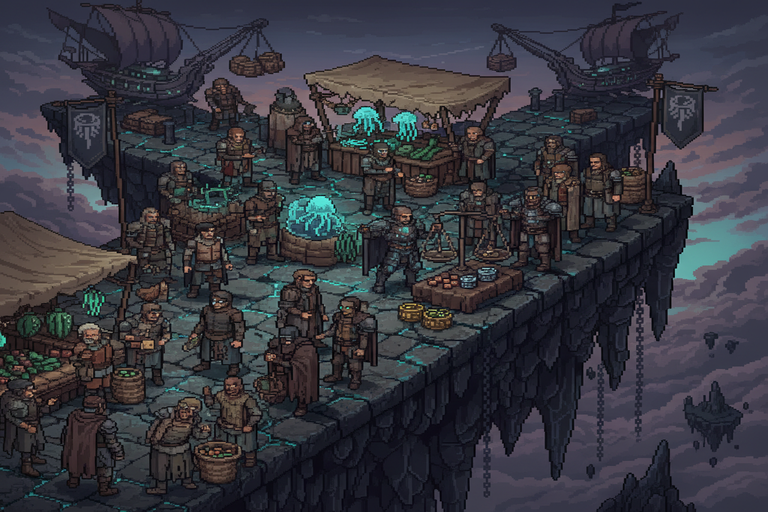 Currency and Trade
Systems
Currency and Trade
Systems
Quick Reference
|| Aspect | Details | ||——–|———| || Standard Currency | Aether-Coins (Guild-backed) | || Denominations | Bits (small), Coins (standard), Crowns (large) | || Conversion | 10 Bits = 1 Coin, 10 Coins = 1 Crown | || Backing | Sky-Guild resources (iron, goods, trust) | || Acceptance | Universal (all major settlements) | || Alternative | Barter (rural areas, Outlands) | || Control | Sky-Guild (minting, regulation, enforcement) | || Economic System | Regulated capitalism (Guild monopoly) | || Trade Volume | Declining (population decline, Rot disruption) |
Table of Contents
- Overview
- Currency System
- Typical Costs (Year 287 S.)
- Income and Wages
- Trade Systems
- Trade Goods
- Trade Routes and Networks
- Economic Centers
- Banking and Credit
- Economic Challenges
- In-World Documents
- Quest Hooks
- Related Topics
Overview
The economic system of the Aetherium is built on scarcity, distance, and the Sky-Guild’s monopolistic control. Unlike the pre-Shattering Apogee, where abundance was universal and needs were met automatically, the Aetherium operates on harsh economics: resources are limited, production is difficult, transportation is expensive, and survival is never guaranteed.
The Aether-Coin—a standardized currency introduced Year 195 S.—is the foundation of modern trade. Backed by the Sky-Guild’s resources and enforced through their monopoly on major trade routes, the Coin enables commerce across scattered settlements. But the system is fragile: it depends on trust (that Coins have value), on the Guild (that they won’t manipulate), and on stability (that civilization continues).
Trade networks connect settlements, moving food from farms to cities, iron from Ironhold to everywhere, and information through markets and taverns. But these networks are strained: the Rot disrupts routes, population decline reduces demand, resource scarcity drives prices up, and Guild monopoly concentrates wealth.
The economy functions. Barely. For now. But like everything in the Aetherium, it’s precarious—one major disruption away from collapse.
Currency System
Aether-Coins (Standard Currency)
Introduction: Year 195 S. - Sky-Guild proposal (standardization) - Gradual adoption (economic pressure) - Universal by Year 210 S. (all major settlements) - Replaced: Barter, local coins, trade chits
Physical Description: - Material: Copper-silver alloy (70% copper, 30% silver) - Size: 2cm diameter (Coin), 1cm (Bit), 3cm (Crown) - Weight: 5g (Coin), 1g (Bit), 25g (Crown) - Design: Constellation symbols (one per denomination) - Minting: Guild-controlled (Ironhold facilities)
Denominations:
Bits (Small): - Value: 1/10 of Coin - Symbol: Single star (Constellation of Light) - Usage: Daily purchases (food, small goods) - Pocket change (common)
Coins (Standard): - Value: Base unit - Symbol: Compass rose (Constellation of the Voyager) - Usage: Most transactions (goods, services) - Most common (standard)
Crowns (Large): - Value: 10 Coins - Symbol: Hammer (Constellation of the Forge) - Usage: Major purchases (property, ships, bulk goods) - Rare (wealthy only)
Backing: Guild resources - Iron reserves (Ironhold) - Trade goods (Guild warehouses) - Trust (most important) - If Guild collapses, Coins worthless
Counterfeiting: Rare but exists - Difficult (alloy is specific) - Detectable (weight, sound, appearance) - Punished harshly (exile or execution) - Black Sky Cartel (occasionally produces fakes)
Alternative Currencies
Ironhold Marks: Military scrip - Internal use (Ironhold only) - Issued to soldiers (wages) - Redeemable for Coins (at discount) - Control mechanism (Vask controls supply)
Trade Chits: Guild credit - Issued to Guild members - Redeemable for goods (Guild warehouses) - Transferable (can be traded) - Convenient (no physical coins) - Debt instrument (Guild tracks balances)
Barter Tokens: Outland system - Physical objects (carved wood, metal discs) - Represent goods (1 token = 1 kg grain, etc.) - Local (each settlement different) - Functional (but limited)
Rot-Shards: Illegal currency - Crystallized corruption (valuable, dangerous) - Black market only (Murky Chasm) - High value (1 Shard = 50-100 Coins) - Illegal (possession punishable) - Dangerous (handling causes corruption)
Typical Costs (Year 287 S.)
Daily Necessities
Food: - Bread (loaf): 2 Bits - Cheese (250g): 3 Bits - Dried meat (250g): 5 Bits - Fresh fish (1kg): 10 Bits (2 Coins from Saltwind) - Vegetables (1kg): 3-5 Bits - Beer (mug): 1 Bit - Wine (bottle): 5-10 Coins (rare) - Week’s food (single person): 5-10 Coins
Lodging: - Tavern bed (night): 5 Bits - Private room (night): 2 Coins - Week’s lodging: 3-5 Coins - Month’s rent (small home): 20-30 Coins - Property purchase (home): 500-2,000 Coins
Clothing: - Simple shirt: 2 Coins - Trousers: 3 Coins - Boots (good): 10 Coins - Cloak: 5 Coins - Full outfit: 20-30 Coins - Lasts: 2-3 years (with repairs)
Services
Transportation: - Ship passage (Eos-Ironhold): 20-30 Coins - Ship passage (Eos-Periphery): 100+ Coins - Private charter: 200-500 Coins (dedicated ship) - Captain Jorah’s rates: 50% premium (but guaranteed arrival)
Skilled Labor: - Blacksmith (tool repair): 2-5 Coins - Healer (treatment): 5-20 Coins - Alchemist (potion): 50-100 Coins - Scribe (letter writing): 1-2 Coins - Pilot (ship rental): 50-100 Coins/day
Information: - Tavern gossip: Free (unreliable) - Guild intelligence: 10-50 Coins (reliable) - Vex’s secrets: 100+ Coins (very reliable) - Archivist research: Free (public service)
Major Purchases
Vehicles: - Personal skiff: 500-1,000 Coins - Cargo hauler: 2,000-5,000 Coins - Passenger ship: 5,000-10,000 Coins - Warship: 50,000+ Coins (military only)
Property: - Small home: 500-2,000 Coins - Large home: 5,000-10,000 Coins - Business: 10,000-50,000 Coins - Island (small): 100,000+ Coins (if for sale, rarely)
Bulk Goods: - Ironwood (1 ton): 500-1,000 Coins - Iron (1 ton): 200-400 Coins - Grain (1 ton): 50-100 Coins - Rope (100m): 20-30 Coins
Illegal Goods
Rot-Shards: 50-100 Coins each Void-Lotus (unprepared, poisonous): 20 Coins Stolen artifacts: Variable (100-10,000 Coins) Weapons (military-grade): 50-200 Coins Slaves: 500-5,000 Coins (rare, mostly Murk)
Income and Wages
Daily Wages (Year 287 S.)
Unskilled Labor: - Dock worker: 5-10 Bits/day - Farm laborer: 5-8 Bits/day - Cleaner: 3-5 Bits/day - Guard (basic): 10-15 Bits/day
Skilled Labor: - Blacksmith: 1-3 Coins/day - Carpenter: 1-2 Coins/day - Pilot: 3-5 Coins/day - Healer: 2-4 Coins/day
Professional: - Merchant: Variable (10-100 Coins/day profit) - Ship captain: 5-20 Coins/day - Alchemist: 10-50 Coins/day - Guild Factor: 20-50 Coins/day
Annual Income: - Poor (laborer): 1,500-3,000 Coins/year - Middle (skilled): 3,000-10,000 Coins/year - Wealthy (professional): 10,000-50,000 Coins/year - Elite (Guild-Master, Commandant): 50,000+ Coins/year
Purchasing Power: - Laborer: Can afford food, lodging, little else - Skilled: Can afford comfort, small savings - Professional: Can afford luxury, significant savings - Elite: Can afford anything (wealth accumulates)
Wealth Distribution
Elite (5%): Own 60% of wealth - Guild-Masters, Commandants, successful merchants - Multiple properties, ships, businesses - Generational wealth (inherited) - Political power (wealth = influence)
Middle (20%): Own 30% of wealth - Skilled workers, small merchants, pilots - Own home, maybe small business - Comfortable (by Aetherium standards) - Vulnerable (one crisis from poverty)
Poor (75%): Own 10% of wealth - Laborers, farmers, servants - Rent homes (can’t afford purchase) - Subsistence (barely scraping by) - One bad harvest from starvation
Inequality: Extreme - Worse than pre-Shattering (Apogee had abundance) - Better than Year 0 (everyone was poor then) - Worsening (wealth concentrating) - Resentment (growing)
Trade Systems
Sky-Guild Dominance
Control: 60-70% of trade - Major routes (Eos-Ironhold, Farming Circuit, etc.) - Bulk goods (iron, grain, manufactured items) - Regulated markets (quality standards, fair dealing) - Arbitration (dispute resolution)
Membership: Required for large-scale trade - Entrance fee: 500 Coins (substantial) - Annual dues: 10% of profits - Benefits: Routes, contracts, protection, arbitration, legitimacy - Obligations: Follow regulations, pay dues, report activities
Guild-Master: Elara Song (Year 279-present) - Youngest ever (age 33 at election) - First woman (broke tradition) - Brilliant economist (undeniable) - Ruthless (concerning) - Embezzling (secret, for expeditions)
Power: Economic monopoly - Sets prices (for major goods) - Controls routes (can block competitors) - Enforces contracts (arbitration courts) - Influences policy (economic pressure on settlements)
Resistance: Growing - Independent merchants (crushed or absorbed) - Outland Clans (refuse membership) - Black Sky Cartel (operates outside Guild) - Resentment (monopoly breeds opposition)
Independent Traders
Who: Non-Guild merchants - Small operators (can’t afford membership) - Ideological resisters (refuse Guild control) - Outlaws (banned from Guild) - Desperate (no other options)
Advantages: - No dues (keep all profits) - No regulations (flexibility) - No oversight (freedom) - Potentially higher profits (if successful)
Disadvantages: - No protection (Guild won’t help) - No arbitration (disputes unresolved) - No legitimacy (settlements suspicious) - Higher risk (pirates, storms, no backup)
Examples: - Captain Jorah Ironwind (legendary independent) - Outland traders (clan-based) - Small merchants (local only) - Desperate refugees (trying to survive)
Guild Response: Tolerate if small, crush if threatening
Black Market
Control: Black Sky Cartel - Operates in Murky Chasm, Underbelly, shadows - Leader: The Captain (identity unknown) - Lieutenant: Vex Shadowhand (Murky Chasm) - Network: Extensive (all settlements)
Goods: Illegal - Rot-Shards (crystallized corruption, alchemical uses) - Weapons (military-grade, restricted) - Stolen artifacts (pre-Shattering, valuable) - Contraband (void-lotus, forbidden texts) - Services (assassination, smuggling, information)
Prices: Premium - Risk premium (illegal = expensive) - No regulation (whatever market bears) - Negotiable (if you’re valuable) - Sometimes: Favors (more valuable than coins)
Currency: Coins preferred - Untraceable (unlike Guild chits) - Universal (accepted everywhere) - Physical (no records) - Anonymous (privacy valued)
Risks: Severe - Authorities (imprisonment, execution) - Competitors (violence) - Customers (betrayal) - Product (Rot-Shards are dangerous) - But: Profitable (if you survive)
Barter
Usage: Still common - Rural areas (coin shortage) - Outland Clans (resist Guild system) - Poor (can’t afford coins) - Desperate (trade what they have)
Advantages: - No currency needed (direct exchange) - Flexible (any goods) - Personal (builds relationships) - Traditional (pre-Guild system)
Disadvantages: - Non-standardized (value subjective) - Inefficient (requires double coincidence of wants) - No savings (can’t hoard goods easily) - Limited (complex transactions difficult)
Common Exchanges: - Food for labor (harvest help) - Goods for services (repair for food) - Skills for skills (teaching for healing) - Favors for favors (social currency)
Trade Goods
Essential Goods (High Demand)
Ironwood: Critical resource - Airship hulls (only suitable material) - Construction (strong, durable) - Tools (long-lasting) - Price: 5-20 Crowns per ton - Source: Limited (slow-growing, most cut down) - Future: Shortage (consumption > growth)
Food: Survival necessity - Grain: 5-10 Coins per 10kg - Preserved meat: 10-20 Coins per 10kg - Fresh vegetables: 3-5 Coins per 10kg - Aether-Fish: 20-30 Coins per 10kg - Source: Windmere Farms, Saltwind Isle, scattered farms - Challenge: Production declining (Rot, weather, exhaustion)
Iron: Manufacturing essential - Raw iron: 20-40 Coins per 10kg - Steel: 40-80 Coins per 10kg - Tools: 5-50 Coins (depending on complexity) - Weapons: 20-200 Coins (depending on quality) - Source: Ironhold (monopoly) - Control: Guild + Vask (political tool)
Rope: Airship necessity - Sky-kelp fiber: 2-3 Coins per 10 meters - Quality critical (failure = death) - Replaced regularly (wear inevitable) - Source: Coastal islands (Sky-kelp harvesting) - Demand: Constant (every ship needs it)
Medicine: Life-saving - Herbal remedies: 1-5 Coins - Alchemical potions: 50-100 Coins - Rot-resistance compounds: 500+ Coins (rare) - Surgery: 20-100 Coins - Source: Healers, alchemists, Drifting Sanctuary (free)
Luxury Goods (Low Demand, High Price)
Pre-Shattering Artifacts: - Functional devices: 100-10,000 Coins - Art: 50-500 Coins - Texts: 100-1,000 Coins - Weapons: 200-2,000 Coins - Source: Ruins (looted), Archivists (sold reluctantly)
Spices: Rare - Exotic flavors: 10-50 Coins per kg - Source: Scattered (few islands produce) - Demand: Wealthy only (luxury)
Fine Cloth: Expensive - Silk-equivalent: 20-50 Coins per meter - Dyed fabrics: 10-30 Coins per meter - Source: Limited production - Status symbol (wealthy wear)
Books: Extremely rare - Pre-Shattering: 100-1,000 Coins (if intact) - Post-Shattering: 50-500 Coins - Source: Archivists (copies), ruins (originals) - Demand: Scholars, wealthy, collectors
Alcohol: Variable - Beer: 1 Bit per mug (common) - Wine: 5-10 Coins per bottle (rare) - Spirits: 20-50 Coins per bottle (very rare) - Source: Local production (limited)
Illegal Goods (Black Market Only)
Rot-Shards: 50-100 Coins each - Crystallized corruption - Alchemical uses (dangerous) - Possession illegal (punishable) - Demand: Alchemists, Rot-Touched, desperate - Source: Corrupted islands (harvested)
Military Weapons: 50-200 Coins - Restricted (Ironhold controls) - Black market (Cartel smuggles) - Quality: High (military-grade) - Demand: Criminals, rebels, paranoid
Forbidden Texts: 100-1,000 Coins - Serpent worship (heretical) - Luminar Council research (dangerous) - Rot transformation (controversial) - Demand: Serpent-worshippers, scholars, Returners
Slaves: 500-5,000 Coins - Rare (mostly Murky Chasm) - Illegal (all settlements officially) - Enforced: Variably (Ironhold executes slavers, Murk tolerates) - Moral: Universally condemned (but exists)
Trade Routes and Networks
Major Routes
Eos-Ironhold Run: Primary route - Distance: 150km - Duration: 3-7 days (weather-dependent) - Frequency: Daily (multiple ships) - Cargo: Food (to Ironhold), manufactured goods (to Eos) - Control: Sky-Guild (monopoly) - Threats: Rare (well-patrolled, safe)
Farming Circuit: Food supply - Route: Windmere → Thornvale → Eos → Ironhold → back - Duration: 15 days (complete loop) - Frequency: Weekly (staggered departures) - Cargo: Grain, vegetables, meat - Critical: Food security depends on this - Threats: Rot-Beasts (farms), storms
Spire Route: Scholar trade - Route: Eos → Glimmering Spire - Distance: 80km - Duration: 2 days - Cargo: Supplies (to Spire), artifacts (from Spire) - Frequency: Weekly - Threats: Increasing (Rot spreading)
Murk Run: Black market - Route: Murky Chasm → Underbelly → scattered - Duration: Variable (avoid authorities) - Cargo: Illegal goods (Rot-Shards, weapons, contraband) - Control: Black Sky Cartel - Threats: Authorities (if caught), pirates (competitors)
Periphery Expeditions: Exploration - Route: Varies (exploring unknown) - Duration: Weeks to months - Cargo: Supplies (out), artifacts (back, if lucky) - Frequency: Rare (dangerous, expensive) - Threats: Everything (storms, Rot, unknown) - Song’s secret expeditions (seeking Luminar Archives)
Minor Routes
Coastal Circuit: Fishing settlements - Connects: Saltwind, coastal islands - Cargo: Fish (primary) - Frequency: Tri-weekly (market days) - Importance: Protein supply
Outland Network: Clan trade - Scattered (no central route) - Barter-based (minimal coins) - Independent (no Guild) - Resilient (if one fails, others continue)
Storm-Sailor Paths: Howling Expanse - Dangerous (storm navigation) - Rarely used (by outsiders) - Storm-Sailors only (specialized skills) - Exotic goods (from unexplored areas)
Economic Centers
Skyport Eos: Largest Market
Population: ~8,000 (Year 287 S.)
Market: Daily operation - 200+ merchants (Guild and independent) - Goods: Everything (food, tools, clothes, artifacts) - Prices: Competitive (multiple sellers) - Atmosphere: Bustling (crowded, noisy, vibrant)
Specialties: - General goods (everything available) - Information (taverns, gossip, news) - Services (healers, scribes, guides) - Hub (all routes pass through)
Control: Elder Council + Guild - Council: Governance (laws, taxes, regulations) - Guild: Trade (routes, prices, standards) - Tension: Growing (Guild wants more control)
Dockmaster Harvin: Harbor authority - Controls docking (assigns berths) - Collects fees (official and bribes) - Corrupt (everyone knows) - Competent (harbor runs smoothly) - Tolerated (because he’s effective)
Ironhold: Manufacturing Center
Population: ~15,000
Market: Controlled - Guild-dominated (80%+ trade) - Military oversight (Vask monitors) - Prices: Set (no negotiation) - Atmosphere: Orderly (efficient, sterile)
Specialties: - Iron and steel (monopoly) - Weapons and armor (military-grade) - Manufactured goods (tools, hardware) - Shipbuilding (best yards)
Control: Vask + Guild - Vask: Political (authoritarian) - Guild: Economic (monopoly) - Alliance: Strained (mutual suspicion) - Opposition: Underground (resistance movement)
Blacksmith Garrick “Stonehand”: Master smith - Can forge anything (legendary skill) - Charges exorbitant prices (but worth it) - Independent (refuses Guild membership) - Tolerated (because he’s best)
Floating Market: Mobile Bazaar
Concept: Fleet of lashed-together airships - 20-30 ships (connected by bridges) - Travels trade routes (visits settlements) - Neutral ground (all factions welcome) - Rare goods (exotic, unusual)
Schedule: Predictable - Eos: Every 15 days - Ironhold: Every 20 days - Outlands: Variable (scattered) - Periphery: Never (too dangerous)
Goods: Exotic - Artifacts (pre-Shattering, unusual) - Spices (rare, expensive) - Books (if available) - Information (gossip, intelligence) - Services (fortune-tellers, entertainers)
Atmosphere: Carnival - Colorful (flags, banners) - Noisy (merchants shouting) - Crowded (everyone visits) - Exciting (break from routine) - Dangerous (pickpockets, scams)
Control: Independent - No Guild affiliation (neutral) - No settlement authority (mobile) - Self-governed (merchant council) - Respected (provides valuable service)
Murky Chasm: Black Market Hub
Population: ~600 (criminals, exiles, Rot-Touched)
Market: Illegal - Everything available (if you can pay) - No regulations (buyer beware) - No Guild (independent) - No morality (anything goes)
Specialties: - Rot-Shards (primary) - Weapons (military-grade, stolen) - Contraband (void-lotus, forbidden texts) - Services (assassination, smuggling, information) - Slaves (rare, but available)
Control: Black Sky Cartel - Vex Shadowhand (enforces “rules”) - The Captain (supreme authority) - Violence (dispute resolution) - Loyalty (enforced brutally)
Atmosphere: Dark - Dangerous (violence routine) - Free (no authority) - Honest (no pretense) - Desperate (everyone here is desperate)
Prices: Negotiable - Cash (coins, preferred) - Barter (goods, services) - Favors (most valuable) - Life (sometimes payment)
Banking and Credit
No Formal Banking
Reality: No banks (most settlements) - No interest (on savings) - No loans (formal) - No investment (financial instruments) - Cash economy (physical coins)
Why: Infrastructure - Trust limited (who to trust?) - Enforcement difficult (no central authority) - Risk high (banks would be robbed) - Tradition (pre-Shattering banking forgotten)
Guild Services
Letters of Credit: Guild members only - Deposit coins (Guild warehouse) - Receive letter (redeemable elsewhere) - Convenient (no physical transport) - Safe (Guild guarantees) - Fee: 5% (Guild profit)
Trade Credit: Extended payment - Guild advances goods (payment later) - Interest: 10-20% (high) - Collateral required (ship, property) - Default: Seizure (Guild takes collateral) - Risk: Debt trap (many merchants indebted)
Personal Loans
Informal: Individual lenders - Interest: 20-50% (very high) - Collateral: Required (property, goods) - Enforcement: Variable (violence common) - Desperation: Borrowers are desperate - Exploitation: Common (predatory lending)
Loan Sharks: Criminal - Murky Chasm specialty - Interest: 100%+ (usurious) - Enforcement: Violence (brutal) - Default: Death (or slavery) - Avoided (unless no alternative)
Wealth Storage
Physical Goods: Primary method - Property (homes, land) - Ships (valuable, functional) - Goods (ironwood, iron, preserved food) - Artifacts (pre-Shattering, appreciating) - Tangible (can’t be devalued easily)
Cash Hoarding: Secondary - Coins buried (hidden) - No interest (but safe) - Risk: Theft (if discovered) - Risk: Inflation (value might decline) - Common (no alternative)
No Investment: Opportunity lost - Can’t earn interest (no banks) - Can’t invest (no financial instruments) - Wealth stagnant (doesn’t grow) - Economic inefficiency (capital unused)
Economic Challenges
Scarcity
Resources: Limited - Ironwood (slow-growing, consumption > growth) - Iron (finite deposits, declining) - Food (production declining, Rot affecting farms) - Water (some islands have none) - Everything (scarcity is default)
Impact: Inflation - Prices rising (supply < demand) - Wages stagnant (labor abundant) - Purchasing power declining (poor suffer) - Wealth concentrating (rich buy scarce goods)
Future: Worsening - Population declining (but slower than resources) - Resources depleting (faster than population) - Prices will rise (inevitably) - Standard of living will decline (already happening)
Guild Monopoly
Power: Economic control - Sets prices (for major goods) - Controls routes (blocks competitors) - Enforces membership (join or be crushed) - Manipulates markets (profit maximization)
Abuse: Common - Price-fixing (artificially high) - Route blocking (eliminate competition) - Selective service (favor allies, punish enemies) - Information control (read messages, delay news)
Resistance: Difficult - Guild is powerful (resources, ships, influence) - Alternatives are risky (independent trade is dangerous) - Outlands resist (but isolated) - Black market thrives (but illegal)
Reform: Unlikely - Guild-Master Song (not interested in reform) - Guild members (benefit from monopoly) - Settlements (dependent on Guild) - Change requires: Revolution (or Guild collapse)
Corruption
Officials: Often corrupt - Dockmaster Harvin (takes bribes, everyone knows) - Guild Factors (skim profits, common) - Settlement authorities (accept bribes, variable) - Guards (look away for coins, frequent)
Impact: Inefficiency - Costs rise (bribes add up) - Trust erodes (everyone’s corrupt) - Justice fails (rich escape punishment) - Resentment grows (poor suffer)
Acceptance: Pragmatic - “Everyone’s corrupt” (common belief) - “Pay the bribe” (easier than fighting) - “It’s how things work” (resignation) - Reform attempts (fail, corruption persists)
Inequality
Wealth Gap: Extreme - Elite (5%): Own 60% of wealth - Middle (20%): Own 30% of wealth - Poor (75%): Own 10% of wealth - Worsening (wealth concentrating)
Social Mobility: Limited - Birth matters (wealthy families stay wealthy) - Luck matters (find artifact, get rich) - Skill matters (but not enough) - Connections matter (most important) - Upward mobility: Rare (but possible)
Resentment: Growing - Poor resent rich (inequality visible) - Rich fear poor (violence possible) - Middle squeezed (declining into poverty) - Tension rising (could explode)
Instability
Rot Threat: Economic disruption - Islands fall (production lost) - Routes disrupted (Rot-clouds block) - Refugees (strain resources) - Fear (affects investment, trade)
Political Tension: Trade disruption - Vask’s war plans (could close routes) - Factional conflicts (disrupt trade) - Instability (merchants avoid risk) - Future uncertain (planning difficult)
Population Decline: Demand falling - Fewer people (less demand) - Prices should fall (deflation) - But: Supply falling faster (scarcity) - Result: Stagflation (prices rise, economy stagnates) - Confusing (economists struggle)
In-World Documents
Guild Price List (Year 287 S., Official)
SKY-GUILD STANDARD PRICES
Effective: Year 287 S., Day 1
Food (per 10kg): - Grain: 8 Coins - Preserved meat: 15 Coins - Fresh vegetables: 4 Coins - Aether-Fish: 25 Coins
Materials (per 10kg): - Ironwood: 180 Coins (1.8 Crowns) - Iron: 30 Coins - Rope (10m): 2.5 Coins
Services: - Ship passage (Eos-Ironhold): 25 Coins - Messenger service: 8 Coins - Arbitration: 50 Coins (dispute resolution)
NOTE: Prices subject to change. Guild reserves right to adjust based on supply, demand, and market conditions.
ENFORCEMENT: All Guild members must adhere to these prices. Violations punishable by fine, suspension, or expulsion.
Independent Merchant’s Complaint (Year 287 S.)
To the Elder Council:
The Sky-Guild is crushing us. Their prices are too low (we can’t compete). Their routes are exclusive (we’re blocked). Their regulations are impossible (we can’t comply).
I’ve been merchant for 20 years. I’ve served this community. I’ve provided goods, fair prices, honest dealing.
But the Guild offers lower prices (they can afford losses, I can’t). The Guild has better routes (they control them). The Guild has arbitration (they enforce their rules).
I’m going bankrupt. My family is starving. My ship will be seized (debt).
Please. Regulate the Guild. Break their monopoly. Give independents a chance.
Or we all become Guild members. Or we all become poor. Or we all become criminals.
—Merchant Kael Windborn, Skyport Eos
[Note: Petition denied. Guild too powerful. Kael joined Black Sky Cartel. Now smuggles contraband. Survival required adaptation.]
Vex’s Price Quote (Black Market, Year 287 S.)
You want Rot-Shard? I have Rot-Shard.
Price: 75 Coins. Non-negotiable.
Why so expensive? Because it’s illegal. Because it’s dangerous. Because I’m the only one selling. Supply and demand, friend.
You want it cheaper? Go harvest it yourself. Visit corrupted island. Touch the Rot. Crystallize it. Bring it back.
Oh, you don’t want to do that? Because you’ll get corrupted? Because you’ll die?
That’s why it’s 75 Coins.
Take it or leave it. I don’t care. Someone else will buy it.
Outland Barter Record (Year 287 S.)
Trade Agreement: Windmere Farms and Thornvale
Windmere Offers: 500kg grain Thornvale Offers: 200kg preserved meat, 50kg vegetables
Terms: Exchange at harvest (Day 200, Year 287) Delivery: Windmere ships to Thornvale Witnessed: Elder Talvyn, Captain Mara
No Coins Exchanged: Barter only (Outland tradition)
Signed: [marks, not signatures—many can’t write]
[Note: This is how Outlands operate. No Guild. No coins. Just trust, tradition, and community. Guild calls it primitive. Outlands call it freedom.]
Economist’s Analysis (Year 285 S.)
Subject: Aetherium Economic Trends
Findings: We’re in economic decline. Slow, but inevitable.
Evidence: - Production declining (Rot, exhaustion, population) - Demand declining (fewer people) - But: Production declining faster (scarcity) - Result: Prices rising (inflation) - Wages stagnant (labor abundant) - Purchasing power declining (everyone poorer)
Projection: Standard of living will decline 20% by Year 300. 50% by Year 350. By Year 400: Subsistence only.
Causes: - Resource depletion (using faster than replenishing) - Population decline (but slower than resources) - Rot disruption (routes, production) - No innovation (technology stagnant)
Solutions: - Increase production (how? Resources limited) - Decrease consumption (people are already poor) - Find new resources (explore Periphery? Dangerous) - Recover pre-Shattering tech (Luminar Archives? Might not exist)
Conclusion: We’re getting poorer. Slowly. Inevitably. Unless something changes.
But what can change? I don’t know.
—Guild Economist Mara Coinweaver
Quest Hooks
The Price War: Mediate between independent merchant and Guild. Economic conflict. Both sides have valid points. Resolution affects livelihoods.
The Counterfeit Ring: Discover counterfeit Coin operation. Stop them (protect economy) or join them (profit from crime)?
The Trade Route: Establish new route (connect isolated settlement). Dangerous (storms, pirates, Rot), but profitable and humanitarian.
The Monopoly Break: Help resistance break Guild monopoly. Economic revolution. Risky (Guild is powerful), but possibly necessary.
The Black Market Deal: Vex offers illegal goods (Rot-Shards, weapons). Buy them (useful but illegal) or report him (legal but he’ll escape)?
The Debt Collection: Help (or stop) loan shark collecting debt. Debtor can’t pay. Violence imminent. Moral dilemma.
The Economic Collapse: Song’s embezzlement discovered. Economic crisis. Help stabilize (prevent panic) or exploit (profit from chaos)?
The Barter Network: Help Outlands maintain independence (resist Guild). Establish barter network, avoid coins, preserve freedom.
The Treasure Hunt: Discover valuable pre-Shattering artifact. Sell it (get rich) or donate it (Archivists preserve)? Wealth vs. duty.
The Trade Negotiation: Negotiate major trade deal (settlements, factions, goods). Complex, high-stakes, affects many lives. Success or failure has consequences.
Related Topics
- Sky-Guild - Controls trade
- Airships - Transportation for goods
- Black Sky Cartel - Black market control
- Guild-Master Elara Song - Economic power
- Vex Shadowhand - Black market leader
- Skyport Eos - Largest market
- Ironhold - Manufacturing center
“Aether-Coins are
worthless metal. But everyone agrees they’re valuable. That agreement is
what keeps trade flowing, civilization functioning. Lose that agreement,
everything collapses.”
—Economic theory
“In Apogee, everyone had everything. In Aetherium, everyone has
nothing. We trade what little we have, hoping to survive another day.
That’s our economy. That’s our life.”
—Common observation
“Guild controls trade. Trade controls resources. Resources
control survival. Therefore: Guild controls survival. That’s power.
That’s tyranny. That’s reality.”
—Independent merchant’s bitter reflection