Aether-Vine
Aetheria serpentis / “Sky-Creeper” / “The Reaching Plant”
“Beautiful, invasive, and deadly. The Aether-vine reaches for
what it cannot have and pulls down everything in its path.”
—Botanist’s field notes
Quick Reference
| Attribute | Details |
|---|---|
| Type | Flora (Climbing/hanging plant) |
| Rarity | Uncommon (but spreading) |
| Habitat | Island edges, ruins, abandoned structures, zero-gravity zones |
| Danger Level | Moderate (structural damage, entanglement, falls) |
| Growth Rate | Fast (2-5 meters per week in ideal conditions) |
| Lifespan | Perennial (individual vines live 5-10 years, colonies indefinite) |
| Value | Low (nuisance mostly, minor uses) |
| Edibility | No (mildly toxic) |
| Cultivation | Discouraged (invasive, destructive) |
 Aether-Vine - The Reaching
Plant
Aether-Vine - The Reaching
Plant
Description
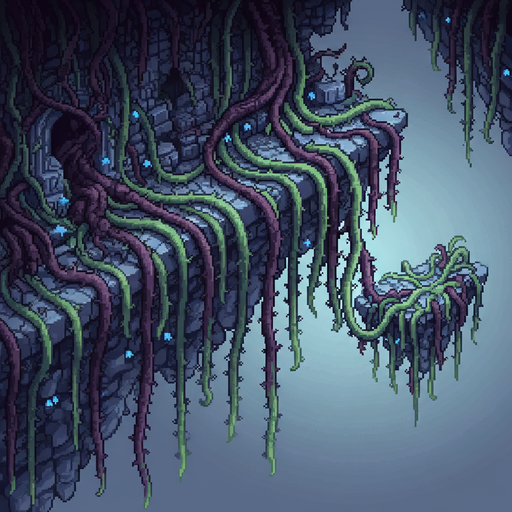
Aether-vines are one of the most distinctive plants of the post-Shattering Aetherium—climbing plants that grow not toward sunlight but toward the void, reaching down from island edges into open Aether as if seeking something in the emptiness below. They are simultaneously beautiful (bioluminescent blue flowers, elegant tendrils) and destructive (structural damage, navigation hazards, entanglement risks).
The vines emerge from cracks in stone at island edges, sending roots deep into the rock while extending tendrils downward into the Aether. Unlike pre-Shattering climbing plants that grew upward toward light, Aether-vines grow in all directions—up, down, sideways—with apparent preference for downward growth. They can reach 50+ meters in length, creating curtains of vegetation hanging from island edges like green-purple waterfalls.
What makes them particularly notable is their ability to grow in zero-gravity Aether zones. Tendrils that extend beyond an island’s gravity well don’t fall—they continue growing in whatever direction they were heading, creating bridges, tangles, and hazards. When two islands drift close enough, Aether-vines can create natural bridges between them, though these are unstable and dangerous to traverse.
The vines are covered in small, sharp thorns and secrete a mildly irritating sap. The flowers bloom year-round, glowing faintly blue in darkness, creating beautiful displays at night. However, this beauty comes at a cost: Aether-vines are structurally destructive, their roots breaking stone and their weight pulling down buildings. They’re considered a nuisance in most settlements and are actively cleared from inhabited areas.
Physical Characteristics
Appearance
Tendrils: - Purple-green coloration (darker purple at base, lighter green at tips) - Cylindrical, 2-5cm diameter - Covered in small thorns (1-2mm long, sharp) - Flexible but surprisingly strong (can support human weight, barely) - Segmented appearance (nodes every 30-50cm)
Leaves: - Small, triangular (5-10cm long) - Dark green with purple veins - Waxy coating (water-resistant) - Grow in clusters at nodes - Fall off older sections (leaving bare tendrils)
Flowers: - Bell-shaped, 3-5cm diameter - Pale blue, bioluminescent (glow faintly at night) - Bloom continuously (no seasonal pattern) - Sweet scent (attracts cloud-hoppers and aether-flies) - Short-lived when cut (wilt within hours)
Roots: - Penetrating type (break through stone) - Extensive network (can destabilize structures) - Gray-white coloration - Thick (up to 10cm diameter at base) - Difficult to remove completely
Seeds: - Tiny (1mm), wind-dispersed - Produced prolifically (thousands per plant) - Viable for years - Germinate in cracks and crevices - High success rate (invasive tendency)
Growth Patterns
Directional Growth: - Primary direction: Downward (toward void) - Secondary: Horizontal (along surfaces) - Tertiary: Upward (if blocked from going down) - Appears to “seek” open space
Growth Rate: - Ideal conditions: 5 meters per week - Poor conditions: 2 meters per week - Slows in winter (if applicable to location) - Accelerates after rain or Aether-storms
Colony Formation: - Single plant can spawn dozens of tendrils - Multiple plants merge into colonies - Colonies can cover entire cliff faces - Difficult to distinguish individual plants in mature colonies
Ecology and Habitat
Distribution
Primary Habitat: Island edges - Grows from cracks in cliff faces - Prefers nutrient-poor stone (limestone, sandstone) - Avoids metal and treated wood - Thrives on neglect
Secondary Habitat: Ruins - Abandoned buildings - Collapsed structures - Pre-Shattering sites - Anywhere humans no longer maintain
Tertiary Habitat: Zero-gravity zones - Extends into Aether beyond gravity wells - Creates floating tangles - Bridges between close islands - Navigation hazards for airships
Geographic Range: Widespread - Found throughout Bright Reaches - Rare in Murk (Rot outcompetes it) - Absent from Veiled Heights (too cold) - Common in Periphery ruins
Nutrient Acquisition
Root Absorption: - Extracts minerals from stone (literally dissolving rock slowly) - Absorbs moisture from air - Minimal soil requirements - Can survive on bare stone
Aether Absorption (Unique): - Tendrils in open Aether absorb nutrients directly from void - Mechanism unknown (subject of alchemical study) - Appears to filter microscopic particles from Aether - Enables growth in impossible locations
Water: - Collects condensation on leaves - Absorbs moisture from Aether - Can survive months without rain - Drought-resistant
Reproduction
Sexual (Flowers and seeds): - Flowers attract pollinators (cloud-hoppers, aether-flies) - Seeds wind-dispersed - Germination rate: 60-70% - Primary reproduction method
Asexual (Vegetative): - Broken tendrils can root if they land on suitable surface - Nodes can sprout new plants - Enables rapid colony expansion - Makes eradication difficult
Ecological Role
Positive: - Provides habitat for small creatures (sky-rats nest in tangles) - Flowers feed pollinators - Creates bridges between islands (dangerous but functional) - Stabilizes loose soil (in some cases)
Negative: - Structural damage to buildings - Destabilizes cliff faces - Navigation hazard - Outcompetes native plants - Invasive in most ecosystems
Interaction with Humans
As Nuisance
Structural Damage: - Roots break stone (slow but inevitable) - Weight pulls down weakened structures - Blocks gutters and drains - Damages foundations - Expensive to repair
Navigation Hazard: - Airships can become entangled - Tendrils obscure island edges - Creates false “bridges” (unstable) - Difficult to see at night (despite glow)
Maintenance Burden: - Must be cleared regularly from inhabited areas - Regrows quickly if not fully removed - Labor-intensive - Never-ending task
As Resource
Fiber (Minor use): - Tendrils can be processed into rope - Weak but flexible - Used for non-critical applications - Better alternatives exist (sky-kelp)
Medicine (Limited): - Root extract is mild painkiller - Effectiveness: Low - Side effects: Nausea, dizziness - Rarely used (better medicines available)
Decoration (Temporary): - Glowing flowers attractive - Used in festivals (short-lived) - Wilt quickly when cut - Not worth cultivating for this alone
Alchemical Research: - Aether-absorption mechanism studied - Potential applications in Aether-navigation - No practical results yet - Ongoing research
Cultural Significance
Symbolism: - Represents neglect and decay - “Aether-vine covered” = abandoned - Used in poetry about loss - Negative connotations generally
Sayings: - “Let the vines take it” (abandon something) - “Vine-covered heart” (emotionally closed off) - “Reaching for the void” (futile effort)
In Art: - Depicted in paintings of ruins - Symbol of nature reclaiming civilization - Romantic but melancholy imagery
Dangers and Hazards
Direct Dangers
Entanglement: - Airships can become caught in hanging tendrils - Difficult to free (tendrils are strong) - Can cause crashes - Pilots learn to avoid vine-heavy areas
Falls: - Vines look like they might support weight - Often don’t (or break unexpectedly) - People attempting to use as rope have died - Children especially at risk
Structural Collapse: - Buildings weakened by root damage - Can collapse suddenly - Vines often hide the damage - Warning signs: Cracks, leaning, vine growth
Thorns: - Small but sharp - Cause minor injuries - Sap irritates skin (rash, itching) - Not serious but unpleasant
Indirect Dangers
Concealment: - Vines hide cliff edges - Obscure hazards in ruins - Create false sense of solidity - “Vine floor” that’s actually just tangles over void
Pest Habitat: - Sky-rats nest in tangles - Rot-beetles sometimes present - Can harbor disease - Attracts unwanted wildlife
Fire Hazard: - Dry vines are flammable - Can spread fire between structures - Difficult to extinguish (hangs in air) - Rare but dangerous
Removal and Control
Manual Clearing
Method: - Cut tendrils at base - Dig out roots (difficult) - Burn cut material - Repeat regularly (regrows)
Effectiveness: Moderate - Temporarily removes vines - Doesn’t prevent regrowth - Labor-intensive - Ongoing maintenance required
Cost: 5-10 coins per structure per year
Chemical Treatment
Method: - Apply alchemical compounds to roots - Kills plant (usually) - Expensive - Can damage stone
Effectiveness: High - Kills existing plants - Doesn’t prevent new growth - Single application often sufficient - But costly
Cost: 50-100 coins per application
Prevention
Method: - Fill cracks in stone (prevents rooting) - Regular inspection and early removal - Maintain structures (vines prefer neglect) - Metal or treated wood barriers
Effectiveness: High - Prevents establishment - Much cheaper than removal - Requires vigilance - Worth the effort
Natural Control
Predators: None significant - Some insects eat leaves (minimal impact) - Sky-rats damage tendrils (but also nest in them) - No effective biological control
Competition: - Other plants can outcompete in soil - But vines thrive where others can’t - Rot outcompetes vines (in Murk)
Notable Locations
The Hanging Gardens (Thornvale)
Description: Abandoned terrace garden, now covered in Aether-vines
Appearance: - Vines cascade down multiple levels - Blue flowers create stunning night display - Completely overrun (no original plants remain) - Dangerous but beautiful
Status: Tourist attraction (from safe distance)
Warning: Do not enter (structural collapse risk)
The Vine Bridge (Between two minor islands)
Description: Natural bridge formed by Aether-vines between islands 50m apart
Formation: Decades of growth, vines met in middle
Stability: Questionable - Supports weight (tested with cargo) - Sways in wind - No safety rails - Regularly breaks and reforms
Usage: Locals use it (carefully), outsiders advised against
The Entangled Wreck (Boneyards)
Description: Crashed airship, suspended in Aether-vine tangle
History: Ship crashed 20 years ago, vines grew around wreckage
Current State: - Hanging 30m below island edge - Completely covered in vines - Cargo might still be inside - Extremely dangerous to access
Quest Hook: Retrieve valuable cargo from wreck
In Alchemy and Research
Current Research
Aether-Absorption Study: - How do vines extract nutrients from void? - Potential applications for Aether-navigation - Alchemist Kael Greythorn studying this - No breakthroughs yet
Growth Direction: - Why do vines grow toward void? - Seeking something specific? - Or just growing away from gravity? - Philosophical implications
Rot Resistance: - Vines resist Rot better than most plants - Why? - Potential for Rot-resistance alchemy - Promising avenue
Alchemical Uses
Root Extract: - Mild painkiller (better options exist) - Preparation: Boil roots, strain, concentrate - Dosage: 5-10 drops - Side effects: Nausea, dizziness - Market value: 2 coins per vial
Sap: - Irritant (weaponized by some) - Can be concentrated - Causes rash, temporary blindness if in eyes - Illegal in most settlements
Fiber: - Rope (weak) - Cloth (rough, uncomfortable) - Not worth processing usually
Encounter Scenarios
The Vine-Covered Ruin
Setup: Party exploring abandoned structure
Complication: Aether-vines everywhere - Obscure floor gaps - Weaken structures - Create entanglement hazards - Hide dangers
Challenge: Navigate safely, avoid falls, find what they came for
The Entangled Ship
Setup: Airship caught in vine tangle
Complication: Vines are strong, ship is stuck - Cutting free takes time - Vines regrow - Ship taking damage - Predators attracted to commotion
Challenge: Free ship before it’s destroyed or something worse arrives
The False Bridge
Setup: Party needs to cross between islands
Complication: Vine bridge looks sturdy but isn’t - Will it support weight? - How many can cross at once? - What if it breaks mid-crossing?
Challenge: Risk the bridge or find another way
Related Topics
- Sky-Kelp - Better fiber source
- Void-Lotus - Another Aether-adapted plant
- The Boneyards - Vine-covered wrecks
- Thornvale - Hanging Gardens location
- Alchemist Kael Greythorn - Studying vines
In-World Documents
Warning Sign (Posted in Thornvale)
DANGER
AETHER-VINE COVERED STRUCTURE
UNSTABLE
DO NOT ENTERVines have weakened walls and floors.
Collapse risk extreme.
Beautiful but deadly.Admire from distance.
Do not climb.
Do not test stability.You have been warned.
From Flora of the Aetherium (Botanical Text)
Aether-vine (Aetheria serpentis) represents one of the most successful adaptations to post-Shattering conditions. Its ability to extract nutrients from the Aether itself enables growth in locations where no other plant can survive.
However, this success comes at a cost to human civilization. The vines are destructive, invasive, and dangerous. They represent nature’s reclamation of abandoned spaces—beautiful in theory, problematic in practice.
Recommendation: Clear from inhabited areas. Study in controlled conditions. Admire from safe distance.
Pilot’s Log Entry
Day 47: Nearly lost the ship today.
Was navigating near old ruins. Didn’t see the Aether-vine tangle until we were in it. Tendrils wrapped around propeller, caught in rigging.
Took three hours to cut free. Damaged sails. Lucky we didn’t crash.
Note to self: Ruins = vines. Vines = danger. Give them wide berth.
The flowers were pretty, though. Small consolation.
“The Aether-vine is a perfect metaphor for the post-Shattering world:
beautiful, deadly, and reaching for something it can never have. It
grows toward the void, seeking nutrients in emptiness, pulling down
everything it touches. We clear it from our settlements, but it always
returns. Perhaps that’s the point. Perhaps the vines are teaching us
that nature adapts, survives, and reclaims what we abandon. Or perhaps
they’re just plants growing in the only direction available. Either way,
they’re here to stay.”
—From Botanical Observations by Scholar Evian