Medicant Order
“Heal All, Judge None”
“Compassion is not conditional. Healing is not a privilege. We
serve all who suffer.”
—The Medicant Vow
Quick Reference
| Attribute | Details |
|---|---|
| Type | Religious healing order (splinter from Constellation Clergy) |
| Founded | Year 189 S. (98 years ago) |
| Founder | Brother Caelum the Elder |
| Current Leader | Abbot Silas (Drifting Sanctuary) |
| Size | 50+ dedicated Medicants, 20+ novices, 200+ lay supporters |
| Territory | Aetherium-wide (traveling healers, no fixed territory) |
| Headquarters | Drifting Sanctuary (primary base) |
| Philosophy | Heal without judgment, compassion over dogma, medicine as sacred duty |
| Primary Activity | Free medical care, disaster response, Rot-Touched treatment |
| Funding | Donations, wealthy patrons, begging |
| Controversy Level | High (orthodox clergy disapproves, some settlements ban them) |
| Public Opinion | Saintly or naive (depending on perspective) |
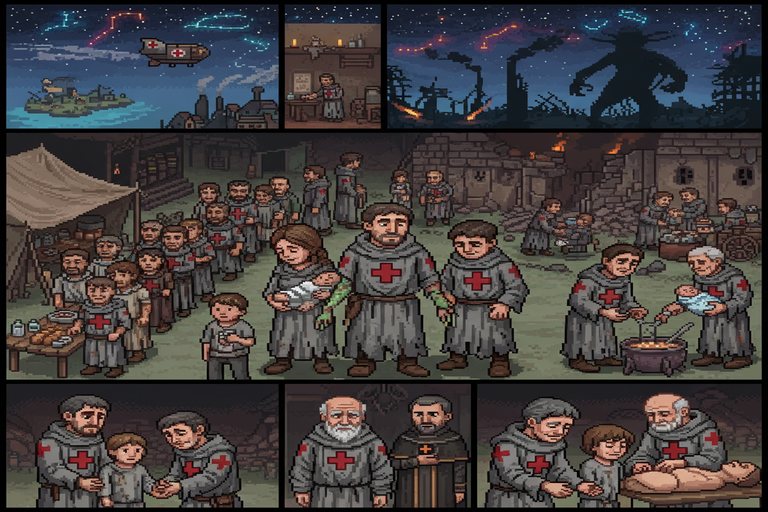 Medicant Order - Healers Without
Judgment
Medicant Order - Healers Without
Judgment
Table of Contents
- Overview
- History and Founding
- Philosophy and Principles
- Organization and Structure
- Services Provided
- Training and Membership
- Operations and Methods
- Funding and Resources
- Relationships with Other Factions
- Controversies
- Notable Medicants
- Current Situation (287 S.)
- Cultural Impact
- Quest Hooks
- Related Topics
- In-World Documents
Overview
The Medicant Order is a religious healing organization that provides free medical care to anyone who suffers, regardless of their Rot corruption status, criminal history, faction affiliation, or ability to pay. Founded in Year 189 S. as a splinter group from the Constellation Clergy, the Medicants fill a crucial gap in Aetherium healthcare: they treat those whom orthodox clergy refuse to help.
The Order’s defining principle is radical compassion. When orthodox clergy declared that treating Stage 2+ Rot-infected patients was “wasting resources on the hopeless,” the Medicants said: “They’re still human. They still suffer. We will help them.” When criminals, outcasts, and heretics were denied care, the Medicants opened their doors. When disasters struck and orthodox clergy calculated who was “worth saving,” the Medicants saved everyone they could.
This philosophy makes them controversial. Orthodox Constellation Clergy criticize them for “enabling corruption” by treating Rot-infected patients. Ironhold has banned them for “undermining public health policy.” Some settlements view them as dangerous idealists who put compassion over pragmatism. But others see them as saints—the only healers who truly embody the principle that all lives matter.
The Order operates through traveling clinics, disaster response teams, and a few permanent facilities like their headquarters at Drifting Sanctuary. Fifty-plus dedicated Medicants travel the Aetherium, providing care wherever it’s needed. They are perpetually exhausted, chronically underfunded, and constantly criticized. But they continue, because as their founder Brother Caelum the Elder said: “If we don’t help them, who will?”
History and Founding
Brother Caelum the Elder (Year 189 S.)
Background: - Light clergy priest - Worked as healer in Skyport Eos - Witnessed orthodox clergy refuse to treat Rot-infected - Watched people die who could have been helped - Felt called to do something
The Crisis (Year 188 S.): - Rot-outbreak in Eos (50+ infected) - Orthodox clergy: “Don’t waste resources on hopeless cases” - Stage 2+ patients abandoned - Brother Caelum treated them anyway (defied orders) - Saved 15 lives (palliative care, pain management) - Expelled from orthodox clergy (disobedience)
His Decision (Year 189 S.): - “If the Clergy won’t help everyone, I’ll create an order that will” - Founded Medicant Order - Recruited like-minded healers - Established principle: “Heal all, judge none” - Began traveling clinics
First Mission (Year 189 S.): - Traveled to remote island (Rot-outbreak) - Orthodox clergy refused to go (too dangerous) - Medicants went anyway - Treated 80 patients (30 Rot-infected) - Saved 60 lives - Proved concept worked
Brother Caelum’s Death (Year 215 S.): - Died treating plague victims (age 71) - Contracted disease from patients - Refused to stop working - Died as he lived (serving others) - Considered founder-saint
Early Years (Year 189-210 S.)
Growth: - Word spread (healers who don’t judge) - More clergy joined (left orthodox church) - Lay healers joined (shared philosophy) - Expanded operations
Thornspire Evacuation (Year 227 S.): - Settlement collapsing (structural failure) - 500 residents needed evacuation - Orthodox clergy: “Save who we can” - Medicants: “Save everyone” - Organized evacuation, treated injured - Saved 450 lives (90% survival rate) - Legendary achievement
Orthodox Clergy Response: - Grudging respect (good works undeniable) - But disapproval (methods questionable) - Tolerated but not endorsed - Uncomfortable relationship
Middle Period (Year 210-260 S.)
Expansion: - 50+ Medicants by Year 250 S. - Operating across Aetherium - Permanent facilities established - Training program formalized
Ironhold Ban (Year 245 S.): - Ironhold banned Medicants - Reason: “Treating Rot-infected undermines quarantine” - Medicants expelled - Controversial but enforced
Drifting Sanctuary (Year 252 S.): - Established permanent headquarters - Floating settlement (neutral territory) - Training center, clinic, base of operations - Abbot Silas appointed leader
Modern Era (Year 260-287 S.)
Increased Demand: - More Rot-corruption (more patients) - Orthodox clergy refusing more cases - Medicants overwhelmed - Desperately need more members
Sanctuary Isle Disappearance (Year 229 S.): - Medicant hospital vanished (Silence Phenomenon) - 30 Medicants, 30 patients lost - Devastating blow - Order traumatized but continues
Current Status (Year 287 S.): - 50+ Medicants, 20+ novices - Operating across Aetherium - Exhausted but determined - Essential service - Controversy continues
Philosophy and Principles
Core Beliefs
Heal All, Judge None: - Everyone deserves medical care - Suffering is suffering (regardless of cause) - Healer’s role is to heal (not judge) - Compassion is not conditional
Medicine is Sacred Duty: - Healing is service to divine - All constellations value compassion - Medical care is right (not privilege) - Denying care is sin
Compassion Over Dogma: - Orthodox rules sometimes wrong - Compassion more important than policy - Follow conscience over authority - Accept consequences
No One Is Hopeless: - Even dying patients deserve care - Palliative care matters - Dignity in death - Every life has value
The Medicant Vow
Taken by all full members:
I swear to heal all who suffer, without judgment of their corruption, faction, or ability to pay.
I swear to serve humanity, not profit or dogma.
I swear to go where orthodox clergy won’t, to help those they abandon.
I am Medicant. Compassion is my guide. Healing is my duty.
Practical Application
Who They Treat: - Rot-infected (all stages) - Criminals - Heretics (including Serpent-worshippers) - Poor (can’t pay) - Outcasts - Enemies - Everyone
What They Provide: - Medical treatment (wounds, illness, childbirth) - Palliative care (pain management for dying) - Mental health support (trauma, despair) - Basic needs (food, shelter if possible) - Compassion (listening, presence, dignity)
What They Don’t Do: - Judge patients - Report to authorities (unless patient consents) - Refuse care based on ability to pay - Prioritize wealthy over poor - Give up on “hopeless” cases
Organization and Structure
Leadership
Abbot Silas (Current Leader): - Age 68, leads from Drifting Sanctuary - Former orthodox clergy (left over Rot-treatment policy) - Wise, compassionate, exhausted - Respected by all Medicants - Struggling with Order’s growth
Council of Elders (5 senior Medicants): - Advise Abbot - Make major decisions - Represent different regions - Balance idealism with pragmatism
Membership Tiers
Novices (20+ current): - In training (2-year program) - Learning medicine and philosophy - Supervised by experienced Medicants - Not yet taken full vow
Medicants (50+ current): - Full members (taken vow) - Provide medical care independently - Travel or staff facilities - Core of Order
Senior Medicants (10 current): - 10+ years service - Train novices - Lead missions - Advise leadership
Abbot (1): - Leader of entire Order - Final authority - Coordinates operations - Represents Order externally
Lay Supporters
Donors (100+ active): - Provide funding - Don’t take vow - Believe in mission - Essential for survival
Volunteers (100+ active): - Help with non-medical tasks - Transport, logistics, administration - Free up Medicants for healing - Invaluable support
Sympathizers (1,000+ estimated): - Support Order’s work - Provide shelter, information, protection - Don’t actively participate - Moral support
Services Provided
Free Clinics
Format: - Weekly in major settlements - Set up in poor districts - Simple tent or borrowed space - First-come, first-served
Services: - Wound treatment - Illness diagnosis and treatment - Childbirth assistance - Basic surgery - Medicine distribution - Health education
Typical Clinic: - 2-3 Medicants - 50-100 patients per day - Dawn to dusk - Exhausting work
Locations: - Skyport Eos (weekly) - Murky Chasm (weekly) - Other settlements (rotating schedule)
Disaster Response
When Called: - Rot-Beast attacks - Airship crashes - Plague outbreaks - Natural disasters - Settlement collapses
Response: - Rapid deployment (within hours) - 5-10 Medicants per disaster - Bring supplies - Treat wounded, organize relief - Stay until crisis resolved
Notable Responses: - Thornspire Evacuation (Year 227 S.) - 450 saved - Clearwater Rot-Outbreak (Year 285 S.) - 200 treated - Multiple smaller disasters annually
Traveling Healers
Purpose: Serve remote settlements (no permanent healers)
Format: - 1-2 Medicants per route - Travel by airship - Visit 5-10 settlements per circuit - 2-3 day stay per settlement - Repeat every 2-3 months
Services: - Medical care - Training local helpers - Distributing supplies - Checking on previous patients - Building relationships
Challenges: - Dangerous travel - Limited supplies - Exhausting schedule - Often alone
Rot-Touched Care
Most Controversial Service: - Treat Stage 2+ Rot-infected - Orthodox clergy refuse (hopeless cases) - Medicants provide palliative care - Pain management, dignity, compassion
What They Provide: - Pain relief (void-lotus, other herbs) - Wound care (corruption causes sores) - Emotional support (facing death) - Spiritual counseling (all faiths welcome) - Dignity in dying
What They Don’t Claim: - No cure (honest about limitations) - Can’t stop progression - Can’t reverse corruption - Can only ease suffering
Impact: - Hundreds helped to die peacefully - Families grateful - Orthodox clergy critical - Controversy persists
Training and Education
Teach Communities: - Basic first aid - Wound treatment - Disease prevention - Hygiene practices - When to seek help
Train Novices: - 2-year program - Medical skills - Medicant philosophy - Supervised practice - Graduation to full member
Share Knowledge: - No secrets (knowledge should be free) - Teach anyone willing to learn - Write medical guides - Preserve techniques
Training and Membership
Becoming a Novice
Requirements: - Genuine desire to help - Willingness to serve all - Basic literacy (read medical texts) - Physical capability (work is demanding) - Recommendation (from Medicant or supporter)
Application: - Apply to Drifting Sanctuary - Interview with senior Medicants - Assessment of motivation - Most applicants accepted (need members)
Reasons People Join: - Personal loss (family died, no one helped) - Religious calling (serve divine through healing) - Idealism (believe in mission) - Guilt (wealthy seeking redemption) - Desperation (nowhere else to go)
Two-Year Training Program
Year One: Medical Skills: - Anatomy and physiology - Wound treatment - Disease diagnosis - Herbal medicine - Surgery basics - Childbirth assistance - Hands-on practice (supervised)
Year Two: Philosophy and Practice: - Medicant principles - Ethical dilemmas - Compassion cultivation - Trauma management (for healer) - Supervised independent practice - Final examination
Graduation: - Demonstrate competence - Recite Medicant Vow - Receive gray robe and red cross - Become full Medicant - Assigned to mission
Life as a Medicant
Daily Reality: - Constant work (patients always need help) - Minimal sleep (emergencies don’t wait) - Simple living (poverty vow) - Emotional toll (witness suffering constantly) - Physical danger (treat dangerous patients, travel to dangerous places)
Rewards: - Saving lives - Gratitude from patients - Sense of purpose - Community with fellow Medicants - Knowing you’re doing right thing
Challenges: - Burnout (compassion fatigue) - Trauma (witness death constantly) - Criticism (orthodox clergy, authorities) - Poverty (no personal wealth) - Loneliness (traveling healers isolated)
Attrition: - 30% leave within 5 years (too hard) - Some return to orthodox clergy - Some become lay healers (less demanding) - Some burn out completely - Those who stay are deeply committed
Operations and Methods
Mobile Clinics
Equipment: - Portable (carried on airship) - Basic supplies (bandages, herbs, tools) - Lightweight (must travel) - Constantly restocked
Setup: - Tent or borrowed building - Treatment area - Waiting area - Supply storage - Takes 1 hour to set up
Typical Day: - Dawn: Arrive, set up - Morning: See patients (50+) - Noon: Brief lunch - Afternoon: More patients (50+) - Evening: Pack up, move on - Night: Rest (if lucky)
Challenges: - Limited supplies (must ration) - No advanced equipment - Weather exposure - Security concerns - Exhaustion
Disaster Response Protocol
Notification: - Message received (disaster occurred) - Assess scope (how many Medicants needed?) - Assemble team (5-10 members) - Gather supplies - Deploy within 6 hours
On-Site: - Triage (assess all wounded) - Treat most critical first - Organize local helpers - Coordinate with authorities (if present) - Work until crisis resolved
Aftermath: - Follow-up care - Train locals (prevent future deaths) - Document lessons learned - Recover (rest before next mission)
Rot-Touched Treatment Protocol
Assessment: - Verify Rot stage (Stage 1: treatable, Stage 2-3: palliative) - Explain limitations honestly - Offer what help possible - Respect patient choice
Treatment: - Pain management (priority) - Wound care (corruption causes sores) - Infection prevention - Emotional support - Spiritual counseling - Dignity preservation
Family Support: - Explain prognosis honestly - Teach care techniques - Provide emotional support - Help with grief - Follow up after death
Safety Precautions: - Protective gear (minimize exposure) - Careful wound cleaning - Isolation when necessary - Monitor self for infection - Accept risk (part of calling)
Funding and Resources
Income Sources
Donations (Primary): - Grateful patients (give what they can) - Wealthy patrons (believe in mission) - Sympathetic merchants - Anonymous gifts - Unpredictable, variable
Begging (Literal): - Medicants beg in markets - “Please help us help others” - Humbling but necessary - Some settlements ban this
Sky-Guild Support (Limited): - Some Guild members donate - Pragmatic (healthy workers = productive workers) - Not official Guild policy - Modest but reliable
Bequests: - Dying wealthy leave money to Order - Occasional large gifts - Unpredictable timing - Significant when they occur
Expenses
Supplies (Largest): - Bandages, herbs, medicines - Constantly depleted - Expensive - Never enough
Transportation: - Airship charters (traveling healers) - Fuel, maintenance - Significant cost - Essential for operations
Facilities: - Drifting Sanctuary maintenance - Few other permanent locations - Minimal (poverty vow)
Food and Shelter: - For Medicants (simple) - For patients (when possible) - Modest but necessary
Training: - Novice education - Medical texts - Teaching materials - Investment in future
Financial Reality
Status: Perpetually underfunded
Impact: - Turn away patients (not enough supplies) - Can’t expand (no resources) - Medicants go hungry (give food to patients) - Dangerous shortcuts (reuse supplies) - Constant stress
Coping: - Prioritize ruthlessly - Accept donations of any size - Beg without shame - Make do with less - Continue despite hardship
Relationships with Other Factions
Constellation Clergy (Complicated)
Orthodox Position: - Disapprove of Rot-treatment policy - Criticize “wasting resources” - Question Medicant judgment - But acknowledge good works - Tolerate but don’t endorse
Medicant Position: - Respect orthodox clergy (mostly) - Disagree on Rot policy - Fill gap Clergy created - Wish for reconciliation - But won’t compromise principles
Practical Relationship: - Occasional cooperation - Share some resources - Refer patients to each other - Tension but functional - Uncomfortable truce
Ironhold (Hostile)
Ironhold Position: - Medicants banned (Year 245 S.) - “Undermine public health policy” - Treating Rot-infected is illegal - Arrest Medicants on sight
Medicant Response: - Respect ban (don’t operate in Ironhold) - But help refugees who escape - Criticize policy as cruel - Hope for change
Reality: - Some Ironhold citizens travel to get Medicant care - Underground support network - Authorities know but mostly ignore - Tense situation
Skyport Eos (Tolerant)
Eos Position: - Elder Mira Thornwell allows Medicants - Weekly clinics permitted - Appreciates their work - Doesn’t officially endorse
Medicant Response: - Grateful for tolerance - Provide valuable service - Respect Eos’s authority - Good relationship
Murky Chasm (Welcomed)
Murky Chasm Position: - Openly welcomes Medicants - Appreciates non-judgmental care - Many Rot-infected need help - Strong support
Medicant Response: - Major operations base - Weekly clinics - Disaster response staging - Valued partnership
The Rot-Touched (Grateful)
Rot-Touched Position: - Only faction that helps them - Desperately needed - Profound gratitude - Strong alliance
Medicant Response: - Serve without judgment - Provide palliative care - Treat with dignity - Mutual respect
The Archivists (Cooperative)
Shared Values: - Preserving knowledge - Serving humanity - Non-judgmental approach - Occasional collaboration
Practical Cooperation: - Share medical texts - Archivists preserve Medicant records - Mutual support - Good relationship
Controversies
The Rot-Treatment Debate
Orthodox Argument: - Treating Rot-infected wastes resources - They’ll die or transform anyway - Resources better spent on saveable patients - Pragmatic triage necessary
Medicant Argument: - They’re still human - They still suffer - Palliative care matters - Compassion doesn’t calculate
Current Status: - No resolution - Fundamental disagreement - Defines Medicant identity - Ongoing tension
The Resource Allocation Question
Practical Concern: - Limited medical resources - Should they go to dying patients? - Could save more lives treating others - Utilitarian calculation
Medicant Response: - Not just about numbers - Dignity matters - Society judged by how it treats dying - Compassion isn’t efficient
Reality: - Medicants do triage (limited resources) - But don’t abandon anyone - Try to help everyone - Impossible task
The Safety Concern
Critics: - Treating Rot-infected is dangerous - Medicants risk spreading corruption - Putting others at risk - Irresponsible
Medicant Response: - Take precautions (protective gear, isolation) - Accept personal risk (part of calling) - Haven’t caused outbreaks - Careful but compassionate
Evidence: - No documented cases of Medicants spreading Rot - Safety record good - But risk remains - Ongoing concern
The Enabling Accusation
Critics: - Helping criminals enables crime - Treating heretics enables heresy - Treating Rot-infected enables giving up - Compassion without judgment is naive
Medicant Response: - Healing isn’t endorsement - Medical care is right (not reward) - Judge behavior, not suffering - Compassion is never wrong
Complexity: - Some truth on both sides - No easy answers - Philosophical debate - Continues
Notable Medicants
Brother Caelum the Elder (Died Year 215 S.)
Founder: - Established Order (Year 189 S.) - Set principles - Led by example - Died serving patients
Legacy: - Considered founder-saint - Inspiration to all Medicants - “What would Caelum do?” common question - Spirit lives on
Abbot Silas (Current Leader)
Background: - Age 68, leads from Drifting Sanctuary - Former orthodox clergy - Left over Rot-treatment policy - Wise, compassionate, exhausted
Leadership: - 15 years as Abbot - Expanded Order - Maintained principles - Struggling with growth
Challenges: - Overwhelming demand - Limited resources - Burnout epidemic - No clear successor
Sister Mara Compassionate (Senior Medicant)
Background: - Age 45, 20 years service - Traveling healer (remote islands) - Witnessed 500+ deaths - Deeply compassionate
Reputation: - Most experienced Rot-care specialist - Trains novices in palliative care - Exhausted but continues - Living example of Medicant ideals
Brother Kael Youngblood (Novice)
Background: - Age 22, first-year novice - Joined after mother died (no one helped) - Idealistic, energetic - Learning harsh realities
Significance: - Represents new generation - Brings fresh energy - But facing disillusionment - Will he stay or leave?
The Sanctuary Isle Martyrs (Died Year 229 S.)
What Happened: - Medicant hospital vanished (Silence Phenomenon) - 30 Medicants, 30 patients lost - No trace found - Devastating blow
Legacy: - Remembered annually - Names inscribed at Drifting Sanctuary - Martyrs to compassion - Inspiration and warning
Current Situation (287 S.)
Overwhelming Demand
Statistics: - 50 Medicants serving thousands - 10,000+ patients treated annually - 100+ disaster responses per year - Impossible workload
Impact: - Turn away patients (not enough capacity) - Medicants working 16+ hour days - Burnout epidemic - Quality declining (too rushed)
Response: - Recruiting more novices (20 in training) - Seeking more funding - Prioritizing ruthlessly - But still overwhelmed
Burnout Crisis
Reality: - 40% of Medicants showing burnout symptoms - Compassion fatigue common - Some leaving Order - Mental health crisis
Symptoms: - Emotional exhaustion - Cynicism (losing compassion) - Reduced effectiveness - Physical illness
Support: - Peer counseling - Mandatory rest periods - Rotation to less intense work - But insufficient
Concern: - If Medicants burn out, who helps patients? - Need more members - Need better support - Crisis point approaching
Abbot Silas’s Health
Situation: - Age 68, declining health - Exhausted from 15 years leadership - No clear successor - Transition will be difficult
Candidates: - Sister Mara (experienced but reluctant) - Brother Theron (capable but young) - No consensus - Succession crisis looming
Expansion Pressure
Demand: - More settlements requesting services - More Rot-corruption (more patients) - More disasters - Can’t meet demand
Limitations: - Not enough Medicants - Not enough funding - Not enough supplies - Can’t expand
Dilemma: - Turn away patients (against principles) - Spread too thin (reduce quality) - Burn out trying (lose members) - No good options
Political Pressure
Ironhold Push: - Wants Aetherium-wide ban on Medicants - Argument: “Undermine public health” - Some settlements considering - Threat to Order’s existence
Defense: - Skyport Eos supports Medicants - Murky Chasm defends them - Public opinion divided - Outcome uncertain
Cultural Impact
On Healthcare
Gap Filling: - Medicants treat those orthodox clergy won’t - Essential service for marginalized - Without them, thousands would die - Undeniable impact
Standard Setting: - Demonstrate compassionate care possible - Inspire other healers - Raise expectations - Improve overall care quality
Pressure on Orthodox: - Medicants make orthodox clergy look bad - Pressure to expand services - Some orthodox clergy changing policies - Slow but real impact
On Society
Moral Example: - Demonstrate radical compassion - Show that principles matter - Inspire others to serve - Cultural touchstone
Debate Catalyst: - Force society to confront questions - Who deserves care? - What is compassion? - Where are limits? - Healthy debate
Hope Symbol: - In dying world, Medicants offer hope - Proof that humanity hasn’t lost compassion - Inspiration to continue - Psychological importance
On Religion
Challenge to Orthodoxy: - Medicants show alternative to orthodox approach - Compassion over dogma - Actions over words - Theological tension
Ecumenical Bridge: - Serve all faiths equally - Bring different believers together - Demonstrate shared values - Reduce sectarian conflict
Quest Hooks
The Clinic Volunteer: Help Medicants run weekly clinic in Skyport Eos. Assist with patients, witness suffering, experience compassion in action. Decide if you support their mission.
The Disaster Response: Join Medicant disaster response team (Rot-Beast attack on settlement). Treat wounded, organize relief, witness crisis. High stakes, emotional impact.
The Rot-Touched Patient: Help Medicant treat Stage 3 Rot patient (orthodox clergy refused). Witness palliative care, understand controversy, confront mortality. Perspective-changing.
The Funding Crisis: Medicants can’t afford supplies (turning away patients). Help raise money, convince donors, organize fundraiser. Success means lives saved.
The Novice’s Doubt: Novice questioning whether to continue (witnessing too much suffering). Counsel them, share perspectives, help them decide. Their choice affects Order’s future.
The Orthodox Confrontation: Orthodox clergy demand Medicants stop treating Rot-infected. Mediate conflict, hear both sides, influence outcome. No easy answer.
The Ironhold Refugee: Help Rot-infected person escape Ironhold (illegal to treat them there). Smuggle them to Medicant care, evade authorities, save life. Dangerous, illegal, moral.
The Burnout Intervention: Senior Medicant suffering severe burnout (breaking down). Help them recover, find balance, decide if they can continue. Mental health support quest.
The Supply Run: Medicants need rare medicinal herb (only grows in dangerous location). Gather herbs, face dangers, return safely. Supplies save lives.
The Training Mission: Join traveling Medicant visiting remote islands. Learn medicine, witness their work, experience isolation and dedication. Educational journey.
The Grateful Patient: Former patient wants to join Medicant Order (you helped recruit them). Sponsor their application, support their training, watch them grow. Mentorship quest.
The Political Defense: Attend hearing about banning Medicants. Testify, present evidence, argue for their value. Political quest with moral stakes.
The Succession Crisis: Abbot Silas dying (needs successor). Help identify candidates, assess qualifications, facilitate transition. Order’s future at stake.
The Sanctuary Isle Investigation: Research what happened to vanished Medicant hospital. Interview survivors, examine evidence, seek answers. Mystery quest.
The Impossible Choice: 10 patients, supplies for 5. Help Medicant decide who to treat. Triage with no right answers. Moral weight.
Related Topics
- Constellation Clergy - Parent organization (complicated relationship)
- Medicine and Healing - Medical context
- The Rot-Touched - Primary beneficiaries of Medicant care
- Priest Valeria - Orthodox healer (different approach)
- Alchemist Kael Greythorn - Experimental researcher (complementary)
- Hospice of Final Rest - Similar philosophy (end-of-life care)
- Skyport Eos - Where they operate clinics
In-World Documents
The Medicant Vow
I swear to heal all who suffer, without judgment of their corruption, faction, or ability to pay.
I swear to serve humanity, not profit or dogma.
I swear to go where orthodox clergy won’t, to help those they abandon.
I am Medicant. Compassion is my guide. Healing is my duty.
I accept poverty, danger, and criticism. I accept exhaustion, trauma, and doubt.
But I will not accept suffering I could have prevented.
I will heal. I will serve. I will continue.
Until I die or can no longer serve.
This I swear.
Brother Caelum’s Founding Statement (Year 189 S.)
I watched them die.
Fifty people. Rot-infected. Stage 2 and 3. Orthodox clergy said: “Don’t waste resources on hopeless cases.”
So they died. In pain. Alone. Abandoned.
And I decided: never again.
I’m founding an order. We will heal everyone. We will judge no one. We will go where orthodox clergy won’t.
They’ll call us naive. They’ll call us dangerous. They’ll call us heretics.
They’re probably right. But we’ll save lives they wouldn’t.
And that’s enough.
Heal all. Judge none. That’s the mission.
Who’s with me?
Medicant’s Prayer (Daily)
Divine, grant me strength to heal.
Grant me compassion to serve all.
Grant me wisdom to help wisely.
Grant me endurance to continue.
I will see suffering today. Help me witness it with compassion.
I will face death today. Help me honor it with dignity.
I will be criticized today. Help me stay true to principles.
I will be exhausted today. Help me continue anyway.
I am Medicant. Compassion is my guide. Healing is my duty.
Let me serve well.
Patient’s Testimony (Year 286 S.)
I have Stage 3 Rot. Orthodox clergy refused to treat me. “Hopeless case,” they said. “Don’t waste resources.”
So I was dying. In pain. Alone.
Then the Medicants came.
They didn’t promise cure. They were honest: “We can’t stop the Rot. But we can ease your pain. We can give you dignity. We can be with you.”
And they did. They gave me medicine for pain. They cleaned my wounds. They sat with me. They listened.
I’m still dying. But I’m not suffering. I’m not alone.
The orthodox clergy abandoned me. The Medicants didn’t.
I’ll die soon. But I’ll die grateful. Because someone cared.
Bless the Medicants. They’re the only ones who still remember what compassion means.
Orthodox Clergy Criticism (Year 287 S.)
The Medicant Order is well-intentioned but misguided.
They waste resources on hopeless cases. They treat Rot-infected who will die or transform anyway. They help criminals who will commit more crimes.
Medical resources are limited. We must prioritize. We must save those who can be saved.
The Medicants say “compassion.” We say “pragmatism.” Both are necessary. But they’ve chosen compassion over wisdom.
We respect their dedication. We acknowledge their good works. But we cannot endorse their methods.
They fill a gap we created by refusing to treat certain patients. Perhaps that gap should exist. Perhaps not everyone can be helped.
The Medicants disagree. And perhaps they’re right. But we cannot afford to find out.
Sister Mara’s Journal (Year 287 S.)
Twenty years. I’ve been a Medicant for twenty years.
I’ve treated 10,000+ patients. I’ve witnessed 500+ deaths. I’ve traveled to 100+ islands.
I’m exhausted. I’m 45 years old and I feel 80. I dream about suffering. I carry everyone’s pain.
But I continue. Because if I don’t, who will?
Today I treated a Stage 3 Rot patient. She’s dying. She knows it. I know it. But I gave her medicine for pain. I held her hand. I told her she mattered.
And she cried. Not from pain. From gratitude. Because someone cared.
That’s why I continue. For those tears. For that gratitude. For the knowledge that I made someone’s ending less terrible.
I’ll keep going until I can’t. And then someone else will take my place. And the work will continue.
Because compassion doesn’t stop. Even when we’re exhausted. Even when we’re dying. Even when no one else cares.
Heal all. Judge none. That’s the mission.
And I’ll die trying.
“The Medicant Order is what happens when compassion refuses to
calculate. When healing refuses to judge. When service refuses to stop.
They’re naive, impractical, and absolutely necessary.”
—Historian
“I opposed the Medicants for years. Then I got Rot. Orthodox clergy
abandoned me. Medicants didn’t. I was wrong.”
—Former critic
“The Medicants save lives orthodox clergy wouldn’t. That’s
undeniable. Whether that’s good or bad depends on whether you think all
lives matter.”
—Theological debate