Social Structure
“How Society Organizes in the Shattered World”
“Pre-Shattering, we
had kings, nobles, rigid hierarchies. That world is gone. Now we have
what works: councils, guilds, and the understanding that survival
requires everyone. Hierarchy still exists, but it’s more fluid. More
practical. More honest about what it is—power, not divine
right.”
—Elder Mira
Thornwell
 Social Structures of the
Aetherium
Social Structures of the
Aetherium
Overview
Social structure in the Aetherium is fundamentally shaped by the Shattering and its aftermath. Pre-Shattering hierarchies—nobility, divine right, rigid class systems—collapsed when the world broke. What emerged was more pragmatic: power based on competence, wealth, or force rather than birth. Settlements organize differently based on their needs, histories, and populations, but all share one truth: survival requires cooperation, and cooperation requires some form of organization.
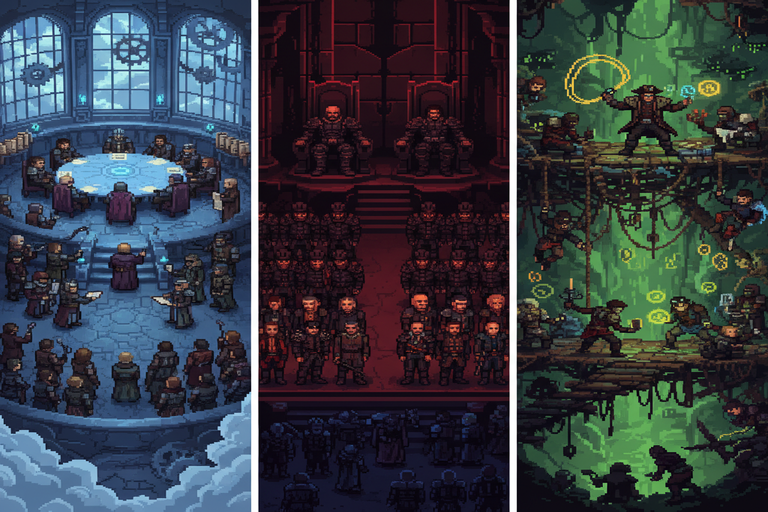
The Aetherium has no unified government, no king or emperor. Each settlement governs itself, and the systems vary wildly: democratic councils, military dictatorships, anarchic marketplaces, clan-based consensus. What works in Skyport Eos fails in Ironhold. What thrives in Murky Chasm would collapse in Windmere Farms. Diversity is both strength (no single point of failure) and weakness (no unified response to threats).
Settlement Hierarchies
Skyport Eos (Democratic Council)
Government Structure: - Elder Council: 12 elected elders (serve 5-year terms) - Guilds: Economic power (Sky-Guild most influential) - Clergy: Spiritual authority (advisory role) - Citizens: Voting rights (born or earned through 5 years residence) - Refugees: Limited rights (provisional, path to citizenship)
How It Works: - Council makes decisions via consensus (slow but stable) - Guilds lobby for economic interests - Clergy provides moral guidance - Citizens vote on major issues (referendums) - Refugees can petition for citizenship
Power Dynamics: - Elder Council has final authority (officially) - Sky-Guild has economic leverage (practically) - Clergy has moral authority (influential) - Balance of power (usually stable) - Tensions exist (Guild wants more control)
Strengths: Stable, representative, adaptable Weaknesses: Slow, vulnerable to corruption, Guild influence
Current Crisis: Refugee influx straining system, Guild pushing for more control
Ironhold (Military Oligarchy)
Government Structure: - Commandant: Military supreme commander (Theron Vask) - Guild-Master: Economic authority (Elara Song) - Military Officers: Power structure (chain of command) - Guild Factors: Economic control (trade, resources) - Citizens: Stratified (military > Guild members > civilians) - Underclass: The Underbelly residents (no rights)
How It Works: - Commandant and Guild-Master share power (uneasy alliance) - Military enforces order - Guild controls economy - Citizens obey or face consequences - Underclass survives in shadows
Power Dynamics: - Commandant has military force - Guild-Master has economic leverage - Neither can rule alone - Cooperation required (but fraying) - Authoritarian in practice
Strengths: Efficient, secure, organized Weaknesses: Oppressive, inflexible, brewing resistance
Current Crisis: Vask’s authoritarianism increasing, Guild-Military alliance straining, resistance growing
Murky Chasm (Anarchic Meritocracy)
Government Structure: - The Captain: Shadow ruler (identity unknown) - Vex Shadowhand: Operational authority (Black Sky Cartel boss) - No Official Hierarchy: Power through force, wealth, or reputation - Cartel Members: Pay dues, follow rules, get protection - Everyone Else: Tolerated (as long as they pay Cartel’s cut)
How It Works: - Cartel maintains order (prevents total chaos) - Rules are simple (pay debts, don’t damage bridges, Cartel gets 10%) - Violence is legal (but retaliation is too) - Reputation is currency - Survival of the capable
Power Dynamics: - Vex has most power (controls trade) - The Captain has ultimate authority (theoretical) - Strong individuals have local power - Fluid, changes constantly - Brutal but functional
Strengths: Freedom, efficiency, honest about power Weaknesses: Dangerous, unstable, no safety net
Current Crisis: Ironhold planning invasion, internal Cartel power struggles
Outland Clans (Consensus-Based)
Government Structure: - Clan Elders: Lead individual clans - The Moot: Occasional gathering (inter-clan decisions) - Sky-Striders: Messengers between clans - No Central Authority: Each clan independent - Consensus: When cooperation needed
How It Works: - Clans govern themselves - Elders make decisions (with clan input) - Moot handles inter-clan issues - Consensus required for collective action - Slow but respectful
Power Dynamics: - Elders have authority (earned through wisdom) - Clans are autonomous (fiercely) - No one can command all clans - Cooperation is voluntary - Works through mutual respect
Strengths: Freedom, resilience, adaptability Weaknesses: Slow, uncoordinated, vulnerable to organized threats
Class Systems
The Elite (5% of population)
Who They Are: - Guild-Masters and senior merchants - High Clergy (bishops, high priests) - Settlement leaders (Elders, Commandants) - Wealthy landowners - Military commanders
Power: - Control resources (economic) - Make decisions (political) - Shape culture (influence) - Often hereditary (children inherit advantages)
Lifestyle: - Best housing (secure, comfortable) - Best food (variety, quality) - Best healthcare (private physicians) - Best education (tutors, apprenticeships) - Insulated from worst hardships
Obligations: - Leadership (expected to govern well) - Charity (social pressure) - Defense (fund guards, walls) - Succession (train heirs)
Tensions: - With lower classes (resentment) - Internal (competition for power) - Moral (comfort vs. responsibility)
Merchants & Skilled Workers (20% of population)
Who They Are: - Traders, shop owners - Artisans, craftsmen - Alchemists, physicians - Pilots, engineers - Skilled professionals
Status: - Middle class (by Aetherium standards) - Essential to society - Respected for skills - Can accumulate wealth (but rarely reach elite)
Lifestyle: - Decent housing (small but private) - Adequate food (variety limited) - Some luxuries (occasional) - Education for children (apprenticeships) - Relative security
Challenges: - Economic pressure (competition) - Guild fees (mandatory) - Maintaining status (constant work) - One disaster from poverty
Common Laborers (50% of population)
Who They Are: - Farmers, field workers - Dock workers, loaders - Servants, cleaners - Guards (low-rank) - Unskilled labor
Status: - Working class (barely scraping by) - Essential but undervalued - No economic cushion - Vulnerable to any disruption
Lifestyle: - Basic housing (cramped, shared) - Subsistence food (adequate calories, little variety) - No luxuries - Children work young (necessity) - Constant struggle
Challenges: - One bad harvest from starvation - One injury from destitution - No savings (live hand-to-mouth) - Exploitation (by employers)
Wanderers (15% of population)
Who They Are: - Sky-Striders, mercenaries - Traveling merchants - Refugees (displaced) - Nomads (by choice) - Those between places
Status: - Outside normal hierarchy - Romanticized but often desperate - Freedom but insecurity - Respected and pitied
Lifestyle: - No permanent home - Irregular income - Minimal possessions - Live by wits and skills - Constant movement
Challenges: - No safety net - No community support - Dangerous lifestyle - Aging is difficult (can’t wander forever)
Outcasts (10% of population)
Who They Are: - Criminals, exiles - Rot-Touched (early stage, hiding) - Addicts, mentally ill - Those who don’t fit
Status: - Society’s untouchables - Minimal rights (if any) - Survive on margins - Often dangerous, sometimes just unlucky
Lifestyle: - Worst housing (Underbelly, ruins) - Worst food (scraps, charity, theft) - No healthcare - No future (usually) - Desperate
Locations: - The Underbelly (Ironhold) - Murky Chasm (criminals) - Ruins (hiding) - Edges of settlements
Social Mobility
Upward Mobility (Difficult)
Paths: - Skill: Master a valuable craft - Service: Military service, Guild work - Luck: Find treasure, marry up - Innovation: Invent something valuable - Heroism: Save settlement, kill major threat
Barriers: - Wealth required (tools, education, connections) - Connections (who you know) - Opportunity (limited) - Time (takes years) - Risk (attempts can fail, leaving you worse off)
Success Rate: Low (5-10% move up significantly)
Examples: - Merchant Vex (started poor, now wealthy) - Captain Jorah (skill made him legendary) - Some Guild members (worked up from apprentice)
Downward Mobility (Easy)
Causes: - Misfortune: Injury, illness, bad luck - Rot Infection: Instant outcast status - Crime: Exile, imprisonment - Economic: Business failure, debt - Disaster: Island falls, family dies
Speed: Can happen overnight
Recovery: Rare (hard to climb back)
Examples: - Rot-Touched (instant fall) - Failed merchants (bankruptcy) - Injured workers (can’t work)
Family Structures
Nuclear Families (Most Common)
Structure: Parents + children
Prevalence: 60% of population
Locations: Settlements, stable communities
Characteristics: - Two parents (usually) - 2-4 children (high infant mortality) - Extended family nearby (often) - Stable (relatively)
Challenges: - Both parents often work - Children help (labor) - One death destabilizes family - Poverty common
Extended Clans (Traditional)
Structure: Multi-generational, 20-50 people
Prevalence: 20% of population
Locations: Outland Clans, farming communities
Characteristics: - Grandparents, parents, children, cousins - Shared resources - Communal child-rearing - Strong bonds
Advantages: - Support network - Shared labor - Knowledge transfer - Resilience
Airship Families (Nomadic)
Structure: Ship crew = family
Prevalence: 5% of population
Locations: Storm-Sailors, nomadic traders
Characteristics: - Not always blood-related - Chosen family - Children raised communally - Tight bonds (survival depends on it)
Unique Aspects: - Born on ships - Never settle - Clan loyalty absolute - Different values
Orphan Collectives (Survival)
Structure: War orphans, Rot-orphans band together
Prevalence: 5% of population
Locations: Cities (Underbelly), settlements
Characteristics: - Children raising children - Survival-focused - Found family - Often exploited
Challenges: - No adult protection - Vulnerable to abuse - High mortality - Desperate
Fractured Families (Refugees)
Structure: Whatever remains
Prevalence: 10% of population
Locations: Refugee camps, temporary housing
Characteristics: - Missing members (dead, lost, separated) - Trauma - Trying to rebuild - Often fail
Gender and Equality
Post-Shattering Shift
Pre-Shattering: More traditional gender roles
The Shattering: Erased many norms (survival mattered more)
Current: Generally egalitarian (with exceptions)
In Practice
Work: Women and men do same jobs (mostly) - Pilots: Both genders - Soldiers: Both genders (Ironhold accepts women warriors) - Craftsmen: Both genders - Leaders: Both genders (Elder Mira, Guild-Master Elara)
Family: Partnerships for survival more common than traditional marriage
Leadership: Merit-based (mostly)
Exceptions: Some conservative communities maintain traditional roles
Remaining Inequalities
Physical Labor: Men often preferred (strength)
Dangerous Work: Men more often (expendable? Or volunteering?)
Clergy: Some constellations prefer specific genders (traditional)
Ironhold: Military culture still somewhat male-dominated
Age and Life Stages
Children (0-14 years)
Status: Protected but also workers
Mortality: High (30% don’t reach age 5)
Education: Informal (apprenticeships, oral tradition)
Work: Begin helping at age 7, full work by 12
Rights: Few (parents decide)
Youth (15-17 years)
Status: Transitional (becoming adults)
Coming of Age: Age 15 (varies by culture)
Work: Full labor expected
Marriage: Can marry (often do)
Rights: Partial (some settlements)
Adults (18-40 years)
Status: Primary workers, decision-makers
Expectations: Work, family, community service
Peak Years: Most productive time
Rights: Full (citizens)
Elders (40+ years)
Status: Respected (survival is achievement)
Rarity: Only 15% reach 40
Role: Advisors, storytellers, knowledge-keepers
Rights: Full (plus respect)
Challenges: Physical decline, limited healthcare
Outsiders and Marginalized
Refugees
Status: Liminal (not citizens, not expelled)
Numbers: Increasing (Rot consuming islands)
Rights: Limited (can’t vote, restricted movement)
Path to Citizenship: Varies (5 years in Eos, nearly impossible in Ironhold)
Challenges: Discrimination, poverty, exploitation
Camps: Forming outside major settlements
Rot-Touched
Status: Extreme outcasts (kill-on-sight in some places)
Numbers: Unknown (many hide)
Rights: None (considered non-human)
Locations: Murky Chasm (only place that accepts them), hiding elsewhere
Challenges: Survival, persecution, transformation
Sister Morrigan: Advocates for them (controversial)
Criminals
Status: Varies wildly by settlement
Eos: Imprisonment, exile, fines (depending on crime)
Ironhold: Harsh (execution common)
Murky Chasm: Legal doesn’t exist (retaliation is private)
Rehabilitation: Rare (second chances uncommon)
The Mentally Ill
Status: Pitied, feared, often abandoned
Care: Minimal (family if lucky, streets if not)
Understanding: Poor (no concept of mental illness)
Treatment: Prayer (sometimes helps), herbs (rarely), nothing (usually)
Tragedy: Many die young, untreated
Power and Authority
Sources of Power
Economic: Wealth, control of resources (Guild-Masters)
Military: Force, weapons, soldiers (Commandant Vask)
Spiritual: Faith, moral authority (High Clergy)
Knowledge: Information, skills (Archivists, alchemists)
Reputation: Respect, fear, legend (Captain Jorah, Vex)
How Power Is Maintained
Economic: Control trade, set prices, monopolies
Military: Walls, guards, weapons, discipline
Spiritual: Blessings, curses, moral pressure
Knowledge: Secrets, expertise, education control
Reputation: Stories, demonstrations, fear
How Power Is Lost
Economic: Bankruptcy, competition, theft
Military: Defeat, mutiny, assassination
Spiritual: Loss of faith, scandal, heresy
Knowledge: Information spreads, rivals emerge
Reputation: Failure, betrayal, death
Related Topics
- Skyport Eos - Democratic model
- Ironhold - Military oligarchy
- Murky Chasm - Anarchic system
- Outland Clans - Clan structure
- Sky-Guild - Economic power
- Elder Mira Thornwell - Democratic leader
- Commandant Theron Vask - Military authority
In-World Documents
Skyport Eos Charter (Excerpt)
ARTICLE I: GOVERNANCE
The people of Skyport Eos shall govern themselves through elected Elder Council.
All citizens may vote. All may serve.
Decisions shall be made by consensus where possible, majority where necessary.
No single person shall hold absolute power.
We learned from the Luminar Council’s failure. We will not repeat it.
Ironhold Military Code (Excerpt)
CHAIN OF COMMAND
- Commandant (supreme authority)
- Officers (execute Commandant’s will)
- Soldiers (obey orders)
- Civilians (obey soldiers)
Obedience is not optional.
Discipline is not negotiable.
Order is survival.Question orders = insubordination.
Insubordination = punishment.
Punishment = severe.
Murky Chasm Rules (Carved on Anchor Platform)
THE RULES
- Keep your word
- Pay your debts
- Don’t break the bridges
- Cartel gets 10%
- No slavery
- What you do is your business
- What happens is your problem
“Social structure in the Aetherium is whatever works for that
community. Democracy works for Eos. Military rule works for Ironhold. Anarchy works
for Murky Chasm.
There’s no single right answer because there’s no single situation. We
organize ourselves based on our needs, our histories, our populations,
and our threats. The only universal truth is this: some form of
organization is necessary. Complete chaos kills everyone. Complete
control kills freedom. The balance is different for every settlement.
And that’s okay. That’s adaptation. That’s survival.”
—From Social Systems of the Aetherium by Scholar Evian