Rot-Hound
Canis corruptus / “Black Dogs” / “The Pack”
“If you hear silence in the Murk, rot-hounds are
near. If you hear breathing, they’ve found you. If you hear nothing and
feel warm breath on your neck—too late.”
—Murk survivor’s
warning
Quick Reference
| Attribute | Details |
|---|---|
| Type | Rot-Beast (Corrupted canine) |
| Rarity | Common (most common Rot-Beast) |
| Habitat | Murk, corrupted zones, ruins, edges of Rot-infected islands |
| Danger Level | High (CR 3-5 individually, CR 8-10 in packs) |
| Size | Large dog (40-60kg, 80cm at shoulder) |
| Corruption Stage | Stage 3 (advanced, stable) |
| Intelligence | Moderate (pack tactics, learning ability) |
| Aggression | High (territorial, hungry, Voice-driven) |
| Pack Size | 5-15 individuals (coordinated) |
| Lethality | High (infection risk, pack tactics, relentless) |
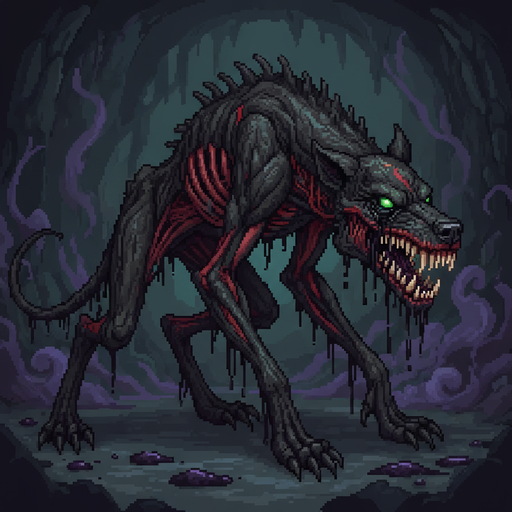 Rot-Hound - Corrupted
Canine
Rot-Hound - Corrupted
Canine
Description
Rot-hounds are the most common Rot-Beasts in the Aetherium—corrupted canines that hunt in coordinated packs through the Murk and other corrupted zones. They are fast, vicious, intelligent, and infectious. For many people, rot-hounds are their first encounter with active Rot-corruption, and that encounter is often fatal.
The creatures retain the basic canine form but corruption has transformed them into nightmares. Their skin is black and hairless, stretched tight over emaciated frames that show every bone and muscle. Their eyes glow sickly green and weep black fluid. Their mouths are filled with too many teeth, and their breath smells like copper and decay. They move with unnatural grace—silent, fluid, predatory—and they hunt with intelligence that suggests either high animal cunning or direct control by the Voice Beneath.
What makes rot-hounds particularly dangerous is their pack behavior. They coordinate attacks, flank prey, set ambushes, and retreat tactically when losing. They’re not mindless beasts—they’re calculating predators that learn from experience, remember threats, and adapt tactics. And their bite spreads corruption, meaning even survivors of attacks face slow transformation unless treated immediately.
Physical Characteristics
Appearance
Body: - Canine form (recognizable as dog-like) - Emaciated (ribs, spine visible) - Black skin (hairless, leathery) - Exposed muscle in places (red, wrong texture) - Corruption oozes from joints
Head: - Elongated snout - Too many teeth (serrated, irregular) - Glowing green eyes (no pupils) - Eyes weep black fluid - Ears: Tattered or missing
Limbs: - Four legs (longer than normal dogs) - Skeletal but strong - Claws: Black, sharp, curved - Joints bend wrong (extra flexibility) - Paws leave black prints
Tail: - Long, whip-like - Hairless - Sometimes barbed - Used for balance
Size: - Height: 80cm at shoulder - Length: 120cm (not including tail) - Weight: 40-60kg (lighter than they look)
Behavior and Hunting
Pack Dynamics
Social Structure: - Packs of 5-15 individuals - Alpha pair (larger, more corrupted) - Hierarchy maintained through violence - Coordination suggests Voice control or high intelligence
Communication: - Silent (no barking—unnatural) - Body language (subtle) - Possibly telepathic (pack acts as one) - Whispers (faint, Voice Beneath’s words)
Territory: - Claim corrupted zones - Defend aggressively - Mark boundaries (corpses, corruption) - Patrol regularly
Hunting Tactics
Ambush: - Wait in shadows - Approach silently - Surround prey - Strike simultaneously
Flanking: - Split pack - Attack from multiple directions - Prevent escape - Coordinated perfectly
Pursuit: - Chase fleeing prey - Never tire (corruption sustains them) - Track by scent (excellent) - Relentless
Retreat: - If losing, retreat tactically - Regroup and try again - Learn from failures - Adapt tactics
Prey Selection
Preferences: - Humans (primary target) - Isolated individuals (easy) - Wounded or sick (vulnerable) - Children (horrifying but true)
Avoids: - Large groups (too risky) - Fire (instinctive fear) - Well-armed parties (learned from experience) - Daylight (prefer darkness)
Combat Abilities
Attacks
Bite: - Primary attack - Damage: Severe (tearing) - Infection: Rot-corruption (Stage 1 immediately) - Grip: Strong (difficult to break)
Claw: - Secondary attack - Damage: Moderate (slashing) - Infection: Minor (less than bite) - Rapid strikes
Leap: - Can jump 3-5 meters - Knockdown attack - Surprise factor - Difficult to defend against
Pack Tactics: - Coordinated attacks - Flanking - One distracts, others strike - Sophisticated
Defenses
Speed: - Fast (outrun humans easily) - Agile (dodge attacks) - Climb walls (pursue anywhere)
Regeneration: - Minor wounds heal (minutes) - Major wounds heal (hours) - Fire prevents healing - Nearly unkillable without fire
Corruption: - Aura spreads Rot (weak but cumulative) - Touch = infection risk - Prolonged proximity = danger
Pack Support: - Protect each other - Drag wounded away - Revenge for fallen (they remember)
Weaknesses
Fire: - Instinctive fear - Prevents regeneration - Kills effectively - Best weapon
Isolation: - Weak alone - Rely on pack - Separate and kill individually
Loud Noise: - Disrupts coordination - Causes confusion - Temporary advantage
Holy Symbols: - Minor effect (they hesitate) - Not enough to stop them - Buys seconds
The Infection
Rot-Hound Bite
Immediate: - Wound (deep, tearing) - Black fluid enters bloodstream - Corruption begins
Hours 1-6: - Fever, chills - Wound turns black - Veins darken around bite - Pain increases
Days 1-3: - Stage 1 corruption - Hearing whispers (faint) - Psychological changes - Treatable (if acted on)
Week 1+: - Progression to Stage 2 - Permanent changes - Treatment difficult - May be too late
Treatment: - Immediate: Sanctification (clergy) - Early: Alchemical purification - Late: Amputation (if bite on limb) - Very late: None (accept corruption or death)
Origins and Ecology
What They Were
Pre-Corruption: - Domestic dogs (most common) - Wolves (rare) - Other canines - All corrupted to same form
Transformation: - Stage 1-2: Sick, aggressive - Stage 3: Fully transformed to rot-hound - Stage 4: Might become something worse - Process takes weeks to months
What They Are
Current State: - Stable at Stage 3 - Don’t progress further (usually) - Retain canine instincts - Enhanced by corruption
Reproduction: - Unknown if they breed - New rot-hounds appear (from corrupted dogs?) - Population stable - Source unclear
Lifespan: - Unknown (corruption preserves?) - Oldest observed: 20+ years - May be immortal - Disturbing thought
Cultural Impact
In Settlements
Primary Threat: - Most common Rot-Beast encounter - Guards train specifically for them - Children warned about them - Constant vigilance required
Defense: - Walls (they can climb but it slows them) - Fire (torches, braziers) - Patrols (detect early) - Dogs (ironic—warn of corrupted kin)
In Stories
Horror Tales: - “The pack in the dark” - “The silent hunters” - “The black dogs” - Effective nightmare fuel
Warnings: - “Don’t wander alone” - “Carry fire” - “If you see one, there are more” - Practical advice
Symbolism
Corruption’s Reach: - Even loyal dogs corrupted - Nothing is safe - Trust nothing
Pack Mentality: - Corruption spreads through groups - Metaphor for social contagion
Encounter Scenarios
The Pack Attack
Setup: Party traveling through Murk
Complication: Rot-hound pack ambush - 8-10 hounds - Coordinated assault - Infection risk - Retreat cut off
Challenge: Survive, protect wounded, escape
The Infected Companion
Setup: Party member bitten
Complication: Corruption beginning - Hours to act - Treatment needed - Resources limited - Time pressure
Challenge: Find cure before too late
The Lair
Setup: Track rot-hounds to source
Complication: Lair in deep ruins - Dozens of hounds - Corruption intense - Treasures (previous victims) - Extreme danger
Challenge: Raid lair, survive, escape
Related Topics
- The Murk - Primary habitat
- The Rot - Corruption source
- Stage 3 Corruption - Transformation level
- Rot-Beasts - Category
- The Voice Beneath - Possible controller
In-World Documents
Guard Training Manual
ROT-HOUND DEFENSE
Identification: - Black skin, emaciated - Glowing green eyes - Silent (no barking) - Pack behavior
Tactics: - Never alone (always pack) - Coordinate attacks - Flank and surround - Relentless pursuit
Defense: - Fire (essential—carry torches) - Stay together (don’t let them isolate you) - Watch all directions (they flank) - Kill alpha first (disrupts pack)
If Bitten: - Report immediately - Seek treatment (hours matter) - Quarantine if necessary - Do not hide infection
Survivor’s Account
The pack came at dusk. Eight of them. Silent.
We didn’t hear them until they were on us.
They separated us. Flanked. Coordinated like soldiers.
Darius went down first. Bite to the leg. He screamed.
Mira used fire. They backed off. We ran.
Got Darius to medic. Treated the bite. He survived.
But he’s infected now. Stage 1. Hearing whispers.
Will he make it? I don’t know.
But at least he’s alive. That’s something.
“Rot-hounds are the Rot’s foot
soldiers—common, effective, and terrifying. They’re what happens when
corruption takes something familiar (dogs) and transforms it into
something alien. They hunt in packs, spread infection, and kill
efficiently. They’re the reason people don’t travel alone in corrupted
zones. They’re the reason guards carry fire. They’re the reason children
have nightmares. And they’re everywhere. Learn to fight them. Learn to
avoid them. Or learn to die quickly. Those are your options.”
—From Bestiary of Horrors