Murk-Root
Radix tenebris / “Bitter-Root” / “Survivor’s Staple”
“Murk-root
keeps you alive. Doesn’t mean you’re living. But alive is better than
dead.”
—Murk farmer
Quick Reference
| Attribute | Details |
|---|---|
| Type | Flora (Root vegetable/tuber) |
| Rarity | Common (in corrupted zones), absent elsewhere |
| Habitat | Corrupted soil, Murk, edges of Rot zones |
| Danger Level | Moderate (occasional Rot contamination, exposure risk) |
| Growth Rate | Fast (harvest in 2-3 months) |
| Value | Low (2-5 coins per kg, subsistence food) |
| Edibility | Yes (safe if tested, nutritious but unpleasant) |
| Cultivation | Easy (in corrupted soil), impossible (in clean soil) |
| Legal Status | Legal (essential food source for corrupted zones) |
 Murk-Root - Survivor’s
Staple
Murk-Root - Survivor’s
Staple
Description
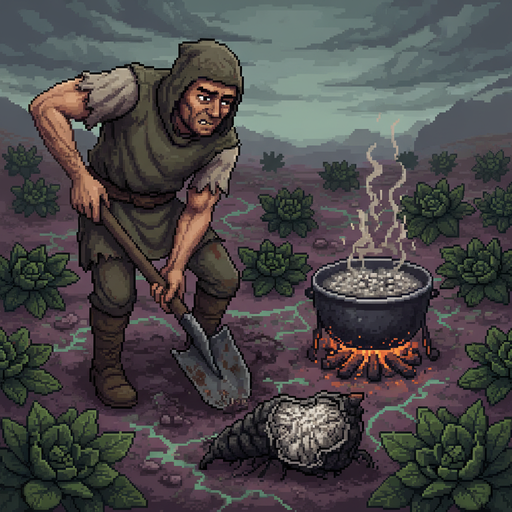
Murk-root is the primary food crop of the Murk and other corrupted zones—a hardy tuber that thrives in Rot-tainted soil where normal crops die. It is bitter, unpleasant, and barely palatable, but it grows where nothing else will and provides calories when starvation is the alternative. For residents of corrupted zones, murk-root is survival itself.
The plant is remarkably ugly: twisted black roots the size of a fist, covered in a tough, warty skin that must be peeled before cooking. The interior is gray-white, fibrous, and releases a smell like wet earth and ash when cut. Raw, it’s inedible—intensely bitter and tough. Cooked, it becomes merely unpleasant: the bitterness reduces (but never disappears), the texture softens to something like overcooked potato, and it can be choked down with enough determination.
What makes murk-root remarkable is its adaptation to corruption. While most plants die when exposed to Rot, murk-root thrives in it, absorbing the corruption without becoming toxic (usually). Alchemists don’t understand how—the plant should be poisonous, but tests show it’s safe to eat. This has made murk-root essential for survival in corrupted zones and a subject of intense study for those seeking to understand the Rot.
For Murk residents, murk-root is a fact of life. They plant it in their corrupted gardens, harvest it every few months, and eat it at nearly every meal. They’ve developed recipes to make it less awful (boiling, mashing, mixing with other foods), but it’s never good—just tolerable. “You don’t eat murk-root because you want to,” goes the saying. “You eat it because you want to live.”
Physical Characteristics
The Plant
Above-Ground Growth: - Low-growing (10-20cm tall) - Dark green leaves (small, tough) - Grows in rosette pattern - Minimal flowering (small, purple, rare) - Dies back after harvest
Root System (The edible part): - Tubers form 20-30cm underground - Twisted, irregular shape - 8-15cm diameter (fist-sized) - Black skin, warty texture - Gray-white interior
Skin: - Thick (2-3mm) - Tough (requires knife to peel) - Warty protrusions - Slightly oily - Protects interior from corruption
Interior: - Gray-white flesh - Fibrous, dense - Smells like wet earth and ash - Raw: Intensely bitter - Cooked: Less bitter, still unpleasant
Seeds (Rare): - Tiny, black - Produced occasionally - Spread by water or animals - Germinate only in corrupted soil - Most reproduction is vegetative (tubers divide)
Ecology and Growth
Habitat Requirements
Corruption Required: - Must have corrupted soil (Stage 1-2) - Won’t grow in clean earth (dies within days) - Dies in heavy corruption (Stage 3+) - Requires specific corruption level
Soil: - Corrupted but not toxic - Rich in minerals (corruption breaks down rock) - Moist but not waterlogged - Dark (corruption darkens soil)
Climate: - Tolerates cold well - Prefers shade (direct light inhibits) - Needs moisture (rain or irrigation) - Thrives in Murk conditions
Distribution: - Murky Chasm (extensive farms) - Murk edges (wild populations) - Weeping Halls (gardens) - Any corrupted zone with soil
Life Cycle
Planting (Year 1, Month 1): - Plant tuber sections (each with “eye”) - In corrupted soil - 30cm spacing - Shallow planting (10cm deep)
Growth (Months 1-3): - Leaves emerge (2 weeks) - Photosynthesis (minimal—plant feeds on corruption too) - Tubers form underground - Rapid growth (2-3 months to harvest)
Harvest (Month 3-4): - Dig up tubers - Leave some in ground (regrow) - Or plant new sections - 3-4 harvests per year possible
Storage: - Keeps well (months if cool and dry) - Doesn’t spoil easily - Skin protects interior - Essential for food security
Ecological Role
In Corrupted Zones: - Primary food crop - Stabilizes corrupted soil - Provides food for Rot-adapted animals - Indicates corruption level (growth vigor)
Interactions: - Sky-rats dig up tubers (pest) - Rot-beetles eat leaves (minor damage) - Humans cultivate extensively - Competes with flesh-fruit for space
Uses and Value
As Food
Preparation (Required—inedible raw): - Boiled: Most common (reduces bitterness) - Mashed: Mixed with fat or other foods - Fried: Crisps exterior, still bitter inside - Stewed: Long cooking, mixed with meat/vegetables - Dried: Preserves well, can be ground to flour
Taste: - Bitter (always, even cooked) - Earthy (like dirt, literally) - Slightly metallic - Aftertaste: Ash - Acquired taste (never pleasant)
Texture: - Fibrous, dense - Like overcooked potato - Chewy (even when soft) - Gritty (mineral content)
Nutrition: - Adequate calories (150 per 100g) - Moderate carbohydrates - Low protein - High in minerals (iron especially) - Vitamin content: Low
Making It Palatable: - Boil twice (changes water between) - Add fat (improves texture) - Season heavily (masks bitterness) - Mix with other foods (dilutes unpleasantness) - Desperation helps (hunger is best sauce)
Economic Value
Market Price: - Murk: 2 coins per kg (cheap staple) - Poor settlements: 5 coins per kg (survival food) - Bright Reaches: Won’t buy (too unpleasant) - Ironhold: Banned (bad for morale)
Trade: - Murk exports to poorest communities - Sold as “emergency rations” - Growing market (as desperation increases) - Stigma attached
Cultivation Economics: - Cheap to grow (minimal inputs) - High yield (3-4 harvests/year) - Reliable (doesn’t fail) - Profitable (for Murk standards) - Provides food security
Other Uses
Animal Feed: - Livestock eat it (if desperate) - Prefer other foods - But will eat when necessary
Medicinal (Minor): - High iron content (treats anemia) - Fiber (digestive health) - Not used medicinally (food is enough)
Alchemical (Research): - Studying corruption-resistance - How does it absorb Rot without toxicity? - Potential applications - No breakthroughs yet
Cultivation
Farming Techniques
Site Selection: - Corrupted soil (required) - Flat area (easier harvesting) - Access to water - Defensible (Rot-Beasts threat)
Planting: - Plant tuber sections - 30cm spacing - Shallow depth - Minimal preparation needed
Maintenance: - Water regularly - Weed (other corrupted plants compete) - Watch for pests (sky-rats) - Test corruption level (too much kills plants)
Harvest: - Dig up tubers (3 months after planting) - Leave some for regrowth - Store in cool, dry place - Repeat 3-4 times per year
Yield: - 5-10 kg per square meter - 3-4 harvests per year - 15-40 kg per square meter annually - Reliable, predictable
Challenges
Corruption Management: - Too little: Plants won’t grow - Too much: Plants die - Must maintain balance - Requires monitoring
Pests: - Sky-rats dig up tubers - Rot-beetles eat leaves - Occasional Rot-Beast damage - Constant battle
Contamination: - Occasional batch becomes Rot-toxic - Must test before eating - Contaminated batches must be destroyed - Loss of food (serious)
Social Stigma: - Murk-root farming seen as desperate - Farmers face prejudice - But they provide essential service - Unjust but real
Safety and Testing
Contamination Risk
The Problem: - Occasional tubers absorb too much corruption - Become toxic (Rot-infected) - Eating causes corruption - Must be identified before consumption
Testing Methods: - Visual: Rot-infected roots are darker, smell worse - Touch: Feel warmer than normal - Alchemical: Simple test (color change) - Taste: Don’t (if you’re testing, it’s too late)
Frequency: - ~5% of harvest contaminated - Higher in heavily corrupted areas - Lower with careful farming - Constant vigilance required
Consequences: - Eating contaminated root: Corruption begins - Early detection: Treatable - Late detection: Serious - Prevention: Test everything
Long-Term Safety
Known: - 80+ years of consumption data - No obvious long-term effects - Murk residents who eat it lifelong seem fine - Nutritionally adequate (barely)
Unknown: - Subtle long-term effects? - Cumulative corruption? - Generational impacts? - Monitoring ongoing
Concerns: - Children raised on murk-root - Eating corrupted food daily - Is this safe? - No alternative, so must hope
Cultural Impact
In the Murk
Staple Crop: - Eaten at every meal - Primary carbohydrate source - Food security depends on it - Cultural identity tied to it
Recipes Developed: - Boiled murk-root (basic) - Mashed murk-root (with fat) - Murk-root stew (with flesh-fruit) - Fried murk-root (crispy) - Murk-root bread (ground to flour)
Cultural Acceptance: - No stigma internally - Pride in adaptation - “We survive on what you won’t eat” - Defiant self-sufficiency
In Bright Reaches
Poverty Food: - Associated with desperation - “Eating murk-root” = destitute - Social stigma - Most won’t eat it (even if hungry)
Emergency Rations: - Stored for disasters - “Better than starving” - Rarely used (other options exist) - Psychological barrier high
Sayings and Proverbs
“Bitter as murk-root” (very bitter)
“Murk-root keeps you alive. Doesn’t mean you’re living.”
“You get used to murk-root or you starve. Most get used to it.”
“Eating murk-root builds character. Or destroys your taste buds. Same thing.”
Related Topics
- Murky Chasm - Primary cultivation
- The Murk - Natural habitat
- Flesh-Fruit - Other Murk staple
- The Rot - Enables growth
- Corrupted Soil - Required habitat
In-World Documents
Murk Farmer’s Guide
GROWING MURK-ROOT
Requirements: - Corrupted soil (Stage 1-2) - Water source - Patience
Steps: 1. Plant tuber sections (30cm apart) 2. Water regularly 3. Wait 3 months 4. Dig up (leave some for next crop) 5. Test for contamination 6. Eat or store
Repeat 3-4 times per year.
That’s it. Easy.
Tastes terrible. Keeps you alive. Fair trade.
Recipe (Murky Chasm Common Hall)
MURK-ROOT MASH (Makes it almost edible)
Ingredients: - 1 kg murk-root (peeled, tested) - Fat (any kind, more is better) - Salt - Garlic (if you have it—you don’t)
Instructions: 1. Boil murk-root until soft (1-2 hours) 2. Drain, mash thoroughly 3. Add fat (lots), salt 4. Mix until smooth 5. Eat while hot
Still bitter. Still unpleasant. But edible.
Welcome to the Murk.
Child’s Letter (Found, 286 S.)
Dear Mama,
We eat murk-root every day here. I don’t like it. It tastes bad.
But Papa says we’re lucky to have it. He says some people don’t have any food at all.
I asked if we could have regular potatoes. Papa said those don’t grow here. Only murk-root grows here.
I asked why we live here then. Papa didn’t answer.
I miss you, Mama. I miss regular food.
Love, Kara
Murk Resident’s Philosophy
You want to know what it’s like living in the Murk?
It’s eating murk-root three times a day, every day, for years.
It’s bitter. It’s unpleasant. You never get used to it—you just get used to not having a choice.
But it keeps you alive. And alive means you can still hope. Still fight. Still matter.
So we eat our murk-root. We don’t complain. We survive.
That’s what we do. We survive.
“Murk-root is the vegetable equivalent of the Murk itself: bitter,
unpleasant, corrupted, but surviving. It grows in soil that should be
dead, provides nutrition that should be impossible, and keeps people
alive in places that should be uninhabitable. It’s ugly, it tastes
terrible, and no one would eat it if they had any other choice. But they
don’t. So they eat. And they live. And that’s the Murk in a nutshell:
surviving not because it’s pleasant, but because the alternative is
death. Murk-root is perfect symbol of that survival—bitter, resilient,
and absolutely essential.”
—From Flora of the Aetherium by Botanist Scholar