Flesh-Fruit
Carnis fructus / “The Meat-Plant” / “The Disturbing Harvest”
“It’s fruit. Tastes like meat. Looks like meat. Feels like meat.
Isn’t meat. I eat it anyway. You get used to it. Or you
starve.”
—Murk resident
Quick Reference
| Attribute | Details |
|---|---|
| Type | Flora (Fruit-bearing plant) |
| Rarity | Uncommon (corrupted zones only) |
| Habitat | Murk edges, lightly corrupted areas, weird zones |
| Danger Level | Low (psychologically disturbing, physically safe) |
| Growth Rate | Moderate (fruits 3-4 times per year) |
| Value | Low (5-10 coins per fruit, novelty/survival food) |
| Edibility | Yes (safe, nutritious, but disturbing) |
| Cultivation | Possible (requires corrupted soil) |
| Legal Status | Legal (though many wish it wasn’t) |
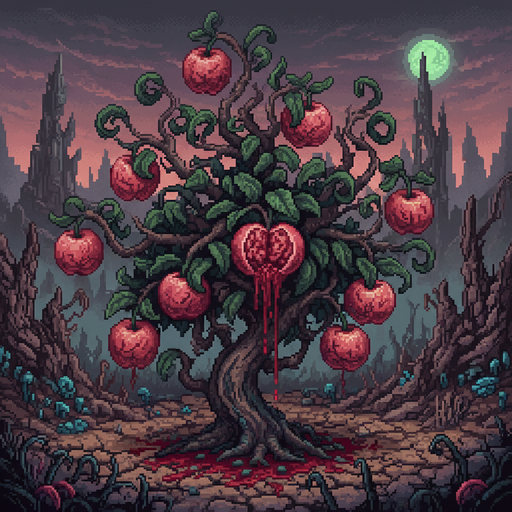 Flesh-Fruit - The
Disturbing Harvest
Flesh-Fruit - The
Disturbing Harvest
Description
Flesh-fruit is one of the most psychologically disturbing plants in the Aetherium—a fruit that looks, feels, and tastes like cooked meat despite being entirely plant-based. It grows in lightly corrupted zones where the Rot has changed reality’s rules but hasn’t yet consumed everything. The fruit is perfectly safe to eat, highly nutritious, and provides protein in areas where meat is scarce. But most people can’t bring themselves to consume it because it’s simply too wrong.
The plant itself resembles a twisted bush, 1-2 meters tall, with dark green leaves and thorny branches. The fruits hang from branches like grotesque ornaments: pink-red spheres the size of apples, with texture that looks and feels like raw meat. When cut, they “bleed” red juice. When cooked, they brown and crisp like pork. The taste is indistinguishable from cooked chicken or pork, and the texture is fibrous like muscle tissue.
Scientists and alchemists are baffled. The fruit contains no animal DNA, no actual meat—it’s entirely plant matter. Yet somehow, through corruption or mutation or impossible biology, it has become meat-like in every measurable way. Kael Greythorn studies it obsessively, trying to understand how corruption can create this without making it toxic. The answer might unlock understanding of the Rot itself.
For Murk residents, flesh-fruit is pragmatic survival food. Calories are calories, protein is protein, and squeamishness is a luxury they can’t afford. For outsiders, it’s a dare food, a curiosity, or a source of nightmares. Philosophers debate whether eating it is ethical if it’s “meat” in every way except origin. And everyone who encounters it asks the same question: What kind of world creates plants that grow meat?
Physical Characteristics
The Plant
Structure: - Twisted bush, 1-2 meters tall - Dark green leaves (waxy, slightly oily) - Thorny branches (sharp, 2-3cm thorns) - Grows in clusters (3-5 plants together) - Root system shallow but extensive
Leaves: - 10-15cm long, oval shaped - Dark green with reddish veins - Slightly warm to touch (warmer than ambient) - Oily coating (water-repellent) - Smell faintly of iron and salt
Branches: - Twisted, gnarled appearance - Dark brown, almost black - Covered in thorns - Surprisingly flexible - Bleed red sap when cut
Flowers (Rare, brief): - Small, red, five-petaled - Smell like copper and roses - Bloom for 2-3 days - Self-pollinating - Quickly become fruit
The Fruit
Appearance: - Spherical, 8-12cm diameter - Pink-red coloration (like raw meat) - Texture: Looks exactly like muscle tissue - Surface: Slightly moist, flesh-like - Warm to touch (2-3°C above ambient)
When Cut: - “Bleeds” red juice (looks like blood, isn’t) - Interior: Fibrous, meat-like texture - Layers visible (like muscle striations) - Seeds: Small, white, bone-like appearance - Smell: Raw meat (pork/chicken)
When Cooked: - Browns like meat - Crisps on outside - Juices run clear when done - Smell: Cooked meat (indistinguishable) - Taste: Pork or chicken (users disagree which)
Nutritional Content: - High protein (plant-based but meat-like) - Moderate fat - Low carbohydrates - Rich in iron - Complete amino acid profile (unusual for plants)
Ecology and Growth
Habitat Requirements
Corruption Level: - Requires light corruption (Stage 1-2) - Won’t grow in clean areas - Dies in heavy corruption (Stage 3+) - Sweet spot: Edge of corrupted zones
Soil: - Corrupted but not toxic - Rich in minerals (especially iron) - Slightly acidic - Warm (corruption generates heat)
Climate: - Tolerates cold better than most corrupted plants - Prefers shade (direct light inhibits growth) - Needs moisture (but not standing water) - Thrives in Murk conditions
Distribution: - Murky Chasm (cultivated farms) - Murk edges (wild populations) - Weeping Halls gardens - Scattered corrupted zones
Life Cycle
Germination (2-3 weeks): - Seeds require corrupted soil - Won’t germinate in clean earth - High success rate (70-80%) - Rapid initial growth
Vegetative Growth (3-6 months): - Bush reaches full size - Develops thorns (defense) - Establishes root system - No fruiting yet
Fruiting (Year 1+): - First fruits after 6-12 months - 3-4 fruiting cycles per year - 10-20 fruits per plant per cycle - Continues for 5-10 years
Reproduction: - Seeds spread by animals (who eat fruit) - Can also spread vegetatively (cuttings) - Colonizes corrupted areas rapidly - Invasive in suitable habitat
Ecological Role
In Corrupted Zones: - One of few edible plants - Provides food for Rot-adapted animals - Stabilizes corrupted soil - Indicates corruption level (won’t grow if too heavy)
Interactions: - Sky-rats eat fruit (spread seeds) - Rot-Beasts avoid it (why? unknown) - Insects pollinate flowers (rare) - Competes with murk-root for space
Uses and Value
As Food
Preparation Methods: - Roasted: Most common, browns like meat - Boiled: Texture suffers, but edible - Fried: Crisps nicely, popular in Murk - Dried: Preserves well, jerky-like - Raw: Edible but inadvisable (psychological reasons)
Taste: - Cooked: Pork or chicken (opinions vary) - Texture: Fibrous, meat-like - Juices: Savory, slightly sweet - Aftertaste: Slightly metallic
Nutrition: - Excellent protein source - Comparable to actual meat - Cheaper than meat (where available) - Doesn’t spoil as quickly as meat
Psychological Barrier: - Most people can’t eat it - Looks too much like meat - “Uncanny valley” of food - Murk residents overcome this (necessity) - Outsiders rarely do
Economic Value
Market Price: - Murk: 5 coins per fruit (cheap staple) - Bright Reaches: 10-20 coins (novelty/dare food) - Ironhold: Banned (disturbing to soldiers) - Periphery: Valuable (any food is valuable)
Trade: - Murk exports to poorest settlements - Sold as “exotic fruit” (misleading) - Black market in places it’s banned - Growing trade (as desperation increases)
Cultivation: - Murky Chasm has farms - Weeping Halls has gardens - Requires corrupted soil (limits locations) - Profitable for those who can stomach it
Research Value
Kael Greythorn’s Interest: - How does corruption create this without toxicity? - Can mechanism be replicated? - Implications for understanding Rot - Potential for Rot-resistance
Questions: - Why meat-like specifically? - Is this intentional (Rot has purpose)? - Or random mutation? - Can it be reverse-engineered?
Psychological and Ethical Issues
The Uncanny Valley Problem
Why It’s Disturbing: - Looks like meat (triggers meat-recognition) - Acts like meat (cooking, taste, texture) - But isn’t meat (cognitive dissonance) - Brain can’t reconcile this - Result: Profound unease
Reactions: - Nausea (common) - Refusal to eat (most outsiders) - Nightmares (some report) - Philosophical crisis (rare but documented)
Adaptation: - Murk residents desensitized - “You get used to it or you starve” - Children raised on it accept it - Outsiders rarely adapt
Ethical Debates
Is It Meat?: - Philosophers debate - If it’s meat in every way except origin, is it meat? - Does origin matter? - What defines “meat”?
Is Eating It Wrong?: - Some say yes (if it’s meat-like, it’s meat) - Others say no (it’s plant, origin matters) - Religious positions vary - No consensus
The Vegetarian Question: - Can vegetarians eat it? - It’s plant-based (yes) - But it’s meat-like (no) - Personal choice, much debate
The Corruption Question: - Is eating corrupted plants safe long-term? - Flesh-fruit seems safe (so far) - But corruption is unpredictable - Risk vs. starvation
Cultural Impact
In the Murk
Staple Food: - Primary protein source - Eaten regularly - No stigma (pragmatism rules) - Recipes developed (flesh-fruit stew, fried flesh-fruit, etc.)
Cultural Acceptance: - Children grow up eating it - Normalized through necessity - Visitors judged for squeamishness - “Soft Bright-Reachers can’t handle it”
Economic Importance: - Farms provide employment - Export income - Food security - Pride in adaptation
In Bright Reaches
Novelty/Dare Food: - Wealthy buy it as curiosity - Dare friends to eat it - Status symbol (weird flex) - Usually only eat once
Disgust: - Most people refuse it - “Corruption food” - Associated with desperation - Social stigma
Philosophical Interest: - Scholars debate implications - What does it mean for nature of reality? - Corruption can create without destroying? - Unsettling implications
In Art and Literature
Symbol: - Represents corruption’s strangeness - Used in horror stories - Metaphor for things that seem right but aren’t - “Flesh-fruit smile” = fake, disturbing
Cautionary Tales: - Stories of people who ate it and changed - Usually false (it’s safe) - But fear persists - Reflects unease with corruption
Dangers and Concerns
Physical Safety
Actually Safe: - Not toxic (tested extensively) - No Rot-infection (despite growing in corruption) - Nutritious - No known side effects
Long-Term Unknown: - Only 80 years of consumption data - Long-term effects unclear - Possible cumulative corruption? - Monitoring ongoing
Psychological Impact
Eating It: - Most people experience nausea first time - Some have nightmares - Cognitive dissonance - Usually passes (or person stops eating it)
Seeing It Grow: - Disturbing to watch fruit develop - “Meat growing on plants” - Some find it fascinating - Most find it wrong
Social Stigma
“Flesh-Fruit Eater”: - Insult in Bright Reaches - Implies desperation, poverty - Murk residents don’t care - But outsiders do
Economic Discrimination: - Those who eat it seen as lower class - Affects social mobility - Murk residents face prejudice - Unjust but real
Locations
The Flesh-Fruit Farms (Murky Chasm)
Description: Cultivated fields, 50+ plants
Production: 500-1,000 fruits per harvest
Workers: 10-15 (Murk residents)
Export: To poorest settlements
Attitude: Pragmatic, no squeamishness
The Hanging Gardens (Murky Chasm)
Description: Rot-Touched cultivate flesh-fruit alongside other corrupted plants
Philosophy: “Corruption provides”
Quality: Excellent (careful tending)
Access: Open to all
Symbolism: Adaptation to new reality
Encounter Scenarios
Survival Challenge
Setup: Party stranded in Murk, must survive on local food
Complication: Flesh-fruit is primary available food - Can they overcome psychological barrier? - What if they’re vegetarian? - How long can they resist?
Challenge: Eat or starve
The Investigation
Setup: Reports of flesh-fruit causing mutations
Complication: Is it true or hysteria? - Investigate claims - Test fruit - Interview consumers - Determine truth
Resolution: Probably false, but uncertainty remains
The Trade Deal
Setup: Opportunity to profit from flesh-fruit trade
Complication: Ethical concerns - Is it right to sell this? - To desperate people? - At what price?
Moral Choice: Profit vs. principles
Related Topics
- Murky Chasm - Primary cultivation
- The Murk - Natural habitat
- Murk-Root - Other Murk staple food
- The Rot - Corruption that enables growth
- Alchemist Kael Greythorn - Studying it
In-World Documents
Murk Recipe (Posted in Common Area)
FRIED FLESH-FRUIT
Ingredients: - 3 flesh-fruits - Oil (any kind) - Salt - Spices (if you have them)
Instructions: 1. Cut flesh-fruit into strips 2. Heat oil in pan 3. Fry until brown and crispy 4. Season with salt 5. Eat while hot
Tastes like fried pork. Don’t think about it too much.
Kael Greythorn’s Research Notes
Day 156: Flesh-fruit analysis continues.
The fruit contains no animal DNA. None. It’s entirely plant-based at the genetic level.
Yet it produces proteins identical to muscle tissue. The texture is created by plant fibers arranged in patterns that mimic muscle striations.
This shouldn’t be possible. Plants don’t “know” what meat is. They don’t have templates for muscle tissue.
Unless… corruption isn’t random. Unless it has intent. Purpose. Intelligence.
That’s a terrifying thought.
But how else do you explain a plant that grows meat?
Visitor’s Journal (Bright Reaches Scholar, 283 S.)
Day 3 in Murky Chasm:
They served me flesh-fruit for dinner. I’d heard about it, but seeing it was different.
It looked like pork. Smelled like pork. When I cut it, it bled.
I couldn’t eat it. I tried. I brought the fork to my mouth three times. Couldn’t do it.
My host—a woman who’s lived here 20 years—laughed at me. Not unkindly. She said, “You Bright-Reachers are all the same. Squeamish.”
She’s right. I am squeamish.
But she’s eating meat that grows on plants in corrupted soil, and I’m the weird one?
This place changes you. I need to leave before it changes me.
Murk Resident’s Response
To the scholar who couldn’t eat flesh-fruit:
You’re right. It’s weird. It’s disturbing. It shouldn’t exist.
But it does. And it keeps us alive.
You have the luxury of being squeamish. You can go back to your clean islands and eat your normal food and forget this place exists.
We can’t. This is our home. This is our food. This is our life.
So yeah, we eat meat that grows on plants. And we’re not ashamed.
We’re survivors. That’s all.
“Flesh-fruit is perfect metaphor for life in the corrupted zones:
disturbing, wrong, shouldn’t exist, but it does, and you either adapt or
you die. The Murk
residents have adapted. They eat flesh-fruit without flinching,
cultivate it in their gardens, trade it to outsiders who can barely look
at it. They’ve accepted that their world is fundamentally strange now,
and they’ve found ways to survive in that strangeness. The rest of us
are still squeamish, still uncomfortable, still wishing reality would go
back to making sense. But reality doesn’t care what we wish. The
flesh-fruit grows. And the Murk residents eat. And life continues,
strange and disturbing and real.”
—From Botanical Observations by Scholar Evian