Observatory Dome
“The Stargazer’s Sanctuary”
“They built this place to understand the divine. Now we use it to
understand what the divine won’t tell us.”
—Anonymous astronomer
Quick Reference
| Attribute | Details |
|---|---|
| Location | Glimmering Spire, Auxiliary Building Rooftop |
| Region | The Bright Reaches |
| Type | Pre-Shattering observatory, research facility |
| Size | Dome chamber (20m diameter) + observation platform |
| Population | 3 permanent astronomers (hermits) |
| Primary Function | Constellation observation, astronomical research |
| Rot Status | Stage 1-2 (moderate corruption, still functional) |
| Built | Pre-Shattering (287+ years old) |
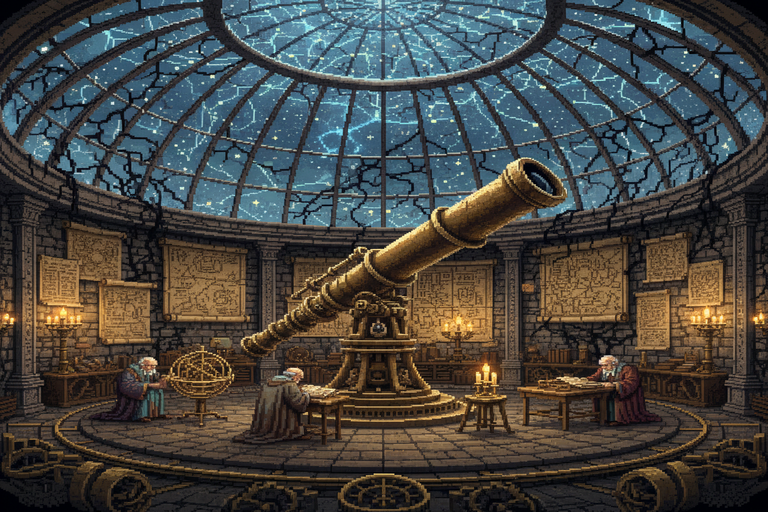 Observatory
Dome - The Stargazer’s Sanctuary
Observatory
Dome - The Stargazer’s Sanctuary
Table of Contents
- Overview
- Location and Access
- Architecture and Design
- The Telescope
- Star Charts and Records
- The Astronomers
- Research and Discoveries
- Quest Connection
- Astronomical Significance
- Related Topics
Overview
The Observatory Dome sits atop an auxiliary building near the base of Glimmering Spire’s crystalline tower, one of the few pre-Shattering observatories still functional in the Aetherium. Built centuries ago when humanity sought to understand the Constellations through science as well as faith, the observatory has witnessed the slow corruption of the island while its three elderly caretakers stubbornly continue their astronomical work.
The dome’s primary feature is a massive 10-meter brass telescope—ancient, magnificently crafted, and somehow still operational despite its age and the Rot spreading through the facility. The rotating dome mechanism, though damaged, still functions well enough to track celestial movements. The walls are covered in star charts spanning centuries, annotated by generations of astronomers who have added observations, corrections, and increasingly disturbing questions.
Three elderly hermit-astronomers refuse to abandon the observatory despite the island’s decay. They’ve spent decades charting constellation movements, and their data reveals troubling patterns: the constellations are moving. Not in their predictable rotational patterns, but changing position—drifting slowly but measurably from where they were before the Shattering. This discovery is simultaneously invaluable and terrifying, raising questions about the nature of the divine beings that watch over (or ignore) the fractured Aetherium.
The observatory serves as both research station and pilgrimage site. The Constellation Clergy pays well for accurate star charts, needing the data for theological calculations and ritual timing. Archivists visit seeking astronomical records. Desperate individuals come hoping the stars will reveal prophecies or omens. And occasionally, someone notices what the three astronomers have been documenting for years: evidence of a ninth constellation, faint and unmarked, that pre-Shattering scholars saw but modern clergy refuse to acknowledge.
Location and Access
Position on Glimmering Spire Island
Building: Auxiliary structure northeast of main Spire
Elevation: 30m above island base level (rooftop location)
District: Scholar’s Quarter (northern section, Stage 1-2 corruption)
Visibility: - Dome visible from landing area - Rotating mechanism audible (grinding gears) - Starlight visible through cracked dome at night - Landmark for navigation
Reaching the Observatory
From Landing Area (northwest): - Cross Scholar’s Quarter (10-minute walk) - Navigate partially collapsed streets - Climb auxiliary building stairs (4 floors) - Ascend narrow spiral staircase to dome (50 steps)
From Spire Complex (center): - Follow Academic Way (ancient paved path) - Pass lecture hall ruins - Enter auxiliary building - Ascend as above
Access Restrictions: - No official restrictions (astronomers don’t enforce rules) - Informal expectations: respect equipment, don’t interrupt observations - Dangerous climb (stairs partially collapsed) - Corruption exposure (Stage 1-2 atmosphere)
Architecture and Design
The Dome Structure
Exterior: - 20m diameter hemispherical dome - Crystalline panels (pre-Shattering material, cracked but intact) - Bronze framework (tarnished, corrupted veins visible) - Rotating mechanism (track around base, gears exposed) - Observation slit (3m wide, opens for telescope)
Interior: - Single circular chamber (20m diameter, 10m height at center) - Stone floor (marble, worn smooth by centuries) - Curved walls (follow dome shape) - No internal columns (open design for observation) - Small side alcove (storage, sleeping space for astronomers)
Corruption State: - Black veins spread across 30% of structure - Crystalline dome panels darkening (still mostly transparent) - Bronze fittings developing organic texture - Floor soft in corners (stone becoming something else) - Surprisingly stable despite corruption
Rotating Mechanism
Function: - Allows dome to rotate 360° - Aligns observation slit with any sky position - Tracks celestial objects as they move
Mechanism: - Gear-and-track system (pre-Shattering engineering) - Hand-cranked (no power source) - Damaged but functional (requires two people, 5 minutes per 90° rotation) - Grinding noise (audible across Scholar’s Quarter) - Maintenance required (astronomers perform weekly)
Marvel: - Still works after 287+ years - Pre-Shattering construction quality - Modern engineers can’t replicate - Some theorize Astral Geometry enhancement
The Telescope
Specifications
Size: 10-meter primary mirror
Type: Reflecting telescope (pre-Shattering design)
Materials: - Brass tube (polished, maintained obsessively) - Silver mirrors (re-silvered dozens of times) - Crystal lenses (unknown material, irreplaceable) - Ironwood mount (corrupted but stable)
Capabilities: - Magnification: 500x (extraordinary for era) - Can resolve individual stars in distant clusters - Tracks constellation movements precisely - Reveals details invisible to naked eye
Condition: - Functional (barely—requires constant maintenance) - Primary mirror intact (miracle, given age) - Secondary systems degraded (focusing difficult) - Mount stable (surprisingly uncorrupted) - Eyepiece replacements (modern additions, inferior)
Operation
Positioning: - Manual adjustment (levers and counterweights) - Requires two operators (one guides, one cranks) - Precise alignment difficult (mechanisms worn) - Tracking requires constant correction
Observation: - Best visibility: nighttime, clear Aether - Constellations visible (direct observation) - Distant islands detectable (useful for mapping) - Aether phenomena (storms, currents, anomalies)
Maintenance: - Daily cleaning (dust, corruption particles) - Weekly mirror polishing - Monthly mechanism lubrication - Annual re-silvering (when materials available)
Star Charts and Records
Historical Documentation
Wall Charts: - Cover every available wall surface - Span 287 years (continuous observation) - Hand-drawn (pre-Shattering through modern) - Annotated in multiple scripts (languages evolved) - Color-coded by era (archaeologists’ dream)
Contents: - Constellation positions (dated observations) - Movement tracking (long-term changes) - Eclipses and alignments (significant events) - Aether phenomena (storms, void rifts) - Theoretical calculations (astronomical predictions)
Organization (chaotic): - No systematic filing - Chronological layers (older charts behind newer) - Cross-references inconsistent - Astronomers know by memory - Outsiders find overwhelming
The Disturbing Pattern
Discovery (recent decades): - Constellations are moving - Not predictable rotation (something else) - Slow but measurable (millimeters per year) - Accelerating (movement faster now than century ago) - No pattern to direction (not orbital)
Evidence: - Comparative charts (pre-Shattering vs. modern) - Precise measurements (multiple observers confirm) - Independent verification (other observatories, rare data) - Mathematical calculations (trajectory extrapolation)
Implications: - Constellations aren’t fixed (are they even “places”?) - Divine beings moving? Dying? Changing? - Shattering affected cosmos itself? - Future religious implications (if constellations vanish?) - Clergy doesn’t want to know (suppresses findings)
The Ninth Constellation
The Mystery: - Pre-Shattering charts show ninth constellation - Faint, unmarked, no associated theology - Modern clergy acknowledges only eight - Visible in telescope (barely—requires perfect conditions) - Ignored or hidden (deliberately?)
Characteristics: - Located between Serpent and Abyss - Dimmer than others (intentionally hidden?) - Pattern resembles reaching hand or grasping claw - Pre-Shattering name lost (if ever named) - Associated with forbidden knowledge (possibly)
Why Hidden: - Theologically uncomfortable (doesn’t fit doctrine) - Forbidden domain (knowledge too dangerous) - Clergy censorship (heretical research) - Simply forgotten (lost in Shattering chaos)
The Astronomers
The Three Caretakers
Elder Astronomer Talvos (age 78): - Senior member (50 years at observatory) - Obsessed with constellation movements - Partially corrupted (Stage 1, black veins on hands) - Brilliant but increasingly erratic - Refuses to leave (“I’ll die here, recording the end”)
Astronomer Mirelle (age 64): - Second-in-command (35 years at observatory) - Focus: Aether phenomena and storm prediction - Uncorrupted (somehow, despite decades of exposure) - Practical (handles maintenance, supplies) - Skeptical of supernatural interpretations
Junior Astronomer Caym (age 52, “junior” is relative): - Newest member (12 years at observatory) - Former Constellation Clergy priest (expelled for heresy) - Studying the ninth constellation - Stage 2 corruption (coughs black fluid) - Believes the stars hold salvation
Daily Routine
Dawn: - Final night observations (constellations before dawn) - Record data (careful notation) - Telescope maintenance (clean, adjust) - Brief rest (few hours sleep)
Daytime: - Chart updating (transfer observations to walls) - Calculations (trajectory plotting) - Repairs (dome, telescope, building) - Meals (simple, shared) - Occasional visitors (scholars, questors)
Dusk: - Prepare for night observation - Rotate dome (position for evening) - Calibrate telescope - Begin constellation tracking
Night: - Continuous observation (rotating shifts) - Detailed recording (notes, sketches, measurements) - Deep sky study (distant phenomena) - Philosophical discussion (during breaks)
Personality and Philosophy
Dedication: - Refuse to abandon observatory (even as island crumbles) - View work as sacred duty (preserve knowledge) - Willing to die here (accepted likelihood) - Believe understanding stars = understanding reality
Relationship: - Deep bonds (decades together) - Frequent arguments (scholarly disputes) - Mutual respect (trust each other’s observations) - Shared isolation (only each other for company)
Visitors: - Welcome knowledge-seekers (happy to teach) - Protective of equipment (don’t touch telescope) - Share findings (if asked respectfully) - Dismissive of theological dogma (science over faith)
Research and Discoveries
Active Projects
1. Constellation Drift Tracking: - Measuring movement rates - Extrapolating future positions - Calculating “escape velocity” (when will they leave sky?) - Results: Terrifying (if trend continues, constellations vanish in 500 years)
2. Ninth Constellation Study: - Attempting detailed mapping (difficult—too faint) - Cross-referencing pre-Shattering texts - Theological implications research - Hypothesis: Related to Shattering cause
3. Aether Storm Prediction: - Correlating constellation positions with storms - Pattern recognition (some success) - Early warning system (could save lives) - Practical application (most immediately useful)
4. Void Observation: - Studying darkness between islands - Anomaly detection (ripples, shadows) - Controversial: “Things move in the void” - Evidence inconclusive (or too disturbing to share)
Equipment Needs
Desperately Needed: - Replacement lenses (crystal quality) - Mirror silvering compound (expensive, rare) - Gears (mechanism wearing out) - Parchment and ink (record keeping) - Food (often forget to eat)
Quest Opportunities: - Fetch rare components (reward: star charts) - Retrieve ancient texts (from dangerous locations) - Verify sightings (travel to distant islands) - Deliver findings (to Clergy, Archivists, others)
Quest Connection
Observatory Secrets
Role: Central location for Observatory Secrets quest
Quest Start: > You climb to the Observatory Dome at the Spire’s peak. The crystalline ceiling reveals the constellations above, their light filtering through the corruption that mars the structure. > > Ancient star charts cover the walls, and a massive telescope points skyward. This place was built to study the divine.
Quest Elements:
Option 1: Study Star Charts (Piety): - Examine ancient documentation - Success: Notice ninth constellation - Failure: Recognize major constellations but miss details - Progresses to discovery stage
Option 2: Use Telescope (Cunning): - Operate the ancient instrument - Success: Direct observation of constellation drift - Failure: See constellations but miss anomalies - Progresses to discovery stage
Resolution Paths: - Share findings with Clergy (theological implications) - Keep secret (protect dangerous knowledge) - Sell information (to Archivists, others) - Investigate further (personal quest for truth)
Astronomical Significance
One of Few Functioning Observatories
Pre-Shattering Network: - Dozens existed (coordinated observations) - Most destroyed in Shattering - Few survivors (3-5 total in Aetherium) - This one most complete
Scientific Value: - Continuous records (287 years) - Functional equipment (rare) - Knowledgeable operators - Strategic location (good visibility)
Political Value: - Clergy depends on data (ritual timing) - Archivists pay well (knowledge preservation) - Navigators need charts (island mapping) - Prophets seek omens (interpretation varies)
Theological Implications
Constellation Movement: - Challenges doctrine (gods are eternal and fixed?) - Suggests divine instability (disturbing possibility) - Clergy response: Denial, suppression - Popular reaction: Fear, doubt
Ninth Constellation: - Forbidden knowledge incarnate - Why hidden? What does it represent? - Pre-Shattering scholars knew (and didn’t share) - Modern discovery = heresy
End Times Speculation: - If constellations leave, what remains? - Divine abandonment? - Aetherium’s end prophesied? - Astronomers: “We record. We don’t interpret. But yes, it looks bad.”
Visitor Experience
What To Expect
Physical: - Difficult climb (steep stairs, partially collapsed) - Cramped space (dome not huge) - Cool temperature (elevation, cracked dome) - Stage 1-2 corruption exposure (limit visit duration)
Social: - Astronomers welcoming (if respectful) - Scholarly atmosphere (quiet, focused) - Long explanations (they love to teach) - Occasional irritation (if equipment touched)
Intellectual: - Overwhelming information (centuries of charts) - Profound discoveries (constellation movement) - Uncomfortable questions (what does it mean?) - Sense of privilege (witnessing rare knowledge)
Etiquette
Do: - Ask before touching anything - Show genuine interest - Listen to explanations - Offer help (maintenance, supplies) - Respect their dedication
Don’t: - Touch telescope without permission (cardinal sin) - Mock their work (“just stargazing”) - Argue theology (they’ve heard it all) - Rush them (explanations take time) - Steal anything (they notice)
Related Topics
- Glimmering Spire - Parent location
- Constellation Clergy - Depend on observatory data
- The Archivists - Preserve astronomical records
- Constellations - Subjects of study
- The Shattering - Event that changed the cosmos
- Alchemist Kael Greythorn - Occasional collaborator
Location Status: Active (functioning research
station)
Designer Notes: Location reveals deep lore about
constellation movement and ninth constellation mystery
“The stars are moving. The gods are leaving. Or perhaps they were
never there at all, and we’re only now noticing the void.”
—Elder Astronomer Talvos