Kael’s Laboratory
“Where Science Meets Corruption”
“Every sample here could kill you. Every experiment could fail
catastrophically. Every day, I inch closer to understanding—or to
oblivion.”
—Alchemist
Kael Greythorn
Quick Reference
| Attribute | Details |
|---|---|
| Location | Glimmering Spire, Base of Spire Tower |
| Region | The Bright Reaches |
| Type | Alchemical laboratory, research facility |
| Size | Large (30m × 20m main lab + side chambers) |
| Population | 1 (Kael) + occasional assistants (short-term) |
| Primary Function | Rot research, alchemical experiments |
| Rot Status | Stage 2 (controlled contamination, heavily dangerous) |
| Established | ~277 S. (10 years ago) by Kael Greythorn |
 Kael’s
Laboratory - Where Science Meets Corruption
Kael’s
Laboratory - Where Science Meets Corruption
Table of Contents
- Overview
- Location and Access
- Laboratory Layout
- Equipment and Apparatus
- The Rot Sample Collection
- Safety Protocols (and Violations)
- Current Research Projects
- Quest Connection
- Services and Opportunities
- Hazards and Warnings
- Related Topics
Overview
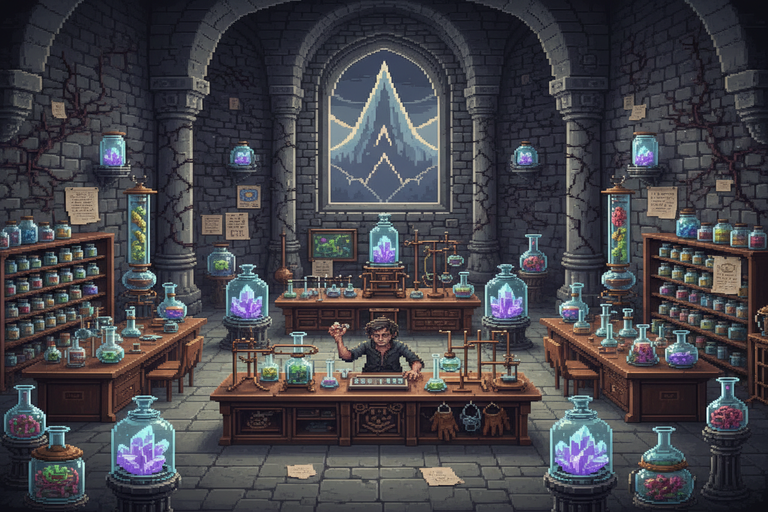
Kael’s Laboratory occupies a converted pre-Shattering chamber at the base of the Glimmering Spire’s crystalline tower, serving as the Aetherium’s most advanced—and most dangerous—facility for Rot corruption research. Here, Alchemist Kael Greythorn conducts experiments that the Constellation Clergy considers heretical, that most scholars consider suicidal, and that might be humanity’s best hope for understanding corruption.
The laboratory is a controlled chaos of alchemical apparatus, research notes, and glowing Rot-Shards sealed in crystal containment vessels. Workbenches overflow with distillation equipment, microscopes, chemical reagents, and partially dissected corrupted specimens. The walls are covered in diagrams, progression charts, and hastily scrawled theories. Black veins of Stage 2 corruption spread across designated “contamination zones,” carefully isolated from the “clean” work areas (though the distinction is increasingly theoretical).
Kael himself is the laboratory’s sole permanent resident, working 16-hour days analyzing samples, testing compounds, and documenting his findings with obsessive precision. He occasionally accepts assistants—scholars seeking to learn, desperate individuals hoping for cures, adventurers needing his expertise—but few last more than a week. The exposure is dangerous, Kael’s social skills are minimal, and the work involves handling materials that could transform you into a monster if you sneeze at the wrong moment.
Despite (or because of) these dangers, the laboratory produces genuine breakthroughs. Kael’s Stage 1 suppression serum can slow early corruption for weeks. His contamination detection reagents reveal invisible Rot particles. His progression charts predict corruption advancement with 70% accuracy. He’s saved lives and advanced scientific understanding immeasurably—even as his own corruption creeps forward, even as his facility crumbles around him, even as the samples he studies whisper promises in the night.
Location and Access
Position on Glimmering Spire
Building: Integrated into Spire Tower base
District: Spire Complex (center of island)
Elevation: Ground level (with basement access to Undermaze)
Visibility: - Main entrance visible from Academic Way - Glow from Rot-Shards visible at night (purple-green) - Chemical smells detectable 50m away - Locals know to avoid (dangerous reputation)
Reaching the Laboratory
From Landing Area: - Cross Scholar’s Quarter (10-minute walk) - Follow Academic Way toward Spire - Laboratory entrance south side of tower - Door marked (alchemical symbols, warning signs)
From Observatory: - Descend from auxiliary building - Cross Spire courtyard - Enter tower base level - Kael’s lab is largest chamber
Access Policy: - Open door policy (Kael welcomes visitors) - Knock first (experiments in progress) - Don’t touch anything (seriously, don’t) - Kael decides if you stay
Laboratory Layout
Main Chamber (30m × 20m)
Central Work Area: - Large workbenches (4-5 stations) - Primary equipment (distillation, analysis) - Kael’s main workspace (organized chaos) - Currently active experiments
Sample Storage (north wall): - Crystal containment vessels (50+) - Each holds Rot-Shard or specimen - Organized by corruption stage - Glowing purple-green array - Temperature controlled
Library Section (east wall): - Bookcases (500+ volumes) - Research journals (Kael’s and others) - Pre-Shattering texts (rare) - Notes and diagrams (everywhere)
Clean Zone (west area): - Minimal contamination (relatively) - Visitor meetings - Non-Rot experiments - Kael’s desk (paperwork, correspondence)
Contamination Zone (south area): - Heavy Stage 2 corruption - High-risk experiments - Sealed off by glass partition (cracked) - Protective gear required (theoretically)
Side Chambers
Storage Room (10m × 10m): - Chemical reagents (hundreds of varieties) - Equipment backups - Failed experiments (contained) - Supplies (when Kael remembers to stock)
Specimen Chamber (8m × 8m): - Live corrupted organisms (contained) - Observation cages - Feeding and care equipment - Dissection table - Smell: horrific
Kael’s Quarters (6m × 6m): - Sleeping pallet (rarely used) - Personal effects (minimal) - Book collection (esoteric) - More research notes (obsession has no boundaries)
Basement Access: - Stairs to Undermaze entrance - Used for specimen collection - Sealed door (usually locked) - Emergency escape route
Equipment and Apparatus
Alchemical Equipment
Distillation Apparatus: - Multiple glass retorts - Copper condensers - Temperature control (Aether-heated) - Used for: Extracting Rot essence, purifying compounds
Microscopes (3 units): - One pre-Shattering (extraordinary) - Two modern (adequate) - Magnification up to 500x - Used for: Cellular analysis, corruption observation
Centrifuge: - Pre-Shattering mechanism - Hand-cranked (exhausting) - Separates Rot particles from tissue - Kael’s most valuable tool
Spectroscope: - Analyzes light absorption - Identifies chemical composition - Detects Rot signatures - Custom-built by Kael
Chemical Analysis Set: - Reagent tubes (hundreds) - pH testing - Precipitation reactions - Identification protocols
Containment Vessels
Crystal Containers (50+ in use): - Pre-Shattering crystal (Rot-resistant) - Various sizes (fist to chest) - Sealed with wax and wards - Contents: Rot-Shards, samples, specimens - Glow intensifies when active
Safety Features: - Multiple containment layers - Crack detection (visual inspection) - Replacement protocol (when available) - Emergency sealing (clay, wax, prayer)
Failures: - Vessels crack (degradation over time) - Seals break (Rot is corrosive) - Contents escape (has happened 7 times) - Kael survives (so far, barely)
Research Instruments
Corruption Meter: - Kael’s invention - Detects Rot concentration in air - Crystal needle responds to particles - Accuracy: 60% (needs calibration)
Progression Charts: - Wall-mounted (3m × 2m each) - Track corruption advancement - Dozens of subjects documented - Pattern analysis (ongoing)
Experimental Logs: - 50+ bound journals - Daily entries (obsessive detail) - Successes, failures, speculations - Illegible handwriting (Kael’s curse)
The Rot Sample Collection
Organization System
By Corruption Stage: - Stage 1 samples (yellow labels): 15 specimens - Stage 2 samples (orange labels): 20 specimens - Stage 3 samples (red labels): 10 specimens - Stage 4 samples (black labels): 5 specimens (extremely dangerous)
By Source: - Tissue samples (human, animal) - Rot-Shards (crystallized corruption) - Contaminated materials (soil, water, air) - Living organisms (in Specimen Chamber)
By Acquisition Date: - Historical collection (10 years) - Recent additions (weekly) - Experimental products (synthetic Rot)
Notable Samples
The First Shard: - Collected 10 years ago (Kael’s first) - Stage 2, fist-sized - Started his obsession - Labeled “Patient Zero” (dark humor)
The Anomaly: - Stage 3 but inert (shouldn’t be possible) - Doesn’t spread, doesn’t glow - Whispers anyway - Kael’s biggest mystery
The Synthetic: - Kael created it (theoretically impossible) - Proves Rot is chemistry, not divine curse - Terrifying implications (Rot can be manufactured) - Hidden (even from himself sometimes)
Acquisition Methods
Scavenger Purchases: - Pays well for quality samples - Specific requests (stage, source, condition) - Market: Murky Chasm black market
Personal Collection: - Undermaze expeditions (dangerous) - Surface contamination sites - Diseased individuals (volunteers and non)
Donations: - Researchers send specimens - Dying individuals contribute (legacy) - Archivists trade texts for analysis
Safety Protocols (and Violations)
Official Protocols
Protective Gear: - Gloves (chemical-resistant) - Goggles (eye protection) - Mask (filter Rot particles) - Full body covering (contamination barrier)
Contamination Procedures: - Work in designated zones - Seal samples between uses - Wash thoroughly after handling - Limit exposure duration (2-hour maximum)
Emergency Protocols: - Breach: Seal, evacuate, cleanse - Injury: Immediate treatment, quarantine - Corruption: Document progression, begin suppression
Actual Practice
Kael’s Violations: - Rarely wears gloves (“reduced tactile sensitivity”) - Goggles fog (“can’t see reactions”) - Mask uncomfortable (“breathe better without”) - Works 16-hour days (“no time for breaks”)
Why He’s Still Alive: - Lucky (extremely) - Experienced (10 years handling) - Careful despite violations (contradictory but true) - Corrupting anyway (Stage 1, progressing)
Visitor Safety: - Kael enforces protocols on others - “Do as I say, not as I do” - Genuinely doesn’t want others corrupted - His own safety: negotiable
Current Research Projects
1. Rot-Neutralizing Compound
Goal: Synthesize chemical that halts corruption
Progress: - Stage 1 suppression achieved (temporary) - Stage 2 slowing experimental (mixed results) - Complete cure: theoretical
Challenges: - Rot adapts (develops resistance) - Side effects severe (worse than disease?) - Requires rare materials (expensive, dangerous)
Status: Ongoing (Kael’s primary focus)
2. Progression Prediction
Goal: Accurately predict corruption advancement
Progress: - 70% accuracy current model - Individual variation high (frustrating) - Environmental factors identified (partial)
Application: - Help individuals plan remaining time - Identify high-risk populations - Guide medical interventions
Status: Operational (used clinically)
3. Synthetic Rot Creation
Goal: Manufacture Rot in laboratory (understand fully)
Progress: - Successfully synthesized (terrifying achievement) - Properties match natural Rot (indistinguishable) - Process repeatable (implications horrifying)
Implications: - Proves Rot is chemistry (not divine curse) - Could be weaponized (nightmare scenario) - Understanding enables countermeasures (hopefully)
Status: Complete (results suppressed, even from Clergy)
4. Voice Analysis
Goal: Understand whispers scientifically
Progress: - Recorded whispers (crystalline resonance method) - Content varies by listener (psychological + external) - Source: Deep underground (possibly Undermaze depths)
Challenges: - Psychological effects on researcher (Kael hears them constantly) - Recording degrades rapidly - Playback affects listeners (contamination vector?)
Status: Halted (too dangerous, even for Kael)
Quest Connection
Kael’s Experiment
Role: Central location for Kael’s Experiment quest
Quest Start: > You enter Kael’s Laboratory, a cluttered space filled with alchemical equipment and glowing Rot-Shards contained in crystal vessels. The alchemist himself looks exhausted. > > “Strider, your timing is… fortuitous. I’m on the verge of a breakthrough with Rot-Shard stabilization, but I need someone capable to retrieve a critical component from the ruins below.”
Quest Elements: - Kael needs component from old alchemy wing (dangerous retrieval) - Player choice: Help (various skill approaches) or refuse - Retrieval involves navigating corrupted ruins - Return brings reward and advances Kael’s research - Moral questions: Is this research worth the risk?
Outcomes: - Success: Kael’s breakthrough (helps future patients) - Failure: Setback (but Kael continues) - Refusal: Kael understands (handles it himself, slower)
Services and Opportunities
Services Kael Offers
Corruption Analysis: - Cost: 20 Aether-Coins - Service: Detailed corruption assessment - Result: Stage identification, progression estimate, treatment advice
Rot Suppression Serum: - Cost: 100 Aether-Coins (expensive—materials rare) - Effect: Slows Stage 1 corruption (2-3 weeks) - Limitation: Temporary, resistance develops
Contamination Detection: - Cost: 10 Aether-Coins - Service: Test items/environments for Rot - Result: Safety assessment
Research Consultation: - Cost: Variable (usually trade-based) - Service: Expertise on Rot-related matters - Value: Kael knows more than anyone
Opportunities for Adventurers
Specimen Collection: - Payment: 50-500 Aether-Coins (depends on rarity) - Request: Specific Rot samples - Source: Undermaze, corrupted sites, dangerous locations - Risk: High (Rot exposure, creature encounters)
Material Acquisition: - Payment: 100-1000 Aether-Coins - Request: Rare alchemical components - Source: Pre-Shattering ruins, distant islands - Risk: Variable
Experimental Subject (voluntary): - Payment: 200 Aether-Coins + treatment - Request: Test new compounds - Risk: Unknown (experimental nature) - Ethics: Questionable (Kael is careful but…)
Research Assistant: - Payment: Room, board, training - Duration: Usually 1-2 weeks (few last longer) - Experience: Invaluable (if you survive) - Risk: Corruption exposure (high)
Hazards and Warnings
Immediate Dangers
Rot Exposure: - Stage 2 atmospheric corruption - Sample containment failures (rare but catastrophic) - Accidental contact (handling errors) - Cumulative (repeated visits = increased risk)
Chemical Hazards: - Toxic reagents (acids, bases, poisons) - Fire risk (volatile compounds) - Explosions (has happened, will happen again) - Fume inhalation (many are toxic)
Physical Hazards: - Glass breakage (sharp edges, spills) - Equipment malfunctions (moving parts, pressure) - Structural issues (building corrupted) - Tripping (cluttered workspace)
Long-term Risks
Working with Kael: - Prolonged exposure (corruption inevitable) - Obsession contagious (Rot becomes fascinating) - Moral compromise (where are the ethical lines?) - Social isolation (Kael’s only companion is science)
Knowledge Dangers: - Some things shouldn’t be known - Understanding Rot = hearing whispers - Research results could be weaponized - Truth more disturbing than ignorance
Visitor Information
What to Expect
First Impression: - Overwhelming (so much equipment, samples, data) - Disturbing (glowing Rot-Shards, specimens) - Fascinating (if scientifically minded) - Dangerous (palpable sense of risk)
Kael’s Demeanor: - Brilliant but socially awkward - Enthusiastic about research (obsessively) - Impatient with interruptions - Helpful if you show genuine interest - Dismissive of moral objections
Duration: - Brief visits: 30 minutes (consultation) - Working: Several hours (assisting) - Extended: Days/weeks (research assistant) - Limit exposure (corruption risk)
Etiquette
Do: - Ask before touching anything - Show respect for research - Follow safety protocols - Ask questions (Kael loves explaining) - Offer useful assistance
Don’t: - Touch samples without permission (death wish) - Mock the work (“playing with corruption”) - Preach Clergy doctrine (he’s heard it) - Stay too long (corruption exposure) - Distract during critical experiments
Related Topics
- Glimmering Spire - Island location
- Alchemist Kael Greythorn - Laboratory director
- Sky-Rot Overview - Primary research subject
- The Undermaze - Specimen source
- Constellation Clergy - Expelled Kael, opposes research
- The Archivists - Trade texts for analysis
Location Status: Active (dangerous research
facility)
Designer Notes: Quest hub offering services, specimen
collection missions, and moral complexity around Rot research
“Every day I work here, I’m a little more corrupted. Every day I
don’t work here, more people die from ignorance. The math is simple. The
choice is hell.”
—Kael Greythorn